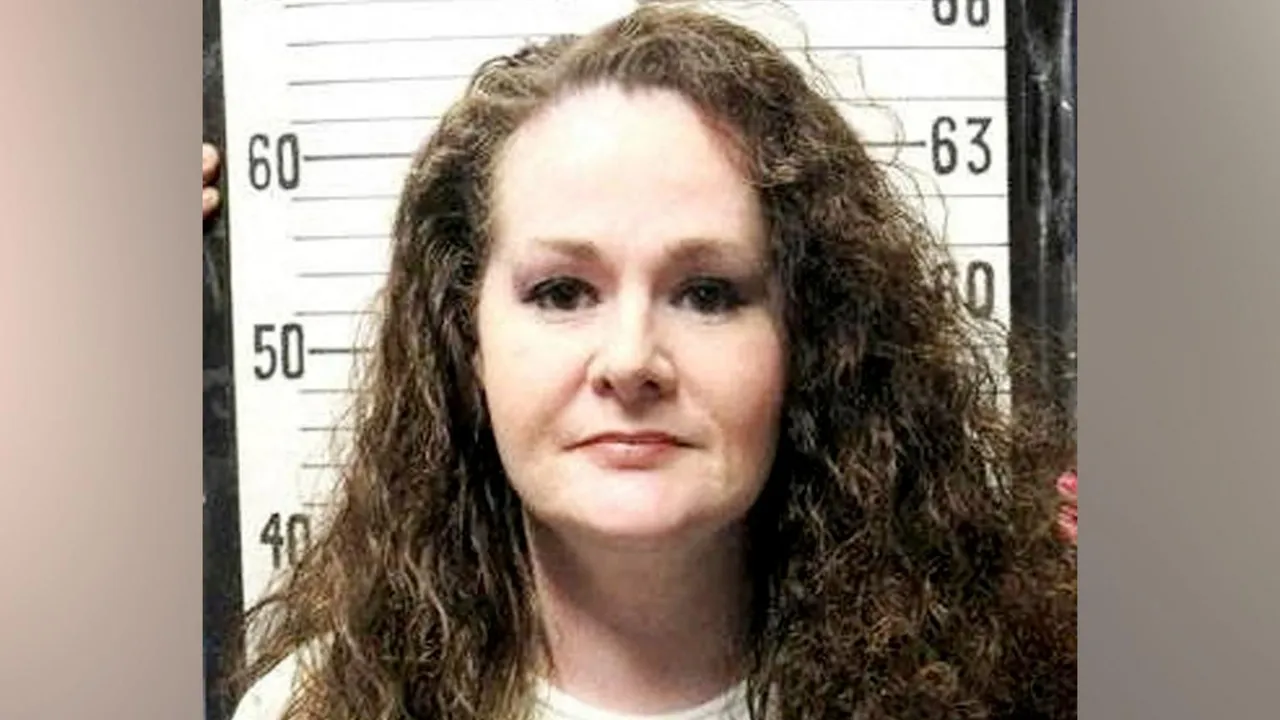
Lawyers for Christa Pike say she is awake and able to speak, nearly one week after a failed execution attempt by the state of Tennessee left her hospitalised in critical condition.
"Against all odds, Christa Pike is conscious, speaking, and continues to receive critical medical care," her lawyers said in a statement released Tuesday. "Despite the severe damage she endured to her arms, she is still handcuffed and shackled to the bed. Her recovery is medically unprecedented. Her prognosis remains unclear but, at a minimum, we expect a long recovery."
The statement marks the first public indication that Pike's condition has improved since she was transported to a Nashville hospital following the botched procedure on September 30.
Pike, 50, received two doses of the drug pentobarbital during the execution attempt. Her lawyers had previously stated she was unconscious and on a ventilator, and described her arms as "swollen, burned and blistered."
Deborah Denno, a criminologist and professor at Fordham Law School, said she was "absolutely astonished" that Pike was conscious and speaking. She noted there have been seven other cases in which prisoners survived executions, but in those instances executioners were unable to inject anything into the inmates' veins.
Pike "is the only person for whom some kind of toxin has been injected," Denno said. "They did everything they were supposed to do as part of the execution process, and it simply didn't work. This has never happened before."
Dr. Joel Zivot, an anaesthesiologist advising Pike's defence team, said the likelihood of recovering from a lethal injection was low. "Most people who get lethal injection die from it," he said. "In fact, pretty well everyone, except Christa. So, the fact that she survived it was unusual."
Zivot said the two doses of pentobarbital Pike received would have been sufficient to kill her had the drug entered her bloodstream through normal circulation. A possible explanation, he said, is that the drug spread across tissue under the skin rather than entering the bloodstream directly.
He cautioned against optimism about her recovery. "I would not, in any way, say at this point that all the big risks are behind her," he said. Significant unknowns remain, including how much pentobarbital entered her system, what her blood levels were after the injection, and what her recovery will look like.
Pike's lawyers had previously warned that her medical history and anatomy — including thrombocytosis, a blood-clotting condition, and small veins — meant she risked experiencing unnecessary pain and suffering during a lethal injection.
Accounts of the failed execution describe Pike kicking off the sheet covering her body and, at one point, appearing to snore. She reportedly expressed feeling pain as the injections were administered.
Pike was convicted and sentenced to death in 1996 for the 1995 murder of 19-year-old Colleen Slemmer. Pike was 18 at the time. She and her then-boyfriend, Tadaryl Shipp, beat, tortured and killed Slemmer, whom they had met at a job training programme for troubled teens. Two co-defendants received lesser sentences.
Slemmer's family, who live in Florida, travelled to Tennessee for the execution using money raised through crowdfunding. Pike's defence lawyers had pointed to her mental health struggles in attempts to commute her sentence.
On the morning of the scheduled execution, a federal circuit court issued a stay, halting the process for several hours. Tennessee authorities then asked the US Supreme Court to lift the stay, and it did. The execution proceeded that evening, only to fail.
Authorities have not said whether they will attempt to execute Pike again, nor have they offered an explanation for what went wrong.
Tennessee Governor Bill Lee suspended all executions in the state for the remainder of the year following the incident. The head of the state's prison system announced over the weekend that he planned to resign.
Pike's lawyers are scheduled to appear in court in Nashville on Wednesday and plan to hold a news conference outside the courthouse.
The failed execution has renewed debate about the use of the death penalty in the United States. According to the Death Penalty Information Center, approximately 3 percent of executions in the US between 1890 and 2010 were botched. In 2022, more than a third of executions across the country were described as botched or highly problematic.
Tennessee had already experienced a failed execution earlier this year. In May, the execution of Tony Carruthers — convicted of kidnapping and murdering three people in 1994 — was postponed after staff were unable to find a vein for a lethal injection. He was granted a reprieve of at least one year by the governor.