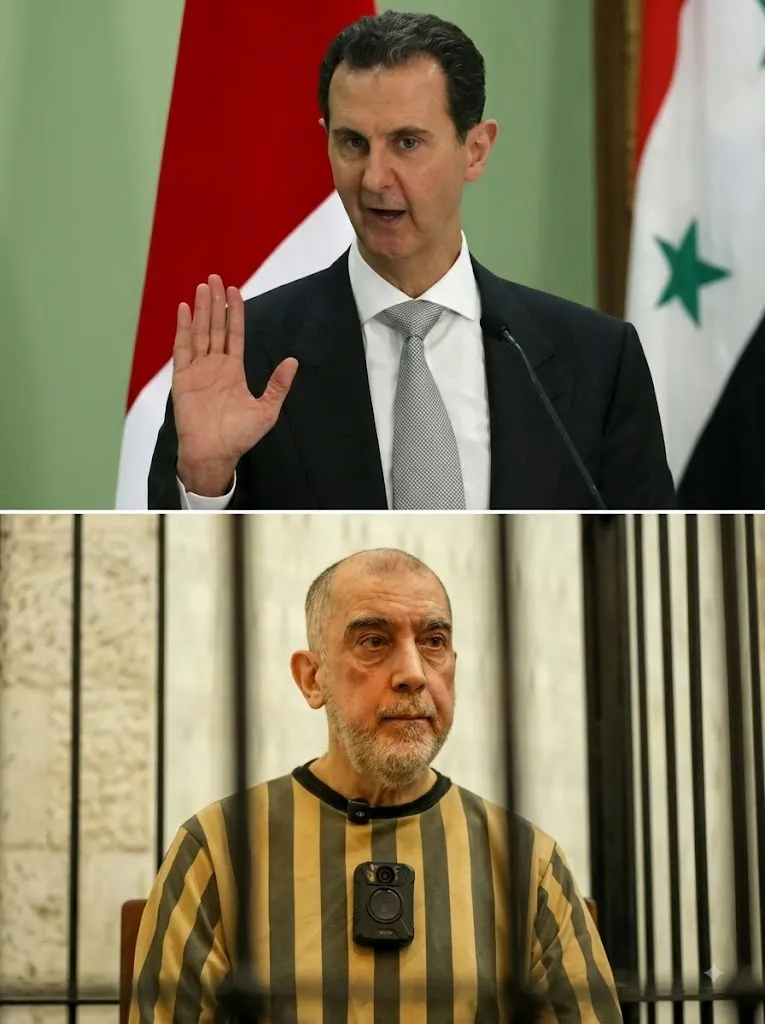
Syria's Criminal Court in Damascus has sentenced former President Bashar al-Assad, his brother Maher al-Assad, and cousin Atef Najib to death after convicting them of crimes committed during the country's nearly 14-year civil war.
The court found Bashar al-Assad guilty on Tuesday of premeditated murder, torture, and crimes against humanity. He was sentenced to death in absentia. Toppled in December 2024, al-Assad now lives in exile in Russia.
His younger brother Maher al-Assad, also residing in Russia, was likewise sentenced to death in absentia for premeditated murder and torture.
Atef Najib, the former head of political security in the southern province of Deraa, was sentenced to death for crimes against humanity. Unlike the al-Assad brothers, Najib was present in court, standing inside a cage in a prisoner's uniform as the judge read the sentence. He had been detained by Syrian authorities in January last year.
Najib is accused of launching a deadly crackdown on protesters in Deraa in 2011, an action widely seen as having triggered the broader uprising and subsequent civil war. The court listed his crimes as including murder, "the intentional killing of children under 15," and "torture leading to death."
Judge Fakhr al-Din al-Aryan stated that Najib had denied all charges and showed "no remorse."
Several other former military and security officials who fled Syria were also sentenced to death in absentia, including former Defence Minister Fahd al-Freij and Louay al-Ali, who headed military intelligence in Deraa province in 2011.
The ruling against al-Assad and his relatives is the first handed down by the transitional authorities, who began prosecuting figures from the former government earlier this year. Addressing the court, Judge al-Aryan said witness testimony had established al-Assad's role in the crimes as "the highest decision-maker" and that he had used state institutions to facilitate their commission.
A crowd gathered outside the Damascus courthouse after the verdict was announced. Some people held up photographs of victims of torture and killings from the civil war years.
Al Jazeera's Obaida Hitto, reporting from Damascus, said the ruling "is going to bring a lot of relief to the Syrian people," contributing to their "healing process."
"This is something they've waited for a long time," said Hitto. "They want to see these people that tortured their children, displaced them from their homes and destroyed their communities be held to account for these crimes."
"This is a historic moment for Syria," he added.
Hitto also said the verdict would set a strong legal precedent for others accused of crimes under al-Assad's rule.
"People across Syrian towns are looking for justice, not just for al-Assad, but for the executioners," said Al Jazeera's Osama bin Javaid.
Damascus has repeatedly demanded that Russia extradite al-Assad, a longtime ally of Moscow who reportedly lives in the Russian capital. Despite nurturing ties with Syria's new government, Moscow has so far refused, having granted al-Assad asylum.
Hitto said Russia is unlikely to reverse course barring "a major political breakthrough between the two countries." He noted, however, that other officials from the al-Assad era are residing elsewhere and could potentially be returned to Syria.
"The Syrian government has been working with Lebanese officials to identify individuals that are currently in Lebanon to bring them back to the country," said Hitto, adding that Damascus is calling on countries where wanted al-Assad-era officials "are either in hiding or being detained" to send them back to Syria.