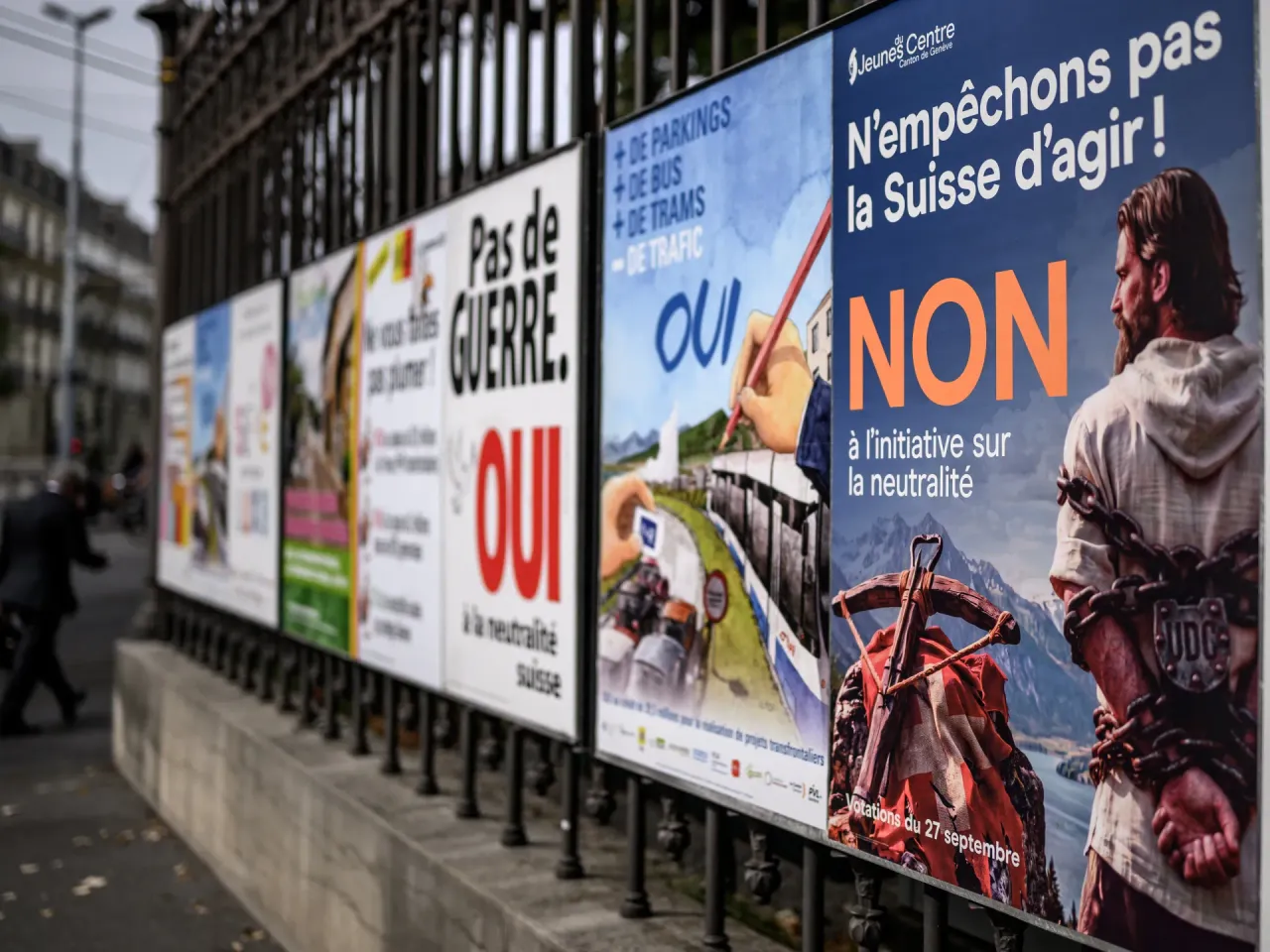
Switzerland goes to the polls on September 27 to decide whether to enshrine a stricter definition of neutrality in its constitution, in a vote that could have significant consequences for the country's foreign policy and security posture.
The initiative, backed by the Swiss People's Party and Pro Schweiz, would bar Switzerland from cooperating with any military alliance unless the country were under direct military attack or such an attack were being prepared. It would also prevent Switzerland from imposing sanctions on a belligerent state unless those sanctions were mandated by the United Nations Security Council.
Polls suggest the initiative will fail. Around 63 percent of voters intend to reject it.
The vote was triggered largely by Russia's invasion of Ukraine in February 2022, when Switzerland adopted European Union sanctions against Russia — a major power Switzerland had long sought not to antagonise. That decision sharpened a longstanding debate over whether economic measures against a belligerent state were compatible with Swiss neutrality at all.
A "yes" vote would bring significant changes. It could force Switzerland to unwind its existing sanctions against Russia and would prevent it from joining future EU- or US-led sanctions regimes unless they carried UN Security Council backing. It would also constrain bilateral cooperation with neighbouring NATO member states in areas such as cyber defence, air defence and joint military exercises — cooperation Switzerland has expanded since 2022.
A "no" vote would largely preserve the flexible, case-by-case approach to neutrality Switzerland practises today.
Swiss neutrality has shaped the country's identity since 1815, when European powers recognised its permanent neutrality following the Napoleonic Wars. The principle survived two world wars and the Cold War on a basic premise: keeping foreign armies off Swiss territory would keep Switzerland out of other countries' conflicts, while trading with all sides would keep its economy connected to the markets on which its welfare depends.
Critics of the initiative argue that the world has changed in ways the vote cannot address.
Switzerland's 2026 Security Policy Strategy warns of a "window of vulnerability" emerging in Europe around 2028, as Russia rebuilds its military capacity while European states rearm. In such an environment, Switzerland could face missiles or drones crossing its airspace without immediately knowing their origin or destination.
Switzerland is also deeply integrated into Europe's financial, rail, electricity and data networks. A continental conflict would therefore reach it even if no foreign soldier crossed its border.
Russian hostility towards Switzerland has grown since 2022. In 2024, Swiss authorities uncovered an alleged Russian effort to obtain sensitive military-related material inside the country. Cyberattacks targeted Swiss government websites around the time of a Ukraine peace summit held in Switzerland in June of that year. By 2025, Swiss intelligence was warning of growing risks of espionage, sabotage and operations targeting critical infrastructure, specifically attributed to Russia.
Analysts note that whether that hostility is a response to Switzerland's sanctions or simply reflects Russia's broader confrontation with Europe matters less than the practical conclusion: formal neutrality does not guarantee security, and security cannot be obtained in isolation.
The deeper question the vote leaves unanswered, according to observers, is not whether to restrict sanctions and alliances, but how neutrality can continue to deliver security and prosperity in a fundamentally changed European security environment.