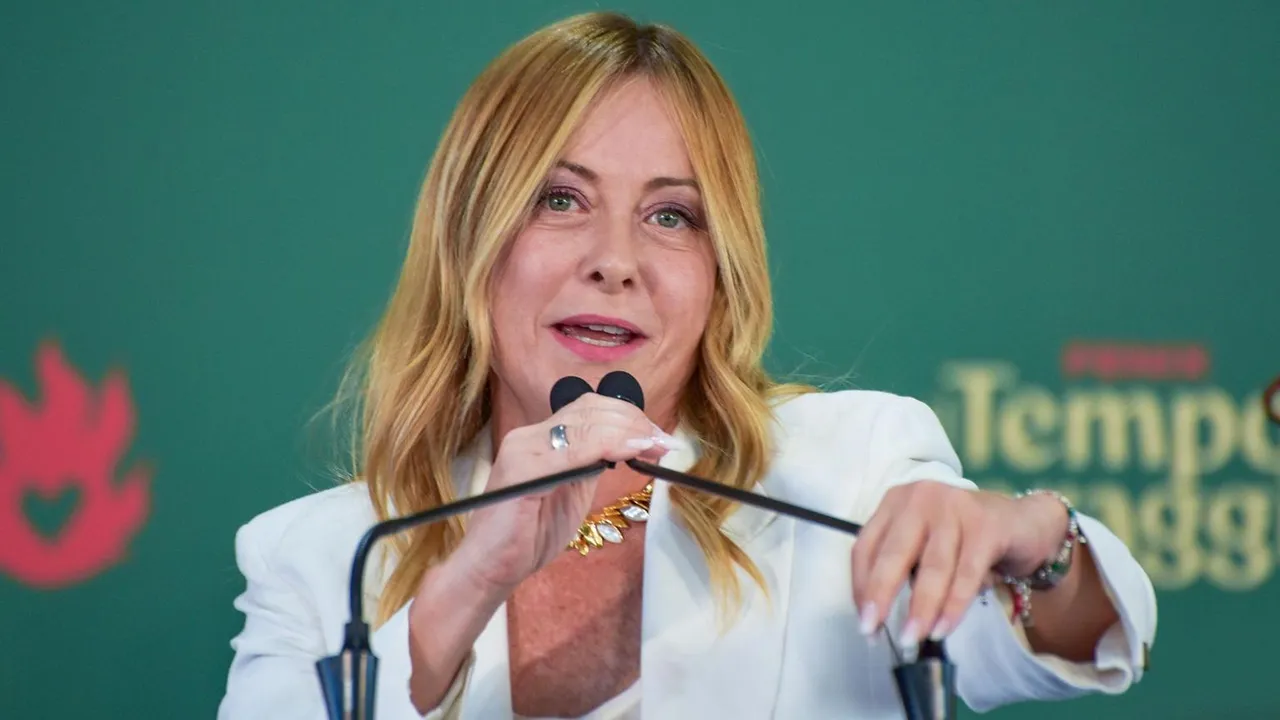
Italy's government has approved a decree banning face-covering Islamic veils in schools and imposing a cap on the number of pupils with limited Italian language skills in each classroom.
The measures, approved at a cabinet meeting on Thursday, take effect immediately but must be ratified by parliament within 60 days. Prime Minister Giorgia Meloni's coalition currently holds a majority in the legislature.
The decree bans burqas and niqabs in schools but continues to permit the hijab, which leaves the face visible. Meloni described the ban as "a matter of security" and said it addressed a fundamental rights issue.
"When a woman — or worse, a young girl — is forced to cover her face, she is being denied fundamental rights and the very integration that is so often loudly championed," Meloni said in a television interview.
"You must go to school with your face uncovered," she added while announcing the plans, saying no one could decide that a young woman should hide herself in the name of tradition.
Education Minister Giuseppe Valditara framed the veil ban as a matter of gender equality. He said the decree would affect approximately 1,000 classrooms, representing around 0.3% of the national total.
The decree also sets a 30% cap per classroom on pupils who lack sufficient proficiency in Italian. The rules differ by school level.
In primary schools, the limit applies to pupils without Italian citizenship who were not born in Italy or did not attend at least two years of preschool. In lower and upper secondary schools, it applies to students without Italian citizenship who have not completed at least three years in the Italian school system.
Local school offices would be required to distribute pupils with limited Italian skills more evenly among nearby schools. Where that is not possible, exemptions would apply, with additional Italian language teaching provided.
Valditara said the aim was to avoid "ghetto classes" and that the cap was "purely linguistic" rather than based on citizenship.
Failure to comply with the decree is punishable by a fine of up to 1,000 euros.
According to official data, pupils without Italian citizenship made up between 11.2% and 11.6% of Italy's school population in recent years. Classes with more than 30% foreign students accounted for 7.6% of the total.
Italy already had guidance on the matter. A 2010 ministerial notice set a 30% limit "as a rule" on pupils without Italian citizenship. The new decree puts that limit into law.
The decree also requires schools to report to social services cases in which persistent language barriers among parents or guardians hinder a child's integration. Free Italian language courses would be offered to those affected.
Opposition parties have strongly criticised the measures. Centre-left Democratic Party leader Elly Schlein called the plan "a new witch hunt at the expense of children" and described it as propaganda that would be impossible to implement. Party deputy and chamber vice-president Anna Ascani echoed those accusations.
Critics also accused the government of using immigration as a political issue ahead of next year's general election, with some opponents saying the measures were designed to appeal to Roberto Vannacci, a retired military general who leads the hard-right Futuro Nazionale party and is seen as a threat to the governing coalition's right flank.
Valditara rejected the charge. "We are not chasing Vannacci; if anything, he is chasing us," he said.
Vannacci said he agreed with the measures but argued they should have come years ago.
The League's Matteo Salvini, who launched a separate package of measures on what he called "political Islam" on Wednesday, accused Vannacci of "continually voting against the government" and said he hoped Futuro Nazionale would back the League's new proposals.
Child rights organisation Save the Children had on Wednesday urged the government to weigh the measure "with the utmost political responsibility," warning it risked creating discriminatory effects. "Such a criterion would create 'first-class' and 'second-class' students," the organisation said.
Concerns were also raised among school authorities about how the rules would function in areas with large migrant populations, and opponents warned the cap could force some students to attend schools far from their neighbourhoods.