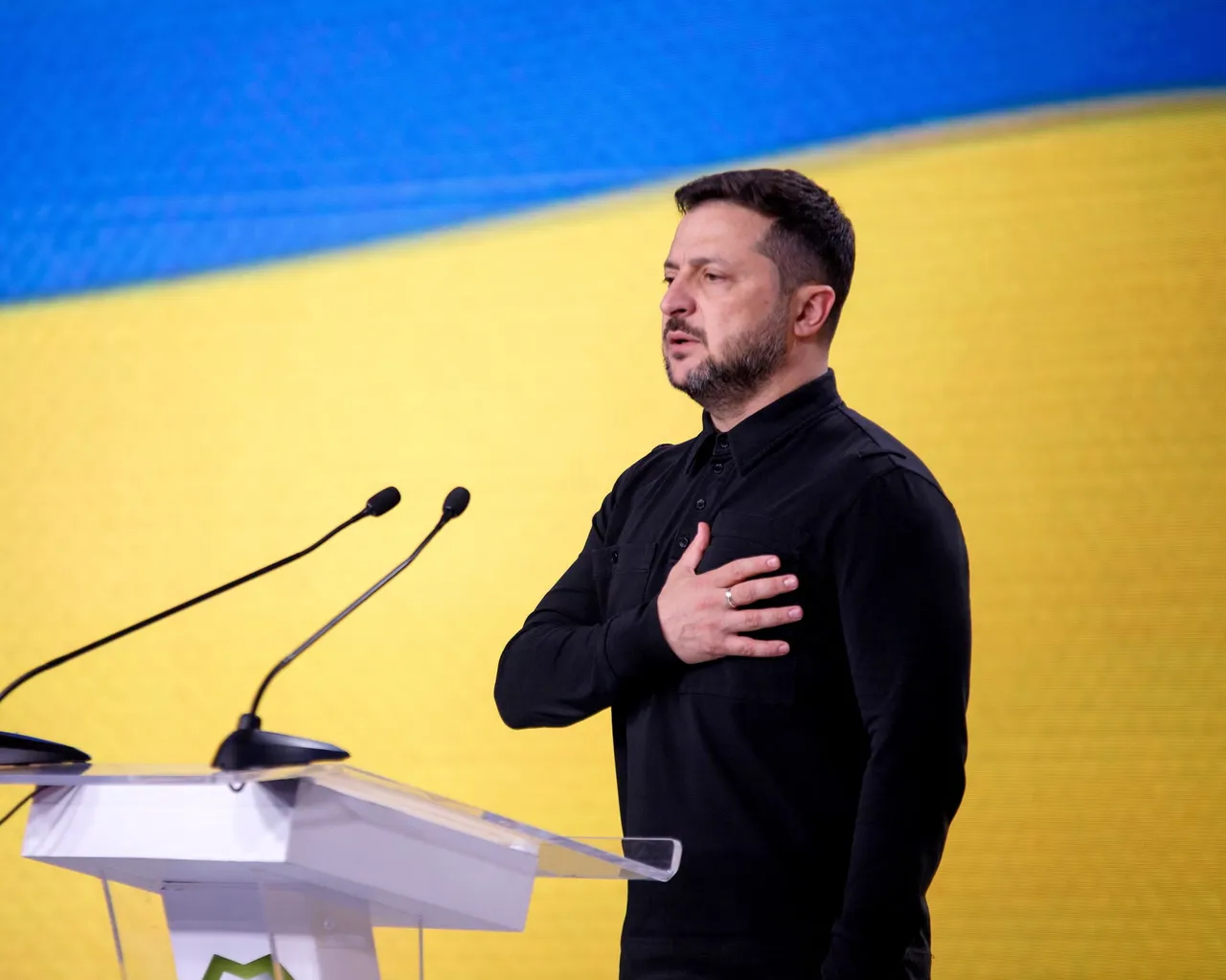
Volodymyr Zelenskyy has warned that holding elections in Ukraine during the ongoing war would risk splitting the country, as Russia stockpiles ballistic missiles and considers mobilising an additional 300,000 soldiers.
The Ukrainian president was responding for the first time to a demand made by the recently dismissed former defence minister Mykhailo Fedorov, sharply criticising the idea as impractical given that Russia appeared to have no interest in a ceasefire.
“I believe that if we want to destroy the country, then during such a war we can move in the selection of elections,” Zelenskyy said in a briefing to selected journalists that was held on Saturday, but details of which were reported on Sunday.
"I believe that during such a war, elections in general are big risks. Elections right now are a tsunami for the state that will split Ukraine," he added, saying his plan was to end the war and preserve Ukraine as an independent state.
Elections have been suspended in Ukraine since martial law was imposed at the start of Russia's full-scale invasion. Zelenskyy's five-year term ended in May 2024, but there had been little appetite in Ukraine for holding a contest while the war continued.
That changed when Fedorov, a popular minister dismissed by Zelenskyy a month earlier, publicly called for a fresh election. It was the most open challenge to Zelenskyy's authority from within Ukraine since the start of the Russian invasion.
According to a transcript of the briefing, Zelenskyy said that if Ukraine's allies were to establish "specific conditions" under which elections could be held safely, legitimately, and democratically, he would support them. Such a process would require "the participation of the military, in front-line territories, abroad, where millions of our citizens have gone, fleeing the war," and would have to take place "without strikes and shelling."
On Fedorov's dismissal, Zelenskyy said the former minister had overreached by attempting to take on functions belonging to the military. He was offered four alternative government posts but declined all of them, the president added.
Zelenskyy also addressed the military situation, saying Russia held a stockpile of 600 to 630 high-speed ballistic missiles — its most potent weapon type — and was producing just over 100 more per month ahead of winter. Its maximum production capacity stood at 1,300 per year, he said.
Ballistic missiles have been used to strike Ukrainian infrastructure, warehouses, and the capital, causing rising civilian casualties. Ukraine faces a shortage of US-made Patriot interceptors, described as the only weapon capable of effectively countering them.
"I wanted to secure 300 Patriot missiles for the winter package. The request from our air force is 360," Zelenskyy said. He acknowledged the difficulty, noting that only around 600 of the most capable PAC-3 interceptor missiles are produced annually.
He said he had reached an agreement with France on at least one SAMP/T air-defence system this year, and with Germany on the supply of approximately 600 PAC-2 and PAC-3 interceptors in 2027-28.
Zelenskyy called on the United States to supply "some small percentage" of its stockpiles — around 5% to 10%. Ukraine was willing to pay, he said, and such a contribution would mean the country "could get through the winter," describing it as "a very significant difference both in protecting lives and diplomatically."
Following a phone call with Zelenskyy on Saturday, French President Emmanuel Macron said he had agreed to strengthen French support for Ukraine, including through the delivery of interceptor missiles, without providing further details.
Ukraine's allies in the so-called coalition of the willing — an initiative led by France and Britain — were set to meet on Monday to discuss how to increase pressure on Moscow to halt its invasion.
Russia is seeking to build up forces for a renewed push to capture the remainder of eastern Donetsk province before the end of the year. Zelenskyy said he was confident Moscow would fail to seize the area, which comprises principally the cities of Kramatorsk and Sloviansk.
The president said he believed Russia would attempt to conscript a further 300,000 soldiers following Russian parliamentary elections in September. He described it as a "peripheral mobilisation," conducted away from Moscow, St Petersburg, and other major cities, in an effort to regain momentum along the largely deadlocked front line.