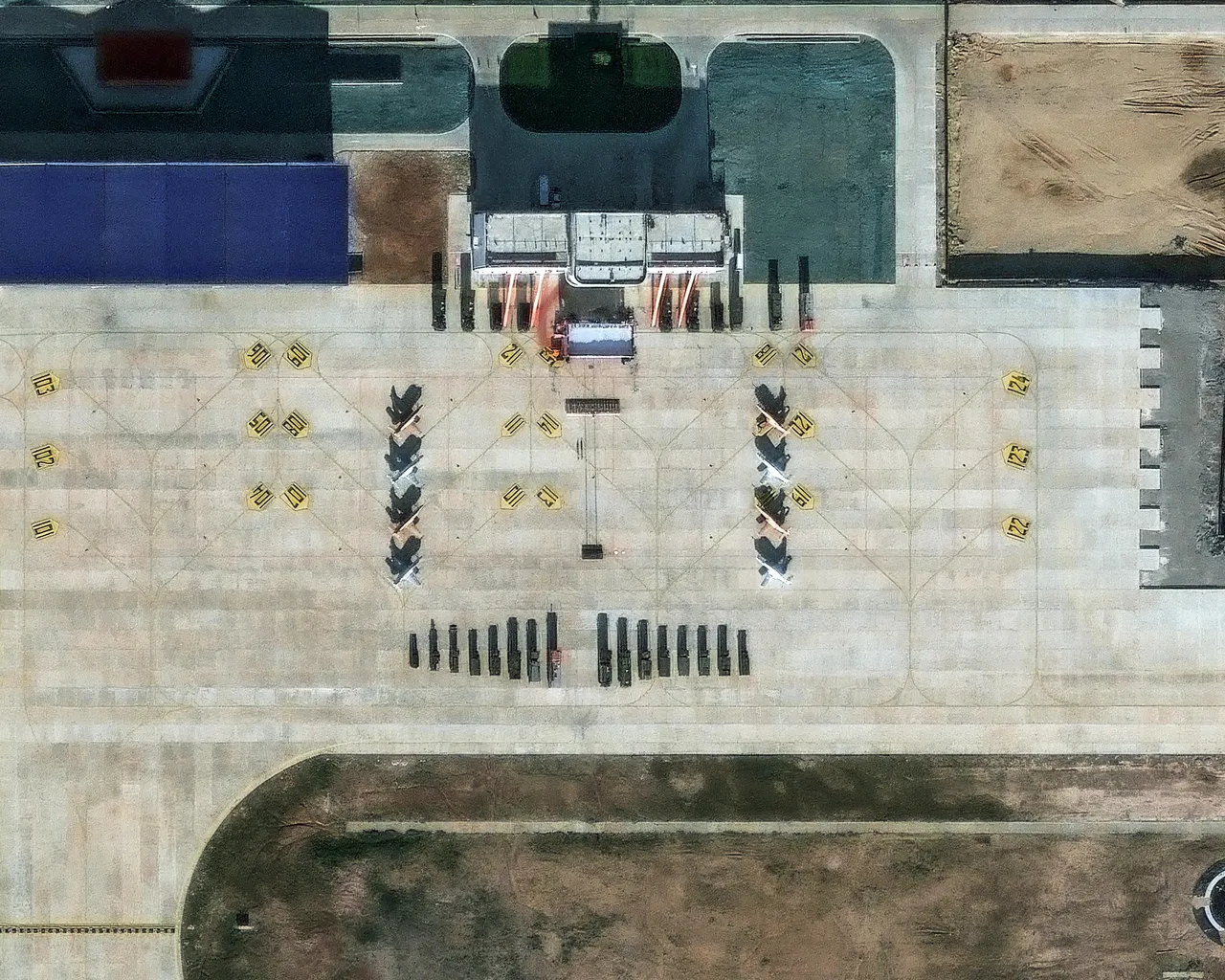
Satellite images have revealed attack jets stationed at a new Chinese military facility in Laos, which opened last week and gives Beijing's air force its first foothold in mainland South-East Asia.
Images provided by commercial satellite provider Vantor show eight light attack aircraft positioned at Ban Keun airport, alongside what appear to be more than a dozen military vehicles lined up in rows.
The planes' shape matches that of the Chinese-made Hongdu JL-8 jet, a two-seat trainer that can also be deployed in combat to carry bombs. Laos is reported to hold four such aircraft, according to the London-based International Institute for Strategic Studies.
China opened what it described as a joint "support and training centre" at Ban Keun on 29 September, in a rare example of Beijing's overseas military expansion. The airport is located approximately 30 miles (50 kilometres) north of Vientiane, the Laotian capital.
The site has been significantly expanded over the past year. Satellite images taken months ago show farmland and dirt paths where new buildings and a paved runway now stand.
The new images, taken a day after the announcement, show extensive construction work that appears focused on a future runway extension. Analysts say such an extension could make the airport capable of handling larger aircraft, including bombers.
Aside from its island bases in the South China Sea, Beijing does not maintain a significant network of military outposts abroad. The Laos facility would be its first in another country capable of handling fighter jets.
In its announcement, China's defence ministry said the new centre would "help Laos strengthen the training of its air force pilots" and was not "directed against any third party." China's government did not mention sending aircraft to Laos in its initial statement. The government of Laos has not commented on the project.
Singapore-based security analyst Collin Koh said following the announcement that it "may not be wrong to conclude this is the first full-fledged PLA [People's Liberation Army] overseas base in south-east Asia."
The US-based Institute for the Study of War has described the facility as the "first PLA overseas military facility focused on air power." In its assessment, the think tank said the base was "not yet equipped to provide the PLA with the ability to execute major combat operations, unlike US military bases." It added that the base would give the Chinese military alternate routes of access to the South China Sea and strategic air routes.
Over the past two decades, China has built an extensive network of outposts on islands in the disputed South China Sea, including airbases with air defence installations. Its navy's sole other overseas military base is a logistics facility in Djibouti, on the Horn of Africa.
The Laos agreement follows a similar programme established in Cambodia at the Ream naval base on the Gulf of Thailand, though that facility has no runway. After years of speculation and denials, China announced last April that it had created a "joint logistics and training" facility in Cambodia, saying it would support both militaries in "conducting regional counter-terrorism, disaster prevention and mitigation, humanitarian assistance, joint training and other operations."
US forces are believed to have used Ban Keun airport during covert military operations at the height of the Vietnam War in the 1960s and 1970s. The facility's development is expected to be closely monitored by Vietnam, which maintains disputes with China over the South China Sea, and by Thailand, which shares a border with Laos.
Thailand's defence ministry spokesperson said Bangkok considered itself a close partner of both Laos and China and viewed the decision as Vientiane's sovereign right.
"Nevertheless, Thailand will continue to closely monitor developments and how the matter proceeds, particularly with regard to building mutual trust," said Rear Admiral Surasant Kongsiri.