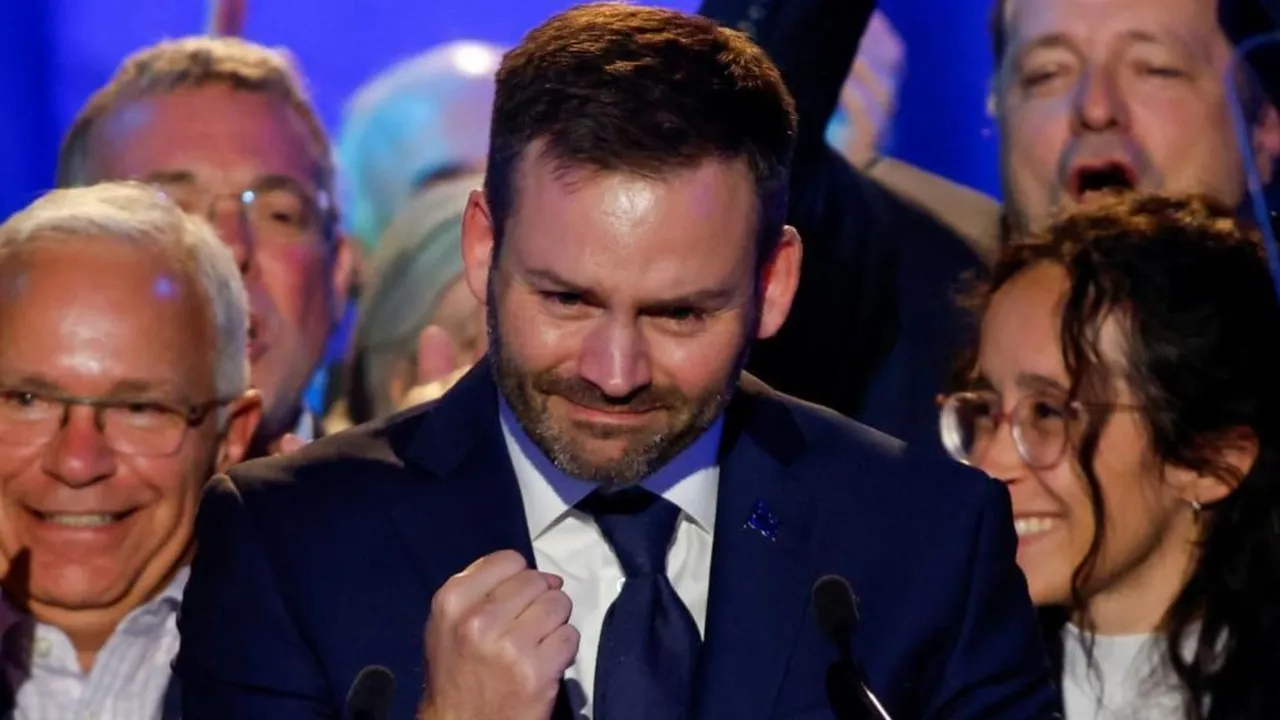
The Parti Québécois (PQ) won Quebec's provincial election on Monday, but the result leaves its core goal of separating the French-speaking province from Canada far more distant than the headline victory might suggest.
The PQ added 56 seats and more than doubled its vote share compared to the 2022 election, giving the party its first taste of power in 14 years. Despite winning the most seats of any party, however, it fell five seats short of a majority and captured only about 28% of the popular vote — the lowest percentage for any winning government in Canadian electoral history, according to polling analyst Philippe Fournier.
The vast majority of Quebecers voted for parties that oppose a referendum on independence. Polls indicate only around 30% of the province's residents support separation from Canada.
The PQ has pledged to hold a referendum on independence, but PQ leader Paul St-Pierre Plamondon has previously said the vote would take place only after US President Donald Trump leaves office, as it would require "conditions that allow for an informed and serene debate." The US and Canada are currently engaged in a trade dispute stemming from Trump's tariff programme.
In his victory speech, St-Pierre Plamondon said: "Our national destiny will be achieved one day." He also pledged to be a "good-faith collaborator" with the rest of the country and addressed the crowd in English — an unusual gesture for a separatist leader. On Tuesday, he announced he would prevent the lieutenant governor, who represents the British Crown, from swearing in his new government.
To hold a referendum, the PQ leader will need support from rival parties. Québec Solidaire, a left-leaning sovereigntist party that won nine seats, is a potential partner. However, Quebec Liberal Leader Charles Milliard said his party, which won 40 seats, is prepared to cooperate with the PQ on a number of issues, but "there is no way we will collaborate on a potential referendum."
Canadian Prime Minister Mark Carney said on Tuesday that he had spoken with Quebec's premier-designate and congratulated him on his win. Asked about the prospect of a referendum, Carney said he is focused on current challenges facing Canada, not those "a few years down the road."
Carney remains the most popular politician in Quebec, largely due to his resistance to Trump's trade measures. That has placed St-Pierre Plamondon in a difficult position: as a separatist leader, he cannot easily be seen as a threat to Canadian unity at a time when many Quebecers view their ties to Canada as essential protection against US economic pressure.
Quebec is among the provinces hardest hit by the latest US tariffs. Analysts at Oxford Economics project a C$2 billion blow to the province's economy.
The election result is widely seen as reflecting public fatigue with the outgoing Coalition Avenir Québec (CAQ) government rather than a surge in separatist sentiment. The CAQ, which has been in power since 2018, suffered a total collapse, failing to win a single seat and receiving roughly a third of its 2022 vote share. The party had made the protection of Quebec's identity and language central to its eight years in office, but its long-time leader, François Legault, lost significant support over time.
Efforts to revive the CAQ by replacing Legault with Christine Fréchette as leader proved unsuccessful. Fréchette lost her own seat in Trois-Rivières to the PQ and resigned on Tuesday. She had said in a concession speech that she would cooperate with St-Pierre Plamondon on the transition. "Governing Quebec is the greatest honour I have ever had," she said. "I have Quebec tattooed on my heart."
The election also saw the rise of the Parti conservateur du Québec (PCQ), a populist party founded in 2009, which won 19 seats, largely in rural areas and the Quebec City region. The party benefited from CAQ voters switching allegiance, in part on the strength of a promise to build an underground highway linking Quebec City to its suburbs — a project government reports estimate could cost as much as C$9.3 billion.
Montreal voted heavily for the Liberals, who will serve as Quebec's official opposition. The staunchly federalist Liberal party is unaffiliated with Carney's federal Liberals. Analysts note that winning a referendum without strong support from Montreal has historically proven near impossible.
Beyond the referendum question, the PQ's minority position also casts doubt on other party pledges, including abolishing the monarchy, extending Quebec's strict language laws to colleges, and reducing immigration levels — the latter a plan that has already drawn opposition from farmers and the business community.