France has suspended police use of stun grenades at high-school demonstrations, Interior Minister Laurent Nuñez announced on Wednesday, following a fortnight of protests marked by violent clashes that have injured hundreds of people across the country.
Nuñez told RTL radio he had ordered a temporary halt to the use of the grenades "in the context of the high-school students' movement" after a 15-year-old boy lost his hand during a protest in Lens, in northern France, on Monday. He said the suspension would remain in place "until we know exactly what happened."
Authorities said approximately 200 to 250 protesters had been hurling projectiles at police when riot officers intervened. They have not confirmed the exact circumstances of the injury, including whether the boy had picked the grenade up or had been struck by it directly.
The boy's mother said on Wednesday that her son's hand had been amputated. She told a French broadcaster: "His life has been stolen. He's a 15-year-old kid, how can children be treated like that?" She said her son had not tried to pick the grenade up. A French newspaper reported the teenager lost his hand and part of his arm after picking up a police grenade during the protest.
Nuñez said 18 internal police investigations have been launched over allegations of brutality during the demonstrations. These include one incident in which a young protester lost multiple teeth and another in which a student lost the use of an eye.
The interior minister insisted officers were present to protect students, but said inquiries were always opened over accusations of disproportionate policing. Rights groups and trade unions have repeatedly accused police of using unnecessary force. Anne Savinel-Barras, president of Amnesty France, said earlier this week that images and testimony from the protests "raise alarming concerns about the dangerous use of teargas, batons and policing techniques."
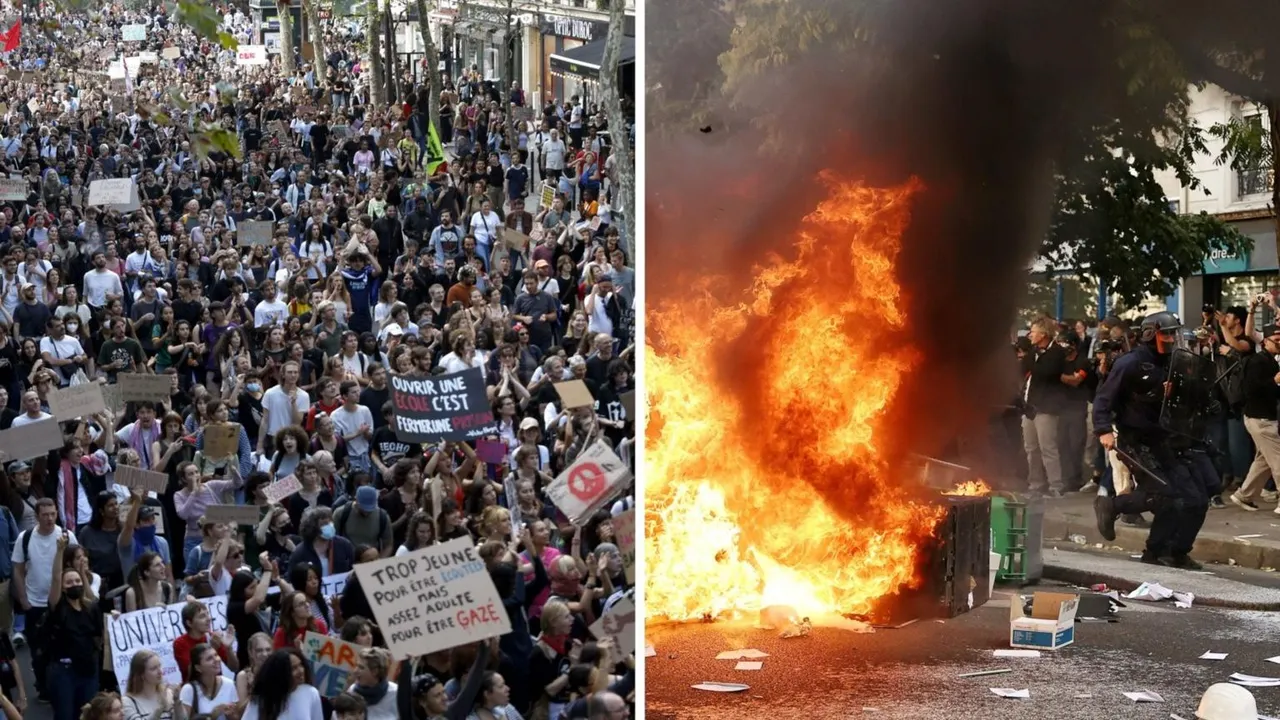
The suspension came a day after at least 250,000 pupils, parents, teachers and unionists took to the streets across France in the largest day of protests yet. Organisers estimated the total number of participants at closer to half a million. The demonstrations prompted President Emmanuel Macron to hold an emergency cabinet meeting.
Most marches passed without serious incident, but some ended in sporadic vandalism and clashes with riot police, who fired tear gas and carried out baton charges. In Strasbourg, Lyon and Rennes, protesters lit fires in the streets and hurled projectiles at officers.
The protests began two weeks ago in Paris's poorest suburbs and have since spread nationwide. Students are demanding more resources for schools, including the replacement of absent teachers, longer lunch breaks, shorter school days, and the repair of dilapidated buildings.
Since the movement began in mid-September, at least 215 teenagers and 85 school staff have been injured. The number of wounded police officers is reported as approximately 750 by one source and 715 by another. More than 6,100 people have been arrested, the vast majority of them minors. The justice ministry said more than 1,800 are being prosecuted, with nearly 1,500 of those under the age of 18.
Twenty-four schools have been burned or ransacked. On Wednesday, classes were wholly or partially suspended in 528 of France's approximately 3,700 high schools, a significantly lower number than on Tuesday. The High School Students Union said nearly 2,000 high schools had been blockaded or closed at the peak of the unrest.
Prime Minister Sebastien Lecornu condemned the violence and told parliament it could not be tolerated, while rejecting accusations that the government had ordered police repression against protesters. He ordered ministers to address students' demands by the end of October and said the government would look into repairing ageing school campuses.
The protests have rattled a government already grappling with a large budget deficit and mounting investor concern over France's public debt and weak economic growth. They have also sparked a political dispute, with the government accusing the radical-left La France Insoumise party of encouraging and orchestrating the movement after several of its MPs attended school blockades. The party's leader and presidential candidate Jean-Luc Melenchon has strongly supported the protests while urging non-violence.
The demonstrations come months before presidential elections to choose Macron's successor.