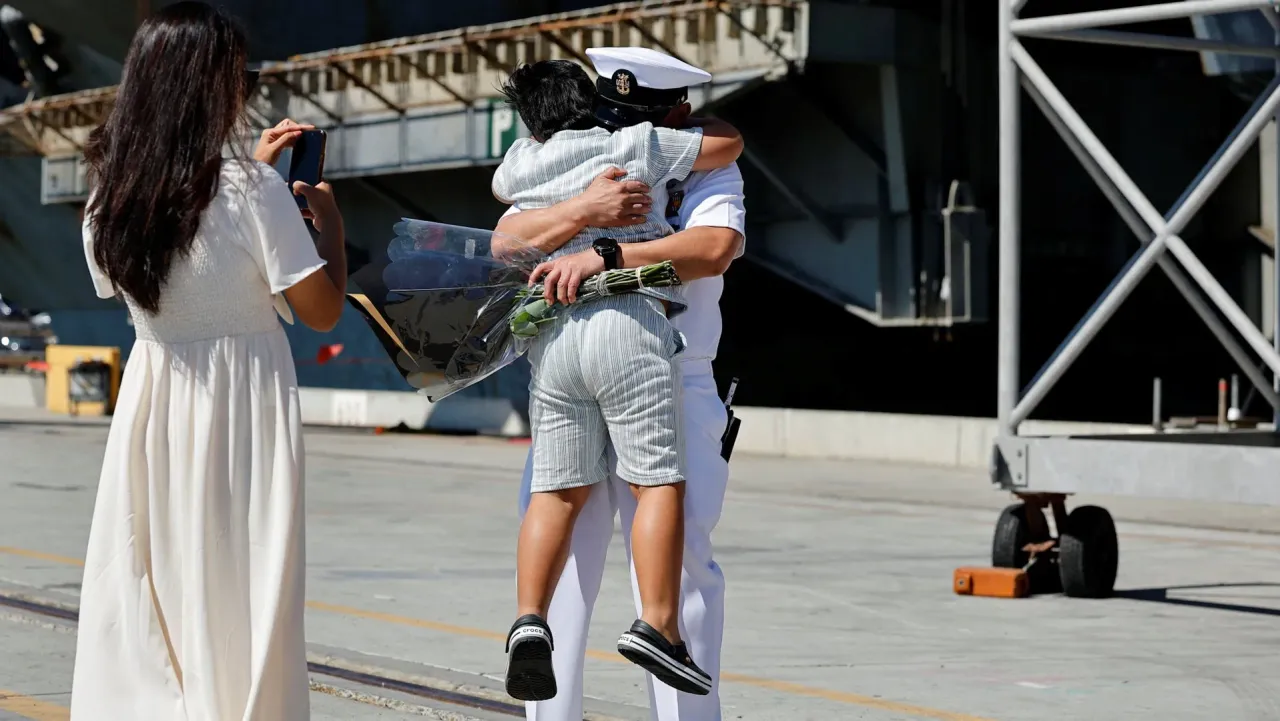
Thousands of sailors aboard the USS Abraham Lincoln returned to San Diego Bay on Thursday after a deployment of more than 300 days, drawing emotional reunions with families who had waited months for their loved ones to come home.
The carrier docked at Naval Air Station North Island in Coronado, California, on October 8, 2026, after a deployment lasting 322 days — just short of the record 326-day deployment completed by the USS Gerald R. Ford, which returned in May. The Lincoln's crew set a record for uninterrupted time at sea, spending 265 consecutive days without a port call.
Among the first to leave the ship were 64 fathers meeting their newborn children for the first time. Including the air wing, the Navy said there were 122 new fathers aboard.
Sailor Kathy Monterrosa, of Virginia Beach, Virginia, waited at the pier holding her six-month-old daughter, Sarahi, dressed in a small blue and white sailor outfit. "She's our deployment baby," Monterrosa said. She described crying throughout her pregnancy after hearing reports about conditions on the ship. When she finally reached her husband, he told her things had been "pretty bad." She said she now feels relieved to have her family together.
Abel Ramirez, 20, walked off the carrier grinning after completing his first deployment. His parents had traveled from Texas to meet him. "It feels amazing," he said. "There was a certain point when I never thought I would come off."
Cassity Garduque, 14, waved from the pier as her mother, still in uniform, waved back from the ship's top deck. "It feels really overwhelming," she said of seeing her mother again. "She missed most of my seventh grade and my birthday."
The deployment was marked by reported supply shortages, facility breakdowns, deteriorating crew mental health, and reports of suicide attempts. Families described losing sleep and crying after hearing about conditions aboard. Many said communication was limited to occasional emails or rare calls.
The ship's commander, Captain Daniel Keeler, acknowledged the difficulties but said the problems were normal for a deployment of that length. He noted that all crew members had access to four meals a day. "It's a floating city as you can see and at any moment there might be a clogged toilet," he said. Keeler added that most of the crew were on their first deployment.
The Navy initially downplayed reports of problems during the deployment. In August, President Donald Trump commented that the Lincoln's lengthy deployment was "not nearly long enough." Navy leaders later acknowledged that some issues had occurred aboard.
Defense Secretary Pete Hegseth flew out to the Lincoln on Wednesday to present the crew with the Presidential Unit Citation, the highest honor a military unit can receive. He told the crew that "what makes the U.S. military and the U.S. Navy and all these sailors different is that you adapt and that you're resilient and you overcome — you finish the mission nonetheless."
Hegseth pushed back against what he described as efforts to turn the "Lincoln into some sort of a symbol, a symbol of dysfunction or a symbol of low morale or a symbol of a failed mission."
The Lincoln is the second carrier to receive the Presidential Unit Citation following an extended deployment during the Iran war. The USS Gerald R. Ford received the same honor after its return in May.
The Lincoln's 322-day deployment is the second longest for a US aircraft carrier in the post-Vietnam War era, behind the Ford's 326-day mission, which was the longest in more than 50 years.