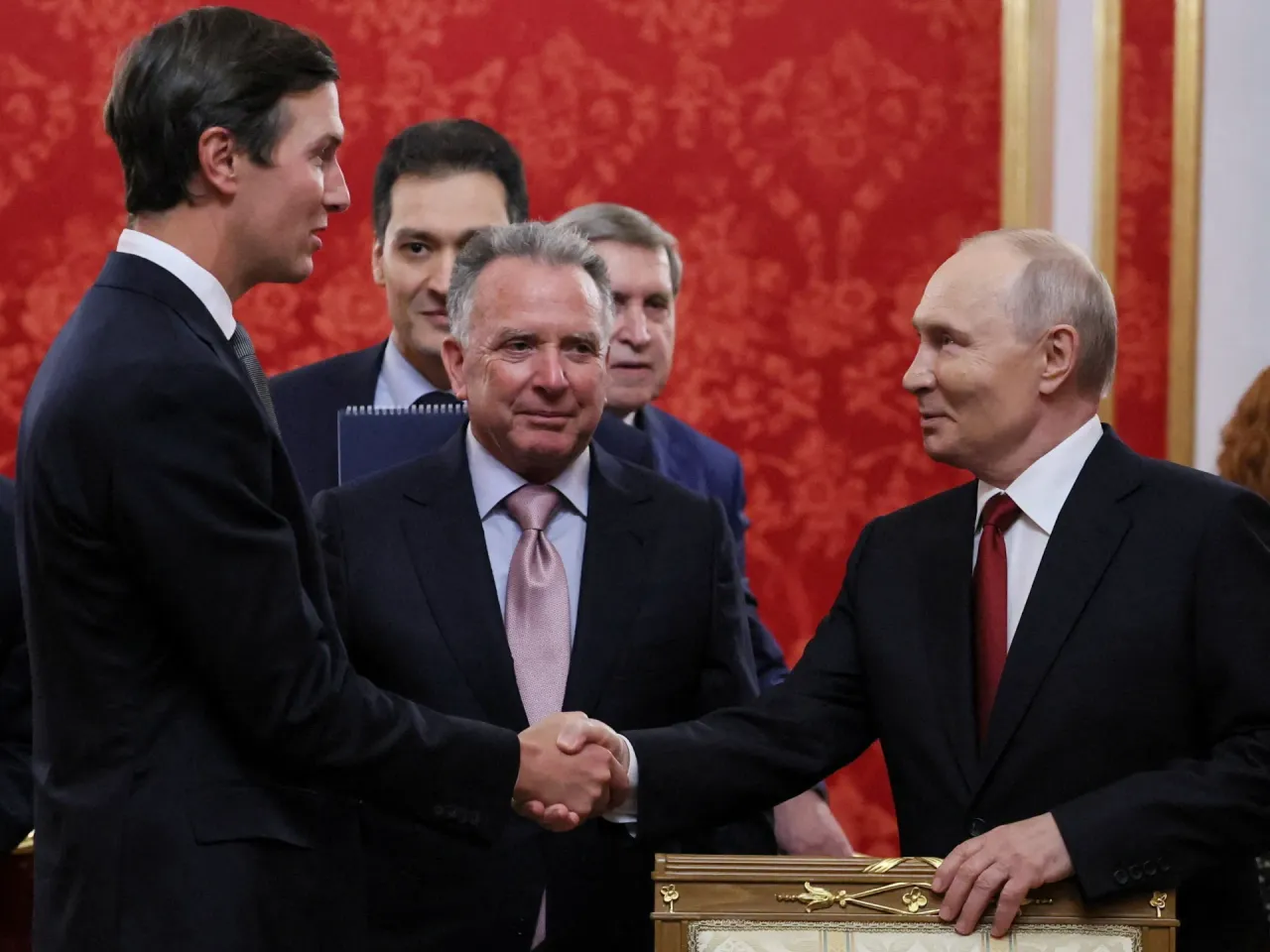
US envoys Steve Witkoff and Jared Kushner held talks with Russian President Vladimir Putin in Moscow on Saturday and travelled to Kyiv the following day for meetings with Ukrainian President Volodymyr Zelenskyy, in the latest American effort to end the war in Ukraine.
President Donald Trump said the envoys were carrying "a proposal to end the war." A senior Russian official described the visit as an "important peacemaking visit."
The Moscow talks lasted more than three hours. Kremlin aide Yuri Ushakov described them as "highly useful," "extremely frank," and "constructive." He said the envoys "outlined a number of ideas regarding possible avenues for a settlement" but provided no specific details. Ushakov added that economic issues and potentially large Russia-US projects were also discussed.
Putin met the envoys in the Red Drawing Room at the Kremlin and told his guests that the situation they were exploring "is, of course, not an easy one." A White House official said the Moscow talks "discussed substantive plans for next steps" and that an announcement would follow in the coming weeks.
Both Moscow and Kyiv declared a three-day ceasefire to coincide with the envoys' visit and pledged to refrain from attacking each other's capitals over the weekend to ensure safe passage. Because Russia had bombed Kyiv's two main airports on Friday, Witkoff and Kushner were forced to travel to the Ukrainian capital by train from Poland.
Zelenskyy greeted the US envoys in Sophia Square, in front of Kyiv's historic cathedral, before holding three rounds of talks. The final round was joined by national security advisers from the United Kingdom, France and Germany.
Witkoff described the Kyiv talks as "very constructive and substantive." Kushner acknowledged the scale of the challenge, saying the US was working "behind the scenes" to create the conditions for a possible deal. "It's a very, very hard problem, but we're going to try," he said.
Zelenskyy said the discussions focused on military aid, including Patriot missile systems and other weapons Ukraine would need in the coming months. He said Kyiv was seeking "serious volumes" of US support, backed by European partners.
"If the war drags on until winter — and that is how things currently look — we will need a 'winter package'," Zelenskyy said. He also specified that this included air defence, energy support, and American liquefied natural gas. The Ukrainian president expressed gratitude that European representatives were present, saying: "Here we are all on the same side."
Zelenskyy announced plans to widen peace discussions to include European countries, saying he wanted to do "everything to ensure that trilateral meetings take place" involving Ukraine, the US and Europe. Witkoff said such meetings would be announced "in short order."
Despite the renewed diplomatic activity, no breakthrough was announced. The two sides remain divided over key issues, particularly territorial concessions. Moscow demands that Ukraine not join NATO and hand over four Ukrainian regions — Donetsk, Luhansk, Kherson and Zaporizhzhia — including territories not currently under Russian control. Putin proclaimed the annexation of those regions in September 2022, a move not recognised by the international community. Ukraine has refused to cede territory.
Talks between the two sides have centred on a 20-point peace plan put forward by Washington and Kyiv in December, but the parties have failed to reach common ground on several sticking points, including control of territory in eastern Ukraine.
The US delegation included officials from the National Security Council, the State Department and the Treasury. The presence of Treasury official Gene Lang, who oversees US sanctions policy on Russia, indicated that financial and trade sanctions may have been part of the Moscow discussions.
Ukraine is facing a critical shortage of US-made Patriot interceptor missiles. Kyiv and surrounding areas have been struck by a sustained barrage of drone attacks for more than a week. Ukrainian authorities reported that at least eight people were killed and 69 injured across the country in the 24 hours prior to Sunday. Many of the recent Russian strikes have involved new-model jet-powered drones capable of reaching speeds of 250 miles per hour, making them difficult to intercept.
Zelenskyy's chief of staff, Kyrylo Budanov, said last weekend that he did not expect the fighting to end before spring 2027 and predicted further Russian strategic air strikes on Ukraine this winter.
Expectations ahead of the talks were described as low. US-backed mediation has stalled in recent months, partly due to Washington's focus on the war with Iran. Many Ukrainians remain sceptical that the Trump administration is committed to a peace agreement acceptable to Kyiv. "People don't trust the Russians and people don't trust Trump personally," said political analyst Artem Bronzhukov.