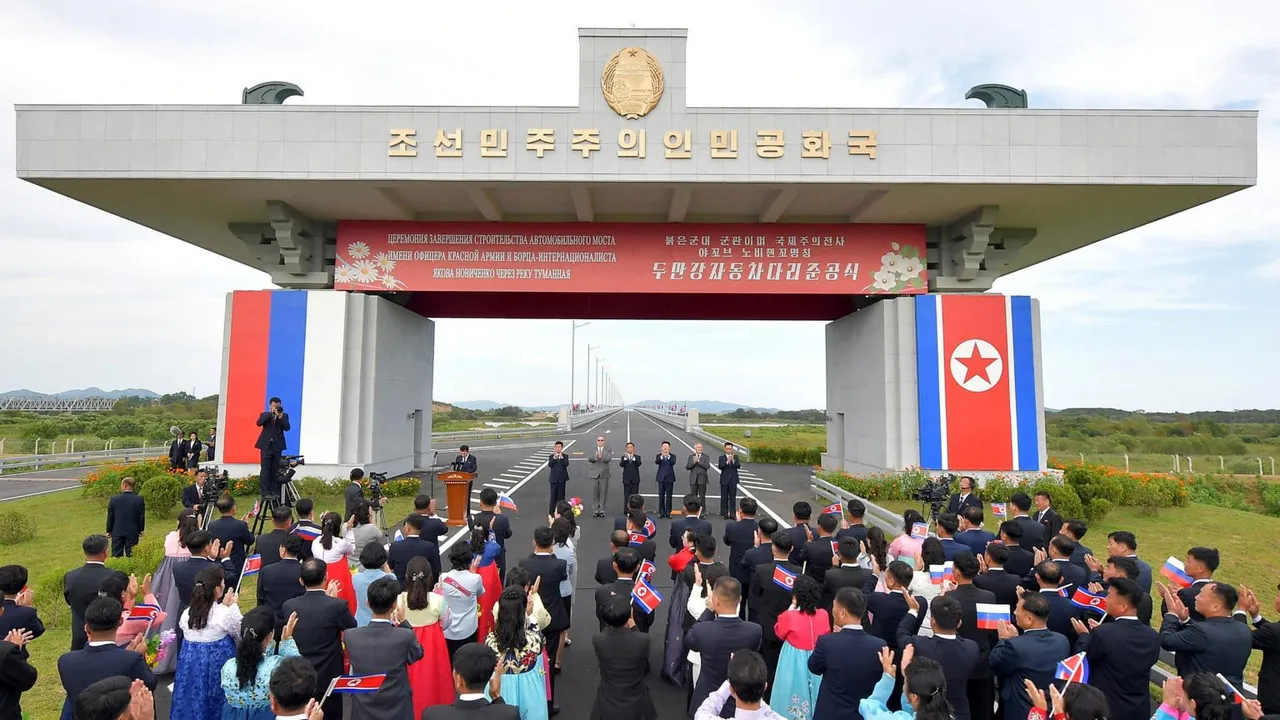
Russia and North Korea have opened the first road bridge across their shared border, a development both governments described as a milestone in their deepening bilateral ties.
The two-lane, one-kilometre bridge spans the Tumen River and links North Korea's Rason with Russia's Khasan. The first flag-adorned trucks crossed the structure on Monday. Up to 300 vehicles and, according to one report, up to 2,323 people can use the crossing daily.
The inauguration ceremony took place simultaneously in both border cities. Russian Prime Minister Mikhail Mishustin and North Korean Premier Pak Thae Song attended via video link.
Mishustin called the bridge "a new symbol of friendship" and said ties between Moscow and Pyongyang were "at an unprecedented high level." He also referred to "the Korean heroes who, only recently, fought shoulder to shoulder with our soldiers and defended Russian soil."
"I am convinced that the expansion of cross-border transport infrastructure will provide a powerful impetus for the further development of trade, economic, scientific, technological and cultural cooperation," Mishustin said.
Pak described the opening as "a significant event adding a new dynamic movement to the overall bilateral cooperation" and said it would cement cooperation "which fulfils the hopes and aspirations of the peoples of both countries as they seek shared development and prosperity."
The Russian government said trucks will begin using the bridge immediately to transport cargo, with the crossing expected to open fully to passenger traffic before the end of the year.
The bridge is named after Yakov Novichenko, a Red Army soldier whom Pyongyang credits with protecting the life of North Korea's founding leader Kim Il Sung in 1946 by intercepting a grenade thrown at him.
Construction began in April 2025, following an agreement reached during Russian President Vladimir Putin's 2024 visit to North Korea — his first trip to the country in 24 years. The visit resulted in a strategic partnership treaty between the two states. The bridge took 495 days to complete.
Until now, the two countries had no proper road link. The only previous road connection was a makeshift arrangement in which wooden planks were placed on the existing rail bridge to allow vehicles to cross. Air and rail links between the two countries remain in place. The new bridge sits close to the so-called Friendship Bridge, a rail crossing commissioned in 1959 following the Korean War.
North Korea's state media said the bridge would be used for "personnel exchanges, tourism and trade." North Korea has been receiving Russian tourists since February 2024, hosting them in Pyongyang and at the Wonsan-Kalma beach resorts, while continuing to restrict visitors from other countries.
The opening comes as relations between the two countries have grown significantly since Russia launched its full-scale invasion of Ukraine in February 2022. Under a 2024 strategic partnership treaty, both countries pledged to assist each other in the event of aggression against either state.
Pyongyang sent thousands of troops to Russia's Kursk region to help repel a Ukrainian incursion there in 2024. Researchers at South Korea's intelligence agency estimate that North Korea has already transferred between $7 billion and $14 billion worth of rockets, missiles and artillery shells to Russia, transported by sea. An estimated 11,000 North Korean troops are actively fighting in Ukraine.
Around 10,000 North Koreans are also reported to be working at construction sites and logging camps in Russia, according to a South Korean estimate. Although the United Nations prohibits the use of North Korean labour, many workers are said to enter Russia on student visas.
Ukrainian open-source intelligence group Truth Hounds said the bridge is intended "primarily to establish a covert military logistics corridor" to support Russia in the war in Ukraine. The group said the bridge could be used to transport North Korean military personnel, construction workers and senior military officials directly to Russia, and would also "enable the flow of Russian technology and resources in the opposite direction."
Victor Cha of the Center for Strategic and International Studies think tank said earlier this year that the speed of construction reflected the volume of trade between the two sides. "This is spurred largely by North Korea's provision of troops, weapons, munitions, and labourers for Putin's war in Ukraine," he said. "It is fair to say that this connection, prior to the war in Ukraine, was one of the sleepiest links between North Korea and its two neighbours."