Thousands of people gathered in Belgrade on Monday for the funeral of Ratko Mladic, the former Bosnian Serb general convicted of genocide for his role in the 1995 Srebrenica massacre. Mladic died in late August at the age of 84 while serving a life sentence at a UN detention facility in The Hague, the Netherlands.
Widely known as the "Butcher of Bosnia," Mladic was found guilty by a UN war crimes tribunal in 2017 for his role in the Srebrenica massacre, in which approximately 8,000 Bosniak Muslim men and boys were killed after Bosnian Serb forces overran the UN-designated enclave. The massacre has been described as Europe's worst atrocity since the Second World War.
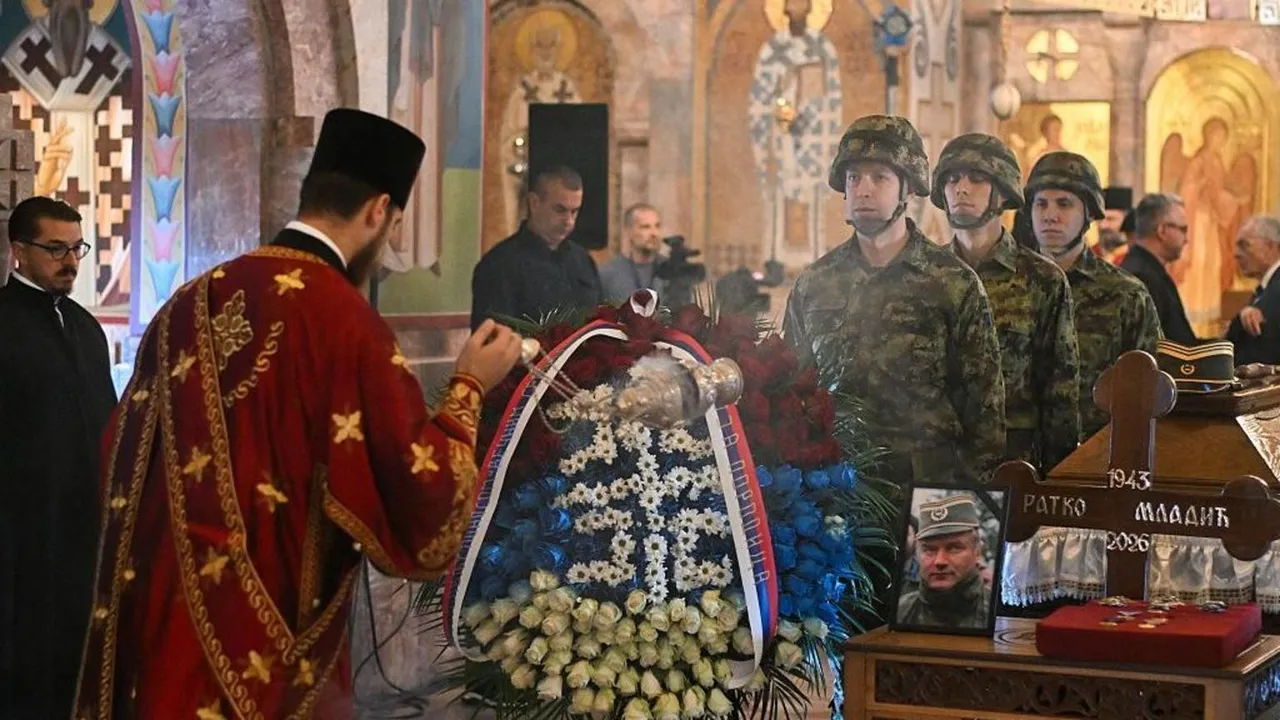
The funeral service was held at the small Church of St. Luke in the Serbian capital. Long queues formed early in the morning as people waited to pay their respects. Many in the crowd were army veterans, and some men were draped in flags bearing Mladic's image. Mourners lit candles outside the church, accompanied by a choir broadcast over loudspeakers.
Inside the church, Mladic's coffin was guarded by war veterans. On top of the casket lay his signature military cap and a sword, with a display of medals placed in front. His wife, son, and grandchildren stood inside receiving condolences.
The funeral service was led by Patriarch Porfirije, head of the Serbian Orthodox Church. "We know that his name will remain deeply etched in the memory and prayers of the majority of our Serbian Orthodox people, who feel and nurture a deep sense of gratitude towards him," the patriarch said.
After the service, a street procession accompanied the coffin to the cemetery, where Mladic was buried with military honours, including a three-volley rifle salute.
Mladic's coffin had been flown back to Serbia the previous week on a government plane, draped in national flags and carried from the aircraft by uniformed soldiers. Free bus services were organised from Bosnia and most towns across Serbia for those wishing to attend.
Several Serbian government ministers joined the crowds paying tribute, including Defence Minister Bratislav Gasic and Justice Minister Nenad Vujic, according to local media. Serbian President Aleksandar Vucic said he had a prior engagement, but his son Danilo attended, along with Russia's ambassador to Serbia. While the ceremony was not designated an official state funeral — reportedly to avoid further damaging international relations — it closely mirrored a state event, with large police and military delegations present.
A Serbian government minister had initially announced that Mladic would receive a state funeral, but those plans were revised following objections from European leaders.
The European Union's enlargement commissioner, Marta Kos, cancelled a forthcoming visit to Serbia in response to the events surrounding Mladic's return and burial. "The return of his remains to Belgrade reminds Europe of the darkest pages in our recent history," she said. "The glorification surrounding his death is incompatible with the values on which the EU path is built. That path requires confronting the past, genuine reconciliation and respecting the victims of war crimes." Serbia has been negotiating EU accession since 2014, though the process has stalled in recent years.
An EU spokesperson reiterated the warning on Monday. "Any glorification of war criminals, genocide denial and revisionism contradict the most fundamental European values and have no place in the EU or in EU candidate countries," the spokesperson said in a statement.
On Sunday evening, football fans displayed a large image of Mladic and chanted his name at a match in Belgrade between Red Star and Partizan.
For survivors and victims' families, the scenes in Belgrade were deeply painful. A woman from Sarajevo, Zdravka Gvozdjar, whose nine-year-old son was killed by Mladic-led forces during the siege of the city, said it was "really horrible" that the funeral was taking place in Belgrade. Mladic "deserved to be erased from memory for good, not to be promoted as a hero," she said. "He should be remembered only as a butcher."
Despite his conviction, Mladic has remained a revered figure among many Serbs, who regard him as a defender of the nation. Vigils were held following his death in the Bosnian Serb entity of Republika Srpska.
Daniella Peled, editor at the Institute of War and Peace Reporting, who covered Mladic's war crimes trial in detail, said the tribunal "provided an incredibly detailed historical record of Mladic's crimes," but that the Serbian media and education system "has not reflected the true scale of his crimes or the perspectives of victims and survivors." Pro-government Serbian media, she said, "depict him as a loyal soldier who simply carried out his duties." She added: "It's extremely challenging for post-conflict societies to undertake a national reckoning or acknowledge responsibility for the crimes of the past."
Also on Monday, Serbia's government announced its intention to dissolve parliament and call a snap election, a year ahead of a planned December 2027 vote. Prime Minister Djuro Macut said: "If we want to mitigate tensions in society there is no better way than to ask people."