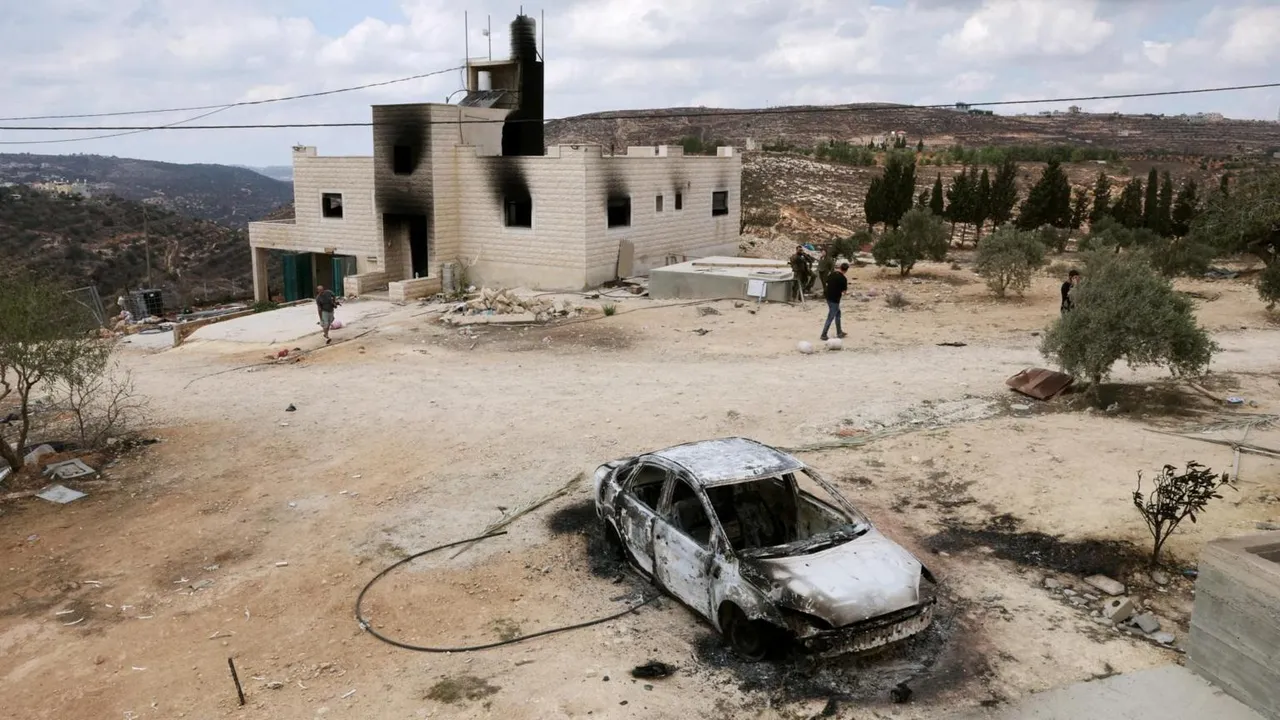
More than 100 Israeli settlers attacked the Palestinian village of Jalud in the northern occupied West Bank overnight, setting fire to two homes and clashing with Israeli security forces as the military attempted to escort a displaced Palestinian family back to their property.
The al-Tubasi family — Mahmoud, 60, his wife Aida, 51, and their 33-year-old son Wael — had been forced to leave their homes earlier this summer following weeks of settler harassment and violence. Israel's High Court ruled earlier this month that the family must be allowed to return.
The family was called at around midnight and told that Israeli military and border police had coordinated their return. They arrived at their home by torchlight and found it extensively damaged. Settlers had smashed holes through doors, torn out electrical fittings, ripped up tiles, broken windows and left the property strewn with rubbish.
A large number of extremist settlers mobilised after alerts were posted in WhatsApp groups used to coordinate action, warning that the Palestinian family was returning and should be stopped.
"As soon as we entered the house, which had already been completely destroyed, settlers started throwing stones at us. The army responded by firing tear gas at them, but there were so many settlers, more than 150, that the army could no longer control them," Mahmoud al-Tubasi said.
Settlers slashed the tyres of a military van the family had been placed in, forcing their transfer to an armoured vehicle. As they were driven away, settlers set fire to the family's car and both of their houses. Video shot from a distance shows smoke billowing from the burning buildings.
Al-Tubasi said Israeli security forces "essentially formed a barrier, took us out safely and got us away from there. But they did not take any action against the settlers themselves."
"It was extremely terrifying, beyond words. It's hard to imagine the situation," al-Tubasi said. "My feeling now is that I am happy to have escaped death. I genuinely expected they were going to kill us."
In a statement, the Israel Defense Forces said that "more than 100 Israeli rioters were present in the village, blocking roads, setting tyres on fire, and throwing stones at security forces." The military said three police officers were lightly injured and a security forces vehicle was damaged. It described the al-Tubasi family as victims of "nationalist crime" and stated that "due to the violence, the mission to return the family to their home was not completed."
The head of the local council in Jalud told reporters that residents had confronted the settlers, leading to clashes that spread to a nearby village, where a Palestinian woman was assaulted by settlers and her home set ablaze.
One month ago, Aida al-Tubasi was attacked by masked Israeli settlers and injured alongside American journalists who were interviewing her in Jalud.
Human rights groups said the events demonstrate that Israeli authorities are failing to take effective action against settler violence.
The violence in Jalud was not an isolated incident. In a separate attack, Israeli settlers assaulted an elderly Palestinian woman after breaking into her home in Qaryut, south of Nablus. A video filmed by a volunteer medic showed the woman had suffered bruises to her hand and head. In al-Mughayyir, northeast of Ramallah, settlers attacked Palestinian homes and property while Israeli army forces raided the village and detained a young man. Settlers also set fire to a home belonging to a Palestinian detainee.
The United Nations Office for the Coordination of Humanitarian Affairs recorded more than 1,330 settler-related attacks on Palestinians in the West Bank from January to late July this year, averaging six a day and representing the fastest pace in approximately 20 years.
"The frequent and severe violence must be brought to an end," said Julien Lerisson, head of the International Committee of the Red Cross's delegation for Israel and the occupied territory. "Authorities have a responsibility to protect the population from violence, including when that violence is inflicted by settlers. What international humanitarian law says on the protection of private and public property and on the population's access to essential services must be respected."
Israeli settlements built on occupied Palestinian land are considered illegal under international law.