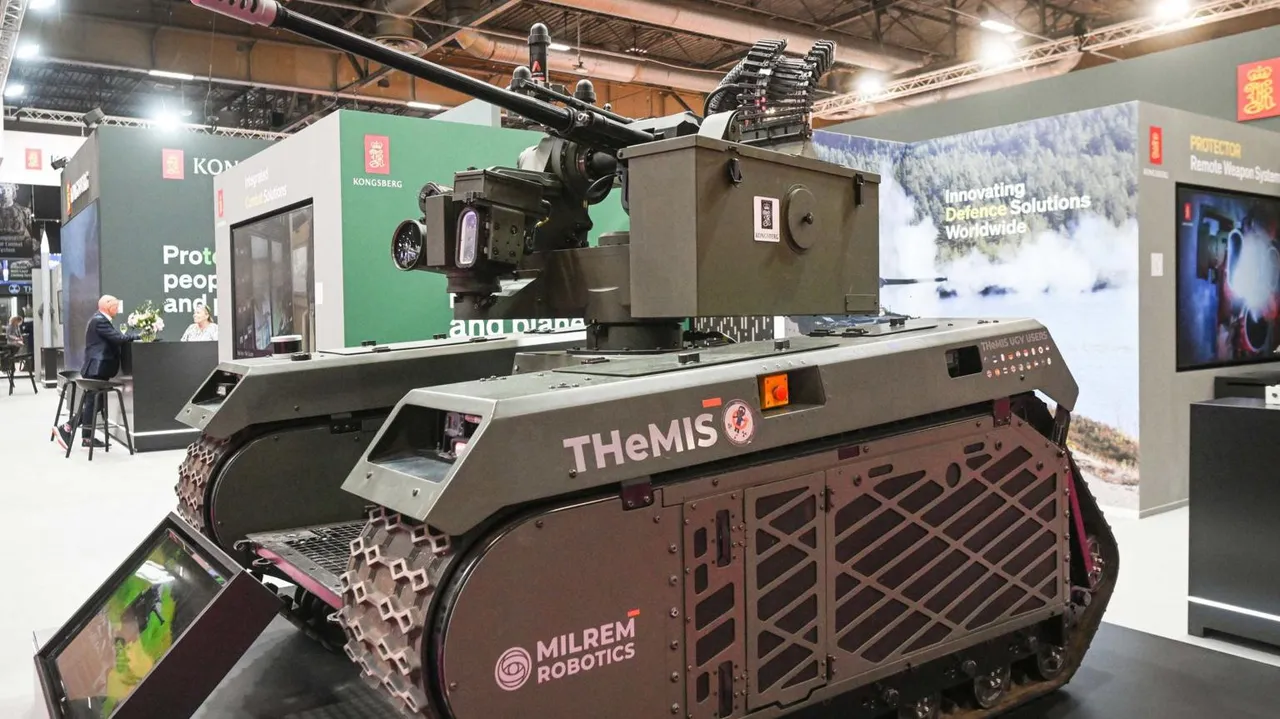
Estonia has formally accused Russia of ordering an arson attack on Milrem Robotics, a Tallinn-based defence company that supplies unmanned ground vehicles to Ukraine.
The attack took place on the night of 14-15 August at a building used by the company in the Estonian capital.
Estonian Foreign Minister Margus Tsahkna said on Tuesday that, based on information gathered by the country's Internal Security Service, "we can conclude with certainty that the arson attack in Tallinn was an act of sabotage ordered by the special services of the Russian Federation."
Tsahkna said the attack was "part of Russia's broader campaign across Europe, aimed at intimidating us and weakening our support for Ukraine." He added that Russia's chargé d'affaires in Tallinn had been summoned to his ministry.
Prime Minister Kristen Michal said Estonia's response would be "the opposite: stronger security at home, more support for Ukraine and greater pressure on Russia. We will not be intimidated."
Three suspects, described as Latvian nationals who had been living in Russia, were arrested in Latvia on 17 and 18 August and subsequently extradited to Estonia. Authorities said the suspects had taken part in previous attacks.
Estonia's internal security service chief Margo Palloson said Russia was "constantly planning, looking for opportunities, trying to find people who would carry out attacks," and that the August arson was its first successful attack of the year.
Palloson warned that individuals recruited for such operations "may be misled or manipulated and may be given false or fabricated justifications for their actions in an effort to conceal the involvement of the Russian state."
The Kremlin rejected the accusations. Spokesman Dmitry Peskov said the allegations were "baseless, ill-considered, have absolutely no relation to reality, and lack any form of reasoning. Consequently, we cannot and will not take such statements seriously."
Western allies rallied behind Estonia and reaffirmed their support for Ukraine.
NATO Secretary General Mark Rutte said: "Russia continues its reckless campaign of hostile actions against NATO allies. It is trying to weaken our resolve and stop our support for Ukraine. But Russia is failing. It is failing on the battlefield in Ukraine and it is failing to undermine our unity and support for Ukraine."
French President Emmanuel Macron described the attack as a "dangerous escalation," saying the "multiplication of these hostile acts represents a dangerous escalation by Russia, which will only lead it into a dead end." He added: "Russia needs to know that it will not overcome our unity or our determination to continue supporting Ukraine."
Macron also referenced an incident at Leipzig airport in Germany in August, in which an explosive-laden drone was found near Ukrainian cargo planes.
Lithuania's Prime Minister Mindaugas Sinkevičius said Russia's actions were becoming "increasingly hostile and less restrained," pointing to hybrid attacks in Lithuania, Poland, Germany and elsewhere. Lithuania's Foreign Minister Kestutis Budrys said Russia's "fingerprints are all over" the Tallinn attack.
Latvian President Edgars Rinkevics said further support for Ukraine "will be needed, and must be provided." Sweden's acting Prime Minister Ulf Kristersson called Estonia's formal attribution "extremely serious," describing the pattern of attacks as "directed against Europe as a whole."
Britain's ambassador to Estonia said the UK "stands with Estonia in confronting these unacceptable attacks. They will not weaken our resolve or our support for Ukraine."
The European Union also condemned the attack, with a European Commission spokesperson saying: "Moscow is trying to scare Europe into winding down its support for Ukraine. This will not happen."
In August alone, Russia was accused or suspected of involvement in multiple incidents across Europe, including the Leipzig airport drone find in Germany, a major fire at a defence warehouse in Bulgaria, an explosion at a munitions factory near Rome, an attempted arson at a Ukrainian-owned drone manufacturer in Slovakia, and two suspicious fires in Poland.
Approximately 200 incidents of suspected Russian sabotage and malign activity have been recorded across Europe since Moscow's full-scale invasion of Ukraine in 2022, including arson plots, drone incursions, theft of defence technology and cyber-attacks on critical infrastructure.
Estonia, along with its Baltic neighbours Latvia and Lithuania, has significantly increased its defence spending since 2022 and remains among Ukraine's staunchest supporters.