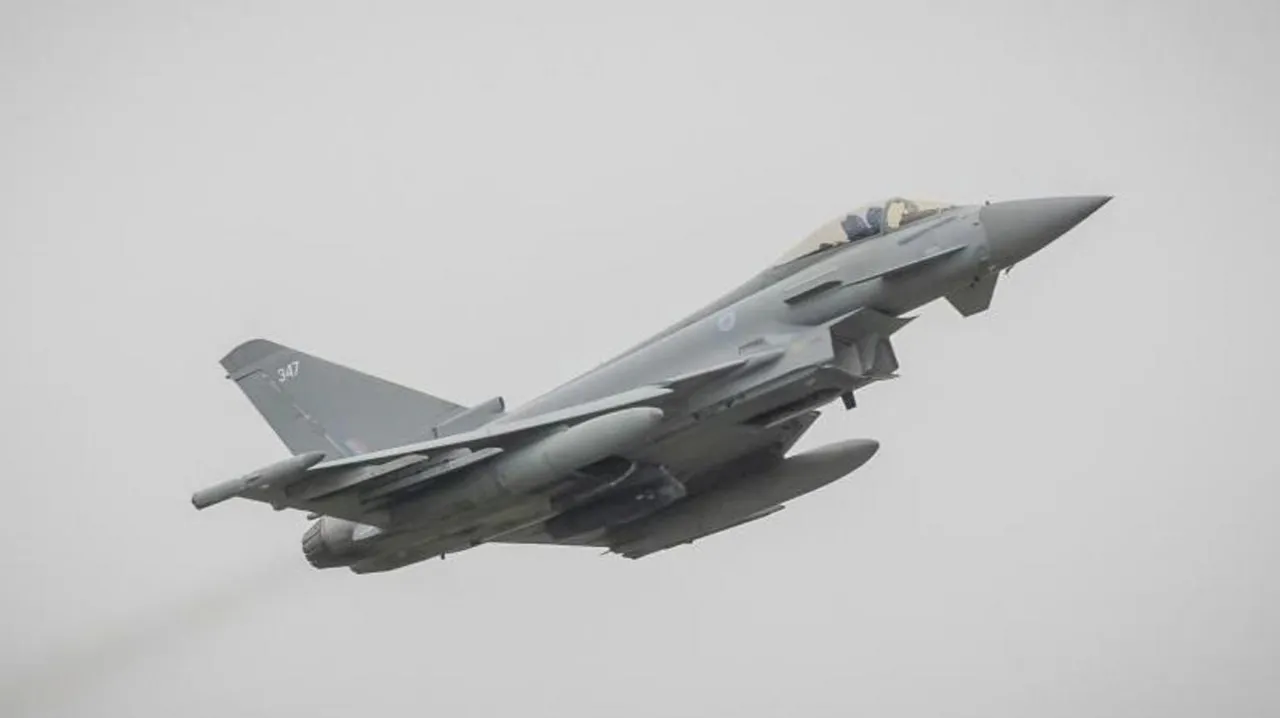
The United Kingdom will deploy Royal Air Force Typhoon fighter jets to Saudi Arabia to help defend the kingdom against escalating missile and drone attacks by Yemen's Houthi rebels, the British government announced on Tuesday.
Defence Secretary Wes Streeting confirmed the deployment in a written statement, saying the aircraft will operate in a strictly defensive role. "These aircraft will operate in a defensive role and will not conduct offensive strikes against the Houthis," he said.
Streeting described the ongoing attacks as "absolutely despicable" and called the escalation "outrageous" and "intolerable." He also pointed to the disruption of energy supplies in the Gulf, warning of rising costs for families and businesses.
The deployment follows a formal request from Saudi Arabia and expands military assistance that London first announced in September. The UK will also send an Atlas A400M military transport aircraft and military advisers to support the movement of defence equipment within Saudi Arabia. Air-to-air refuelling support for Saudi defensive operations has been extended by a further 90 days.
The UK is already providing Saudi Arabia with defence support equipment to protect against aerial attacks. Officials said the RAF Typhoons will not only bolster Saudi air defences but will also free up Saudi aircraft to conduct their own operations.
The Houthis, an Iran-backed armed group, have been locked in a civil war with Yemen's internationally recognised government since seizing the capital Sanaa in 2014. Saudi Arabia backs the internationally recognised government and has long been a target of Houthi strikes.
A ceasefire of sorts in Yemen broke down in September, after which the Houthis launched a fresh offensive, seizing effective control of the strategically vital Bab al-Mandab strait. Government forces, backed by Saudi air cover, mounted a counter-offensive, and the Houthis responded by striking targets deep inside Saudi territory.
Houthi attacks have hit Saudi infrastructure including King Khalid Airport, energy facilities and key ports. Saudi authorities said 19 people had been killed in Houthi attacks on the kingdom's airports. A single missile strike on Riyadh's international airport on 10 October killed 13 people and injured 308 others, making it the deadliest attack on Saudi soil in more than a decade. According to separate reports, strikes on the airport have killed at least 18 people and wounded hundreds this month. The airport has been targeted 20 times since the beginning of October.
Streeting said the targeting of Riyadh airport "shows the lengths the Houthis are going to escalate the situation in the region." "That's why today I have approved further UK military support," he added.
Earlier this week, a Houthi missile strike on a training camp for Saudi-backed government security forces in Yemen's central province of Shabwa killed more than 70 security personnel, according to one source, while another report put the death toll at 58. A spokesman for the Saudi-backed Yemeni armed forces said the Iran-backed group launched three ballistic missiles at al-Alam camp near Ataq city. The Houthis' military spokesman said they had targeted "Saudi enemy concentrations."
According to the Houthi-run health ministry in north-western Yemen, Saudi air and artillery strikes have killed at least 141 people and injured 395 since 3 September. The internationally recognised government's health ministry said last week that at least 1,282 people had been killed across Yemen since 6 August.
Saudi Arabia has struggled to intercept incoming missiles and drones, partly because much of its air defence capability was depleted during Iranian attacks earlier this year. The sheer size of the country also makes comprehensive air defence difficult to maintain.
Houthi attacks have also targeted oil facilities and disrupted naval traffic. The rebels have imposed a naval blockade and attacked tankers, disrupting oil exports and pushing up energy prices globally.
Earlier this month, Houthi military spokesman Brigadier General Yahya Saree vowed to continue "escalating operations deep inside Saudi Arabia."
In a separate development, Saudi Arabia has postponed its flagship Future Investment Initiative conference, informally known as "Davos in the Desert," until 2027. The event had been scheduled for 26-29 October and was expected to attract leading international financiers. According to reports, major banks and private equity firms had raised security concerns about attending. The conference is a central part of Saudi Arabia's efforts to attract foreign investment and diversify its economy away from oil.
Saudi Arabia and the United States accuse Iran of supporting the Houthis, an allegation Tehran denies.