A drone strike on a busy market in the disputed Abyei region has killed at least 153 people, according to local officials, with thousands more displaced by the attack.
The strike hit the Amiet Market at around midday on Monday. The death toll more than doubled within 24 hours, rising from an initial figure of 73 to at least 153, according to Yohana Akol Ngor, the caretaker information minister in Abyei.
Akol Ngor said around 8,000 people had been displaced by the bombing. He blamed Sudan's military for the attack but did not provide evidence.
South Sudan's Foreign Ministry also blamed the Sudanese army, saying the drone struck multiple locations around the busy market. South Sudan said it had summoned Sudan's ambassador to protest and urged Sudan to "refrain from any actions that endanger civilian lives and property."
One of the locations struck, according to witness accounts, was a fuel depot. The resulting fire proved difficult to bring under control overnight and was still burning on Tuesday.
Satellite images revealed the scale of the destruction caused by the blaze.
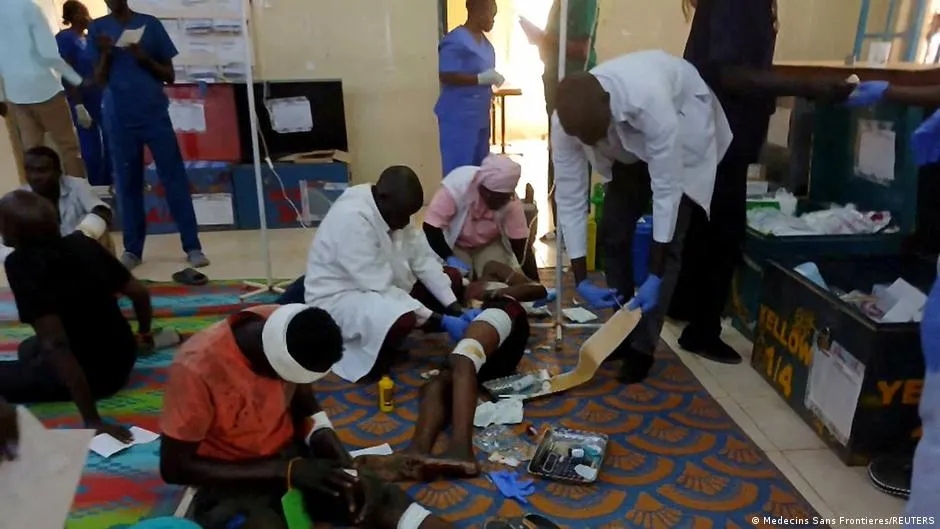
Medical charity Medecins Sans Frontieres (MSF) said its staff were treating wounded patients at the nearby Ameth Bek hospital, providing surgical services, wound dressing and other emergency care.
"So far we received over 20 patients, including several critical cases. Patients with burns were also admitted," said Dr. Christian Lindauer, MSF's medical activities manager at the hospital.
The United Nations also responded to the attack. "We remain alarmed by the relentless drone attacks across Sudan, as well as the damage they are causing to critical infrastructure — these attacks are taking a devastating toll on communities already struggling with the consequences of more than three years of conflict," UN spokesperson Stephane Dujarric told reporters in New York.
The Abyei region's status has remained unresolved for decades. It was not settled by the 2005 peace agreement that broadly ended years of civil war in Sudan, nor by South Sudan's independence in 2011. A planned referendum never materialized, stalling over disputes about who should be allowed to vote.
This left Abyei in a prolonged state of limbo, jointly administered and with a UN interim security force present for 15 years. The region's majority Ngok Dinka population favors joining South Sudan, while Misseriya nomads who use its pastures favor Sudan. The Amiet Market, site of Monday's attack, serves as an important trading hub for both communities.
The region has also experienced intercommunal violence in recent years between Ngok Dinka and neighboring Twic Dinka communities and is home to other armed militias.
The attack comes amid the broader civil war between Sudan's Armed Forces and the Rapid Support Forces (RSF) paramilitary, which broke out in April 2023 and has produced entrenched battle lines, leaving Sudan in a de facto state of partition.
Abyei borders South Kordofan state in Sudan, which has become a major center of fighting. Sudan's military alleges that the RSF is also operating out of Abyei. The UN Interim Security Force for Abyei issued a similar warning in May, cautioning that the RSF's presence in the resource-rich region had placed residents in additional danger and risked intensifying the long-standing territorial dispute between Sudan and South Sudan. Officials in Abyei and South Sudan dispute the claim that the RSF is active in the area.
Both Sudan's military and the RSF have made extensive use of drones throughout the conflict.