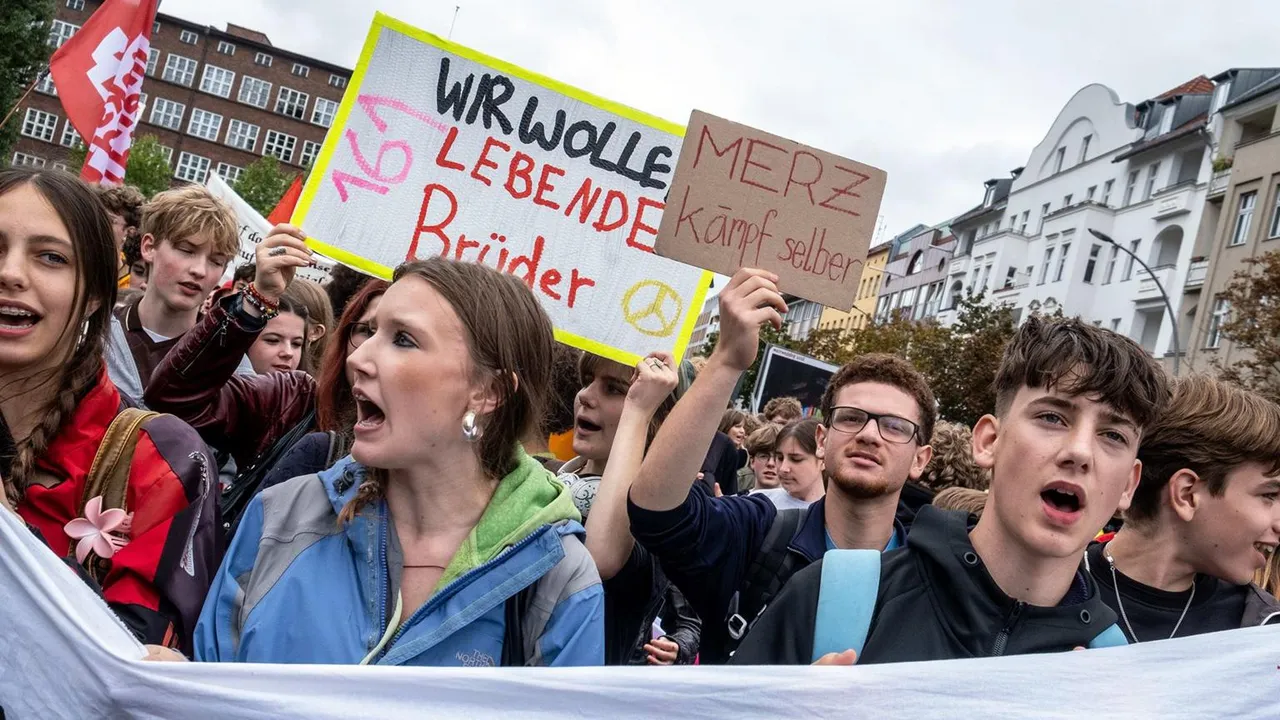
School strikes are taking place across Germany in protest against the possible reintroduction of compulsory military service.
One of the organisers, Bela Breitner of the School Strike Against Compulsory Military Service group, said the federal government was "serious about gradually reintroducing compulsory military service."
At one protest in Hamburg, demonstrators waved flags and held up banners reading "We won't take part in your wars." Organisers say more than a hundred demonstrations are planned across Germany, including in Kiel, Hamburg, Berlin and Frankfurt.
The protests were triggered after some 18-year-olds in the northern German towns of Kiel and Flensburg received official invitations to attend medical examinations, despite having expressed no interest in joining the army on their registration forms.
A 16-year-old protester from Hamburg, Elias Bernhard, said responses to the questionnaires "show that young people do not want to join the Bundeswehr." He added: "That is why I am out on the streets today. That is why we are serious about striking until compulsory military service is off the table. We will carry on."
A new law introducing voluntary military service came into force in January, with the aim of recruiting volunteers to increase the number of soldiers. Under the law, all 18-year-olds in Germany are sent a questionnaire asking whether they are interested in joining the armed forces. The questionnaire is mandatory for men and voluntary for women.
All 18-year-old men are also required to undergo a medical examination to assess their fitness for possible military service. A Defence Ministry spokesperson said the obligation to undergo such an examination applies "to all men liable for military service who were born after 31 December 2007," including those who have stated they have no interest in serving. Since July, around 1,000 men who expressed no interest in the army have undergone the exam.
However, if the security situation worsens or too few volunteers come forward, a form of compulsory military service could be considered by Germany's parliament, the Bundestag.
Chancellor Friedrich Merz has made strengthening Germany's military a priority following Russia's invasion of Ukraine. He has vowed to transform the Bundeswehr into Europe's strongest conventional army, amid perceived threats from Russia and pressure from Germany's traditional ally, the United States.
The Bundeswehr currently has around 186,700 troops. Germany aims to raise that number to 260,000 by the early 2030s, supplemented by around 200,000 reservists, in order to meet new NATO force targets.
Germany, like many other European countries, maintained a large army during the Cold War but reduced its armed forces during the 1990s following the fall of the Iron Curtain. Compulsory military service was ended by former Chancellor Angela Merkel in 2011.