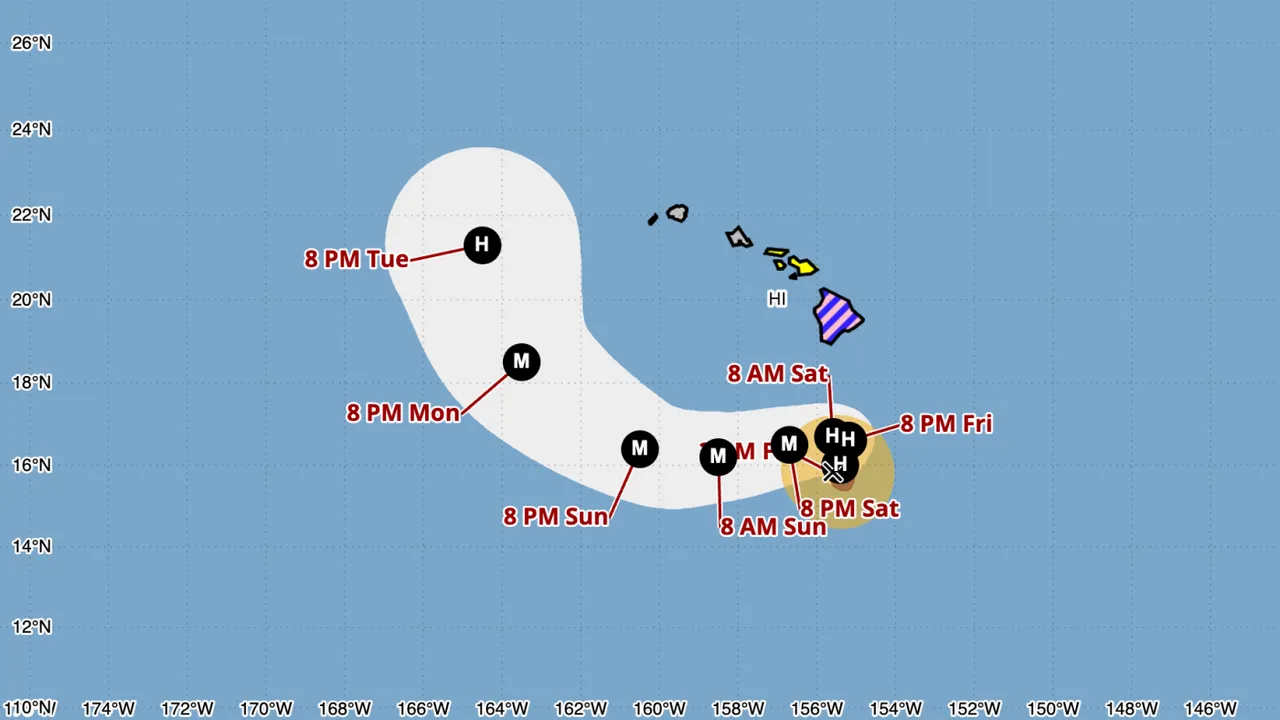
People on the Big Island of Hawaii are under a hurricane watch as Hurricane Nolo moves across the Pacific Ocean toward the Hawaiian archipelago. The alert means hurricane conditions are possible within 24 to 36 hours.
By that time, the storm is expected to have strengthened into a major hurricane, according to the National Hurricane Center (NHC).
Nolo is not expected to make landfall this weekend, but forecasters warn it carries two dangerous qualities: slow movement and extremely heavy rainfall. Maximum rainfall amounts could reach nearly three feet in some areas, with totals of 15 to 30 inches expected more widely.
"This rainfall could produce catastrophic life-threatening flooding and mudslides, especially in areas of steep terrain," the NHC said in its public advisory.
As of Friday morning, Nolo's maximum sustained winds were at nearly 85 mph, while the storm was moving at only 5 mph. It is currently tracking north-northeast and is expected to slow further before turning westward and picking up forward speed on Saturday and Sunday.
Despite its slow pace, the storm is drawing strength from warm ocean waters. Over the next 72 hours, Nolo's winds could reach 140 mph, which would make it a Category 4 hurricane.
The heaviest rainfall is expected to fall across the Big Island's eastern and southern areas. Neighboring Maui is under a tropical storm watch and could see up to 15 inches of rain.
Nolo's path has been marked by sudden and unpredictable shifts. Earlier this week, the storm was heading west across open ocean before taking an abrupt right-hand turn, sending it north directly toward the Big Island.
The storm's intensification follows an unexpected reversal. Last week, forecasters declared the system was dissipating and would not merit further updates unless it regenerated. Days later, the NHC resumed issuing advisories for what was then Tropical Depression Fifteen-E, warning it could strengthen quickly. The system subsequently became Tropical Storm Nolo before intensifying into a hurricane.
Nolo is the latest development in a busy Pacific hurricane season, where warm water is fueling a powerful El Nino phenomenon that is generating storms and reshaping weather patterns globally. The Pacific region has already recorded three Category 5 hurricanes this season: Genevieve, Lowell, and Polo.
Elsewhere in the Pacific, Hurricane Polo has brought heavy rain to Mexico's Pacific coast, while Hurricane Odalys is growing over open water further east.