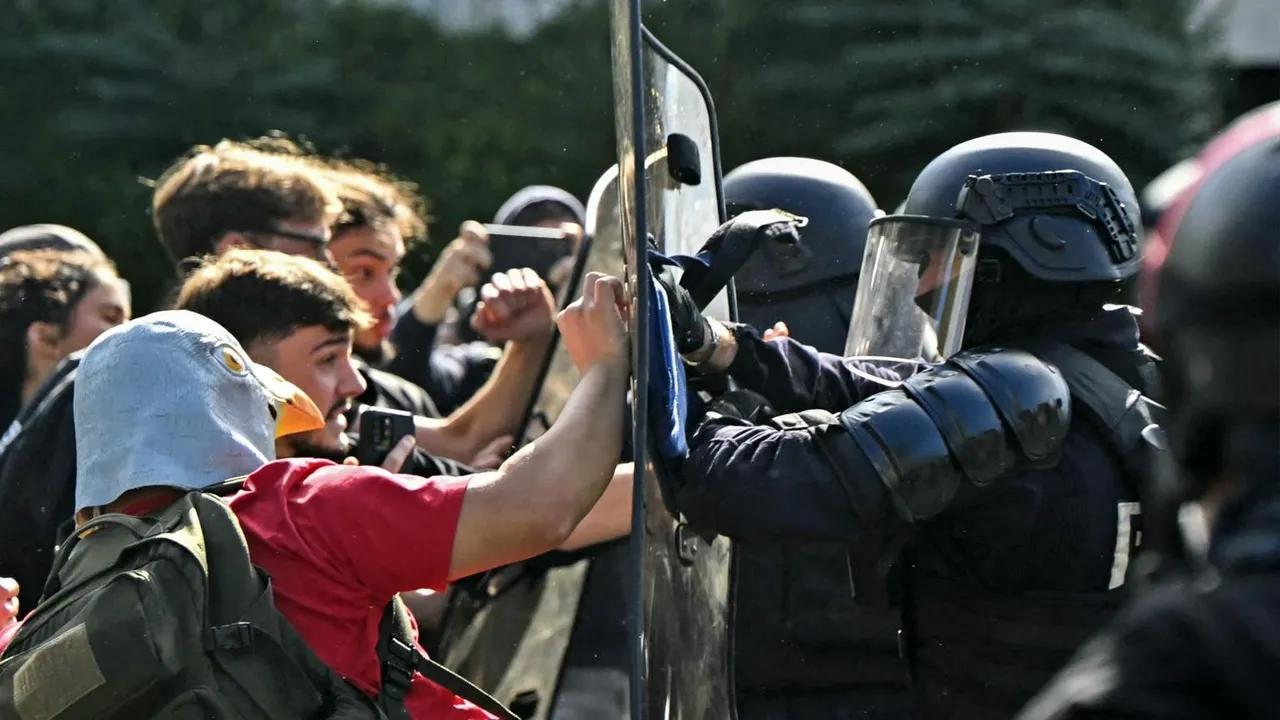
Protests by high school students have continued across France for a fourth consecutive day, with demonstrations spreading and growing in scale since they began in late September.
The wave of unrest started on September 21 at a high school in a deprived area of Paris. Tens of thousands of students have since taken to the streets nationwide, demanding more education funding, renovated school buildings, reduced classroom hours, and an end to staff shortages.
University students and trade unions have since joined the movement. A large rally was expected in Paris on Thursday, with demonstrators also blocking streets outside schools.
"They are moving around, trying to block off the streets," a reporter said from outside one school in the capital, where university students were barricading a large area. "They are out, they say, in solidarity with high school students because they say it's important that as many young people join in the protests as possible."
Students have described deteriorating conditions in France's lycees, schools attended by pupils aged 15 to 18. "Sometimes our teachers are absent for several weeks without being replaced," said Madalena, a Paris student, during demonstrations that drew hundreds of thousands across the country. Her school buildings, she added, were "boiling hot" during recent heat waves.
Other grievances include long school days, the banning of mobile phones, and frustration with Parcoursup, the national online platform that allocates places in higher education, which many students regard as opaque.
The protests have turned violent in places. Dozens of people have been injured, including students, teachers, and police officers. At least 6,600 arrests, mostly of minors, have been made so far, according to the Interior Ministry. Authorities said 375 schools were either fully or partially closed on Thursday, and that two dozen had been burned or destroyed.
Rights groups have accused security forces of using disproportionate force. Several demonstrators have been seriously injured, including one teenager who lost a hand and another whose jaw was shattered by an exploding stun grenade. The use of stun grenades at protests has since been banned.
Interior Minister Laurent Nunez described the movement as "unprecedented" in terms of the number of schools and pupils involved and the degree of violence.
Prime Minister Sebastien Lecornu condemned the violence in a television address on Wednesday. He faulted "political leaders who use this anger to conduct their electoral battles", after opposition leader Jean-Luc Melenchon called for protesters to keep marching. Lecornu also insisted that security forces were not under orders to "confront high-school students", only to enforce the law.
Lecornu has ordered ministers to provide an action plan responding to students' demands by the end of the month. Protesters, however, remain unconvinced.
"As far as they are concerned, the government only talks about solutions but never actually comes up with concrete actions, so they say they are going to keep coming out onto the streets until their demands are met," a reporter said from Paris.
The demonstrations are increasing pressure on the outgoing government of President Emmanuel Macron ahead of April elections.
France has a long history of student protest movements producing tangible results. In October 1990, mass rallies over underfunding and staff shortages led the government to release the equivalent of 1.2 billion euros for lycees. In October 1998, 500,000 pupils marched across France over similar demands, resulting in nearly 1 billion euros to renovate schools and 14,000 additional staff. On several occasions, student protests have also succeeded in defeating government reforms.