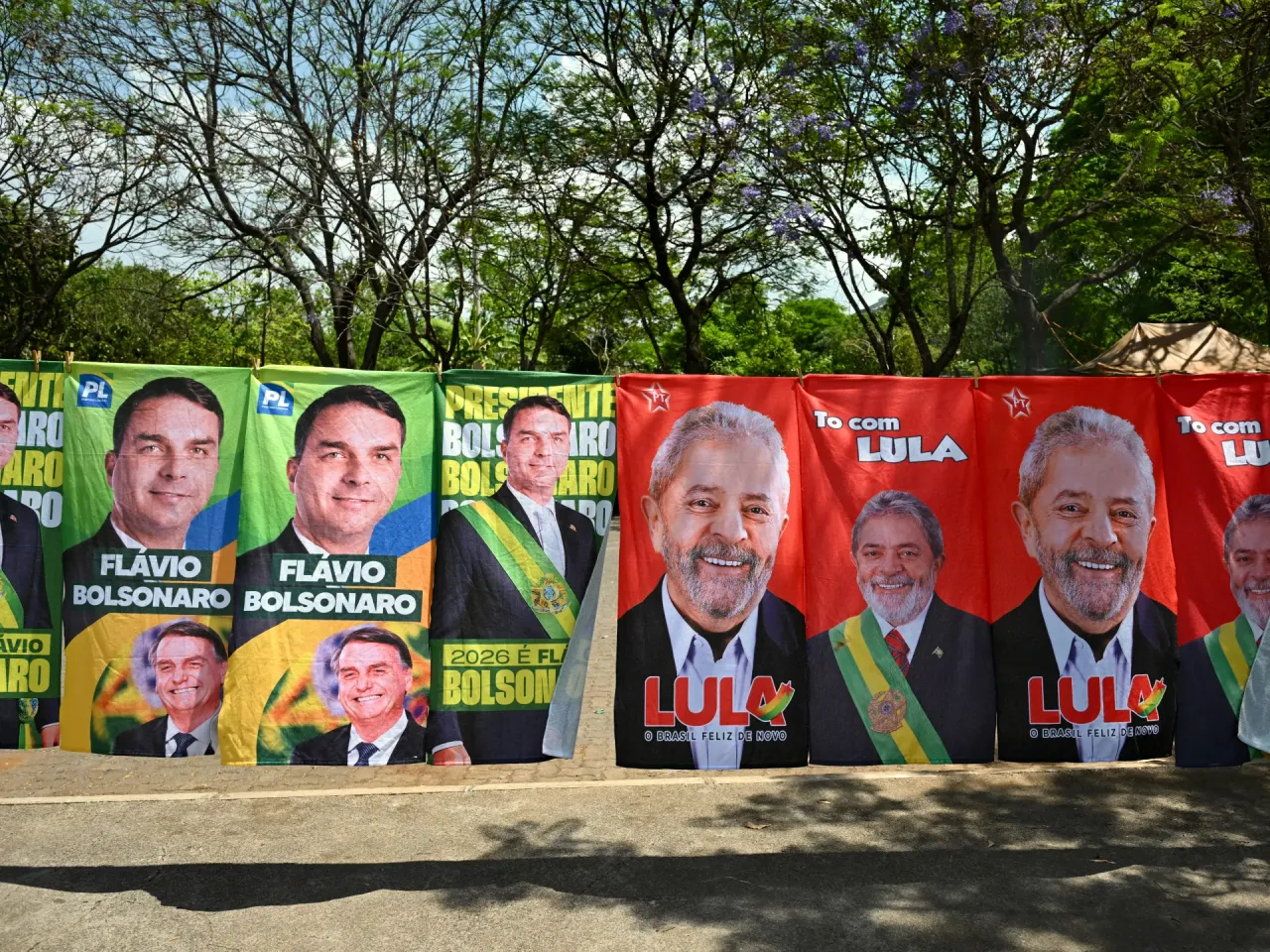
Thousands of people joined a student march in downtown Rio de Janeiro on Wednesday to protest against Flavio Bolsonaro, three weeks before Brazil's presidential runoff scheduled for October 25.
Demonstrators rallied behind incumbent President Luiz Inacio Lula da Silva and expressed opposition to what they described as a potential far-right return to power.
The protest followed Sunday's first-round vote, in which Bolsonaro took approximately 47 percent of the vote compared to Lula's 45 percent — a result that surprised analysts and reversed most pre-election polling expectations.
Most recent polls had predicted Lula would enter the runoff from first place, leading Bolsonaro by roughly three percentage points. The outcome raised questions about what shifted in the final days of the campaign and what the polls may have missed.
Political scientist Carlos Pereira, of the Getulio Vargas Foundation think-tank in Brazil, believes part of the answer lies in a late consolidation of right-wing voters. Some supporters of smaller right-wing candidates — including former Goias governor Ronaldo Caiado and Free Brazil Movement founder Renan Santos — appear to have shifted their votes to Bolsonaro earlier than expected.
"Usually, voters, they vote [sincerely] in the first round, and they vote strategically in the second round," Pereira said. This time, he argued, some made that strategic choice in the first round itself.
"They thought, 'Let's try to resolve this election right now,'" Pereira said. "If you're gonna vote for Flavio anyway in the second round, why not vote for him right now?"
Bolsonaro himself had anticipated this dynamic. On election day, he told reporters he expected a "protest vote" from people united in their opposition to Lula who might otherwise have backed another candidate.
Political analyst Rafael Favetti noted that some of the support Bolsonaro would typically have gained only in a second round had already been "front-loaded," potentially leaving him less room to expand his coalition ahead of the runoff.
A banking scandal also played a role in the final weeks of the campaign. The Banco Master affair — an alleged sprawling banking fraud — touched figures across the political spectrum, including Supreme Court Justice Alexandre de Moraes, who oversaw the case that sent former President Jair Bolsonaro to prison.
Documents emerged appearing to show Banco Master owner Daniel Vorcaro seeking legal advice from De Moraes. The justice has denied the allegations.
Pereira said the scandal may have acted as a late "trigger" for some voters. Bolsonaro's supporters have long viewed De Moraes as a political ally of Lula. During the campaign, Flavio Bolsonaro drew a direct link between the two, saying: "Anyone voting for Lula is voting for Alexandre de Moraes."
A September Datafolha poll found that 34 percent of Brazilians associated the Banco Master scandal more with the left, compared with 27 percent who associated it more with the right.
Andre Pagliarini, a professor of history and international studies at Louisiana State University and author of a book on Lula, agreed the scandal may have hurt the president. A campaign dominated by "spectacular, unceasing scandal involving seemingly the entire political class," he said, played to Bolsonaro's strengths as an "anti-institutional insurgent."
"The irony, of course, is that Flavio himself was directly implicated in the Banco Master scandal in a way that Lula is not," Pagliarini said. The younger Bolsonaro is under investigation over allegations that he sought money from Vorcaro to finance a film about his father. He denies wrongdoing.
Neither analyst viewed the first-round result as a wholesale failure of the polls. For Pagliarini, the bigger surprise was the scale of support for the right more broadly. Bolsonaro won nearly four percentage points more than his father did in the first round in 2022, while his Liberal Party emerged with the largest bloc in Brazil's Senate.