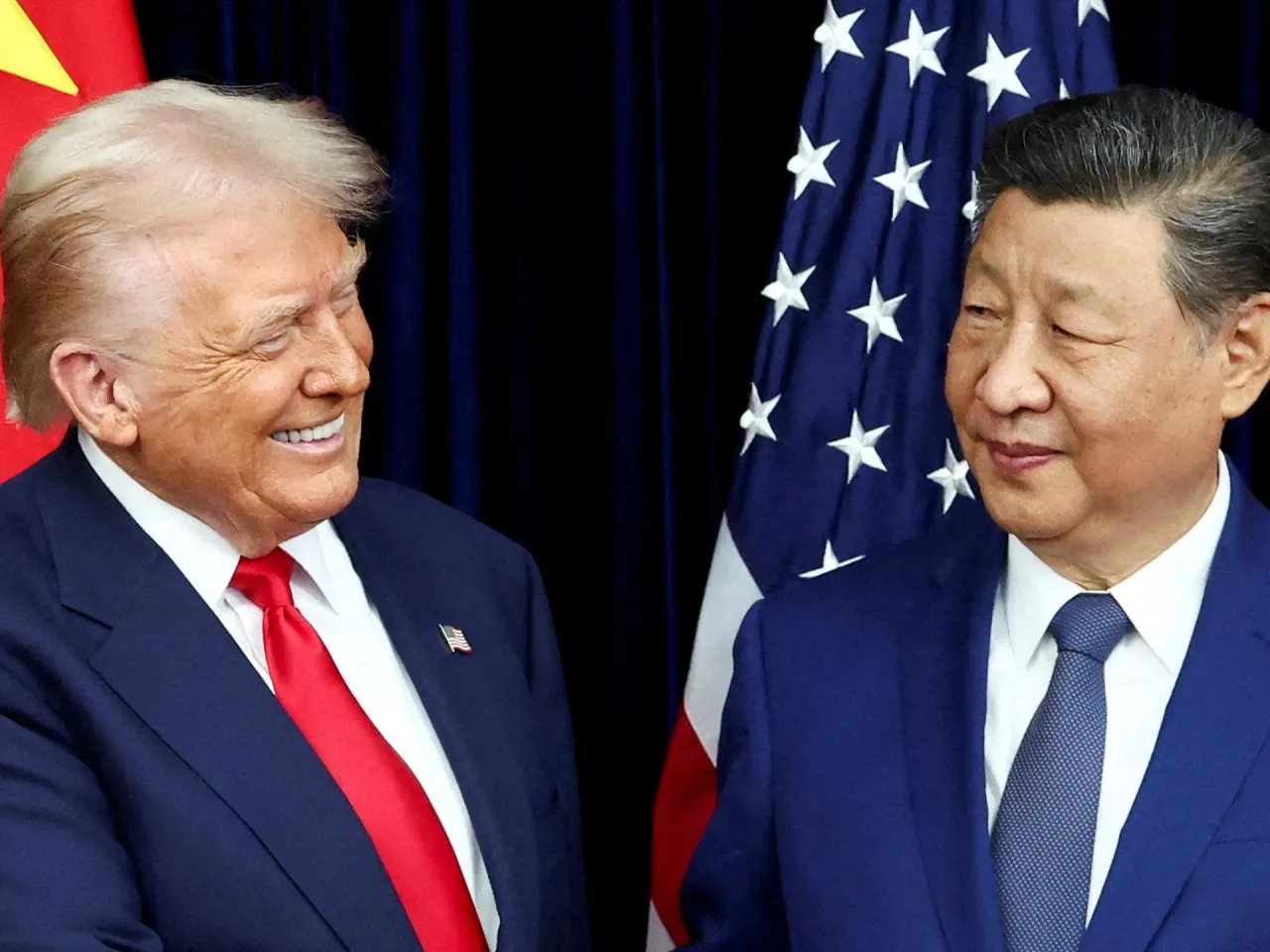
Chinese President Xi Jinping has arrived in the United States for a three-day state visit — the first by a Chinese leader in more than a decade — with trade, artificial intelligence, and the future of a fragile tariff truce topping the agenda for talks with President Donald Trump.
Trump received Xi on the tarmac at Joint Base Andrews outside Washington, a rare gesture reflecting the high stakes of the visit. The two leaders are scheduled to hold formal talks on Thursday.
The meeting comes as the world's two largest economies remain locked in an escalating economic and technology rivalry that has reshaped global trade flows since Trump returned to power in January 2025.
As of July 2026, Chinese goods entering the United States faced an average tariff rate of 36.5 percent, while US goods entering China were taxed at an average of 31 percent, according to a Congressional Research Service report. These are averages; rates vary sharply by product.
Chinese copper and its products faced an effective tariff rate of 73.6 percent in June 2026, aluminium and its products 65.2 percent, iron and steel items between 50 and 58 percent, and vehicles and auto parts 44.4 percent.
China, for its part, maintains a 10 percent additional tariff on US imports on top of its standard duties. US crude oil faces a 20 percent levy, liquefied natural gas 25 percent, soybeans 13 percent, and US beef up to 77 percent.
The trade war began shortly after Trump resumed office, when he imposed a 10 percent duty on Chinese goods citing fentanyl and immigration concerns. Beijing responded with levies on US coal, LNG, crude oil, and automobiles, as well as export curbs on five metals critical to defence and clean energy.
By April 2025, the conflict had escalated sharply. Chinese goods attracted tariffs of 145 percent, while Beijing imposed a 125 percent levy on US imports and restricted rare-earth exports. The two sides later reached a tariff truce following talks in South Korea. That truce is due to expire on November 10.
The truce has not halted all trade restrictions. Last month, the United States banned imports of Chinese-made humanoid robots, sanctioned Chinese shipping operators over alleged handling of Iranian fuel, and threatened sanctions against Chinese artificial intelligence firms. Beijing responded by sanctioning US companies and restricting drone exports to the United States.
The conflict extends well beyond tariffs. It encompasses sanctions, investment restrictions, export controls, entity lists, and the weaponisation of supply chains.
China's primary leverage lies in critical minerals. Beijing controls nearly 90 percent of global rare-earth processing and refining capacity — materials essential for semiconductor manufacturing, electric vehicles, and defence equipment. It has moved to restrict exports of these minerals as part of its broader economic pressure campaign.
Washington's main lever is advanced technology. The United States has restricted China's access to high-end semiconductors and chipmaking equipment, though the policy has become more selective in recent months. Earlier this month, the US launched a trial against Huawei, accusing the Chinese technology giant of stealing technology.
The economic impact has been significant. US-China bilateral trade fell 29 percent — from $584 billion in 2024 to $415 billion in 2025, according to US Census Bureau data. The contraction has continued into 2026, with trade between the two countries reaching $222 billion in the first half of the year.
Overall US trade with China declined by nearly 30 percent in 2025 compared with the previous year. China, however, has offset some of that loss through trade with other partners, recording a $1.2 trillion global trade surplus last year.
Trump has also imposed curbs on the sale of advanced AI chips to China as the two nations compete for dominance in artificial intelligence — an issue expected to feature prominently in Thursday's talks alongside the fate of the tariff truce.