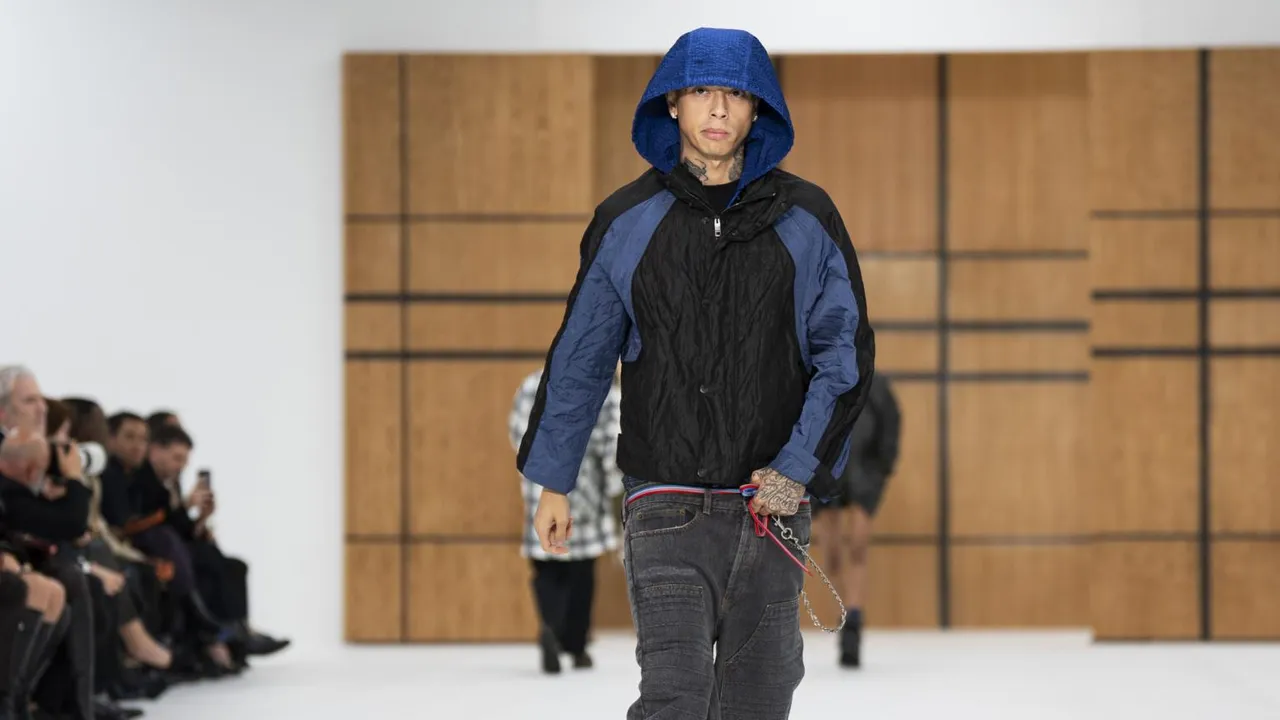
Burberry closed London Fashion Week on Monday evening, with the British fashion house's chief designer Daniel Lee pairing the brand's signature check print with clashing florals and soft leather.
The show was put together with the help of textile designer Celia Birtwell, who hand-painted some of the runway designs, including check-print trenches and smiley-face-emblazoned jumpers.
Rapper Central Cee made a surprise appearance on the catwalk, while Romeo Beckham, Skepta, Jonathan Bailey and Rosie Huntington-Whiteley were among those watching from the front row. Chiwetel Ejiofor and Jason Statham were also in attendance.
Burberry, which reported revenue growth for the first time in three years this summer, has long attracted some of the biggest names in British culture to its shows.
This season's London Fashion Week was marked by notable returns. Alexander McQueen moved its runway back to London after 25 years of showing in Paris. Creative director Seán McGirr brought the brand back to its roots with a collection featuring devil horns, lace corsets and chainmail skull dresses.
Laura Weir, CEO of the British Fashion Council, described the McQueen homecoming as "quite a big deal for us."
Mulberry also returned to the London schedule after a nine-year absence. Christopher Kane's debut collection for the brand centred on the Mulberry Bayswater bag, with a strong emphasis on leather coats, skirts and loafers.
Weir said the "big mission" for her team this season was to "re-platform London Fashion Week as not only a home for British design, but an engine for creativity and commercial growth."
Among the key trends identified at this year's event was what analysts are calling the "messy girl" aesthetic. Elektra Kotsoni, deputy director for Vogue Business and Vogue Runway, described it as the dominant trend of the season.
"The number one trend for this season is messy girl," Kotsoni said. "We're going to be having a messy girl summer." She described it as "a reaction to the clean girl and quiet luxury aesthetics that took over our Instagram feeds" in the previous year.
Kotsoni said the trend reflects a broader mood. "The world is quite messy," she said, adding that this form of dressing is a sign of "resilience" and rebellion. Designers including Chopova Lowena, Sinead Gorey and Conner Ives were cited as examples of the aesthetic on the runway.
A second emerging trend was "gardening-core," with designers such as Erdem, Yuhan Wang and Bora Aksu incorporating allotment-inspired details, parkas and structured outerwear into their collections.
Beyond the runway, the British Fashion Council used this year's event to push a broader agenda: expanding the fashion industry's reach beyond London.
The council's Fashion Britain initiative has been working with London Fashion Week on a series of pop-up events across England, Wales and Scotland, with the aim of showing the event was "bigger than London." Northern Ireland was not included this year but will be added to the initiative next year, the council said.
A recent House of Commons report found that more than half of the creative industries' economic output — 51 percent — was generated in London in 2022, though it also noted "clusters of creative industries" in cities including Manchester and Leeds.
Scottish designer Charles Jeffrey, founder and creative director of fashion label Loverboy, supported the Fashion Britain initiative this year. He argued that strong fashion education exists outside the capital.
"A lot of people think in order to make it big, you have to come to this big city because it has the schools here," Jeffrey said. "But actually, there is so much amazing education that happens in different places."
Jeffrey also pointed to the changing economics of working in London. "Now a lot of them have gone and what made London a capital city for fashion has been taken away, so you're probably better getting your fabrics from a little fabric shop in Manchester — it's probably ten times cheaper," he said.
Birmingham City University graduate Imarnie Bennett, 22, travelled to London to showcase her work at Somerset House as part of the event. She acknowledged the challenge of being based outside the capital but said attitudes were shifting.
"You hear Birmingham and it's a bit like, 'will they get us the same opportunities as London?', but I feel like Birmingham is becoming more noticed for what we do," she said.
British designer Priya Ahluwalia, who showcased her archive at Westfield Stratford City shopping centre during Fashion Week, said the concentration of opportunity in London remains a genuine problem.
"I do think there is a genuine issue with London being seen as the centre of the universe in terms of fashion," she said. "There is incredible talent from all over the UK, some of the best designers have come from the north, come from Wales, Scotland."
Ahluwalia added that decentralisation alone would not be enough. "Whether we decentralise or not, London is still going to be the centre of UK fashion. There needs to also be support for people to be able to travel to London, show up in London," she said.