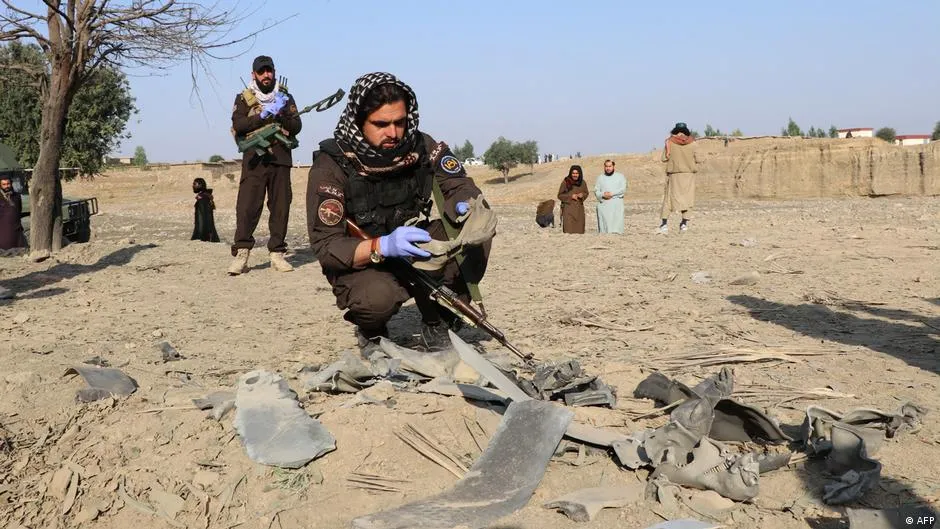
Pakistan launched airstrikes on targets inside Afghanistan on Thursday night, in the latest escalation of a conflict between the two countries that reignited in mid-September after months of relative calm.
The Taliban, which controls Afghanistan, said between nine and ten civilians were killed in the strikes, including women and children. Pakistan disputes this, claiming the attack killed 22 militants and destroyed weapons and ammunition depots.
The renewed hostilities were triggered by a series of attacks on Pakistani security forces. On September 18, a strike on a police compound in the northwestern city of Kohat, in Khyber Pakhtunkhwa province, killed 31 people and injured more than 100. A splinter group of the Pakistani Taliban, known as Tehreek-e-Taliban Pakistan, or TTP, claimed responsibility.
Pakistan accused Afghanistan of providing the TTP with a safe haven. Afghanistan denied the allegation, but clashes along the border and Pakistani airstrikes followed.
The TTP is not the same organization as Afghanistan's Taliban, though the two share close ideological and personnel ties. The TTP is an independent group that fights the Pakistani state. Many of its fighters supported the Afghan Taliban during the long insurgency against international and US-led forces, and after the Taliban returned to power in 2021, the TTP gained greater room to operate and increased leverage.
Pakistan has pressed the Taliban to take action against the TTP, but the deep personal connections between the two movements make this difficult. "Because of these personal connections and networks, it is extremely difficult for the Afghan Taliban to break away," said Conrad Schetter, director of the Bonn International Center for Conflict Studies.
Analysts caution, however, that shared history does not translate into direct control. Thomas Ruttig, co-director of the Afghanistan Analysts Network, a think tank operating between Kabul and Berlin, said the Taliban has no intention of taking direction from Islamabad. "The Taliban are simply not prepared to take orders from Islamabad," Ruttig said. "They won't let anyone outside interfere."
This dynamic has undermined Pakistan's long-standing policy of supporting the Taliban as a means of gaining influence in Afghanistan.
The current tensions are also shaped by a much older dispute over the Durand Line, a border drawn in 1893 by a British diplomat and an Afghan emir to define spheres of influence between British India and Afghanistan. The modern border between Pakistan and Afghanistan follows this line and cuts through territory historically inhabited by Pashtuns, the largest ethnic group in Afghanistan and the second largest in Pakistan.
The border dispute is therefore not purely territorial. "Ethnic and nationalist elements play a significant role in the conflict," Schetter said. Many Pashtuns continue to reject the legitimacy of the Durand Line.
Pakistan's broader rivalry with India adds another layer of complexity. A stable, friendly Afghanistan had long been seen as strategically valuable to Islamabad. That calculation has shifted. India has strengthened its own ties with the Taliban, and according to an analysis by the British think tank Chatham House, "while Islamabad once viewed Afghanistan as a source of 'strategic depth' in its rivalry with India, it now increasingly views its north-western neighbor as a liability."
Despite the deteriorating relationship, Pakistan retains significant economic leverage over Afghanistan. As a landlocked country, Afghanistan depends heavily on trade routes through Pakistan. Islamabad has used border closures and trade restrictions as tools of pressure, even as the Taliban seeks to reduce its economic dependence on its neighbor.