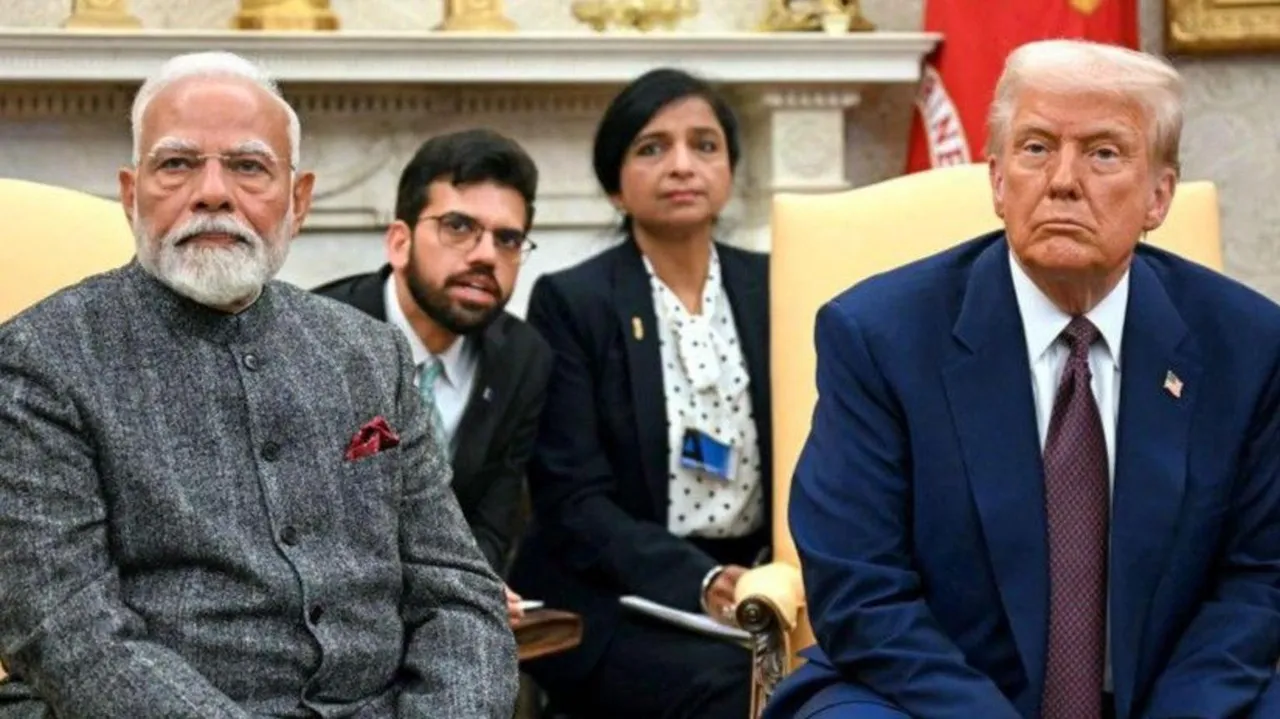
India has warned the United States that new measures to levy tariffs on buyers of Russian oil could damage bilateral relations, hours after the US Congress approved legislation giving President Donald Trump broad powers to impose economic penalties on countries that purchase Russian energy.
The US House of Representatives passed the bill on Wednesday. It now goes to Trump to be signed into law.
The legislation targets Russia's energy and defence sectors, President Vladimir Putin and other senior officials, and Moscow's so-called shadow fleet of tankers used to circumvent Western sanctions. It also authorises Trump to impose tariffs of up to 100 percent on countries that continue buying Russian oil and gas, and extends sanctions on Iran.
India's foreign ministry said on Thursday that New Delhi "remains firmly committed to ensuring energy security for its 1.4 billion people." It noted the bill's passage and said the issue had been raised with various US interlocutors in recent months.
"Its potential implications for not just the bilateral relationship but also the international energy market have been very clearly articulated by the Indian side," the ministry said in a statement.
"The Indian side has also made clear its determination to take all necessary measures to protect its trade and economic interests," it added. The government said it would work closely with trade and industry bodies to address the legislation's implications.
India, the world's third-largest oil importer, has been one of the biggest buyers of Russian crude since Moscow's full-scale invasion of Ukraine in February 2022. Russian crude, displaced from Western markets following the invasion, flowed to Indian refineries, often at significant discounts.
Russia supplied 30.3 percent of India's crude imports in fiscal 2026, worth $40.8 billion out of a total crude import bill of $134.7 billion, according to the Global Trade Research Initiative, a Delhi-based think tank. In July, Russian crude accounted for more than half of India's total oil imports. By comparison, the UAE accounted for 10.8 percent of India's July imports, Saudi Arabia 9.6 percent, Venezuela 6.3 percent, Brazil 5.5 percent, Oman 5.3 percent and the US 2.9 percent.
Between December 2022 and August 2026, China accounted for half of Russia's crude exports, followed by India at 37 percent, with Turkey and the EU each at 5 percent, according to the Centre for Research on Energy and Clean Air.
New Delhi has repeatedly resisted pressure to reduce its oil trade with Russia, arguing that its large population and economy require secure, affordable and reliable energy supplies.
"India buys Russian oil to secure affordable energy for 1.4 billion people, not to finance war, and these purchases have helped stabilise global supplies and prices," said Ajay Srivastava, a former Indian trade official who runs the Global Trade Research Initiative. He described the bill as "a blunt and dangerous attempt to pressurise India to sign the bilateral trade agreement on one-sided terms."
Under the legislation, countries would normally have 180 days to cut Russian energy imports or negotiate with Washington, though the president can shorten that deadline.
"China and India, you better buy your oil and gas somewhere else," Democratic Senator Richard Blumenthal told reporters after the bill's passage.
Analysts warn that replacing Russian crude at scale would carry significant costs. According to S&P Global, alternative supplies can mean higher crude, freight and insurance costs, while longer shipping routes add further burden.
"The issue is not simply whether Russian barrels can be redirected to other buyers, but whether enough alternative crude is available to replace them without tightening the global market further," said Sumit Ritolia, an analyst at maritime intelligence firm Kpler.
The tariff threat also extends beyond energy. The US imported approximately $104 billion worth of goods from India in 2025, with two-way US-India trade in goods and services totalling roughly $240 billion.
"This new bill could have major problematic impacts for India, and at the worst possible time, amid sensitive final-stage trade talks and shaky broader relations," said Michael Kugelman, a senior fellow at the Atlantic Council. "India has built some insulation to fend off the shocks of US tariffs through new trade deals with key markets in the EU and elsewhere, and through bolstering an already strong trade partnership with China. But 100% tariffs from a critical export destination is real bad news, no matter how you slice it and even with successful hedging tactics."