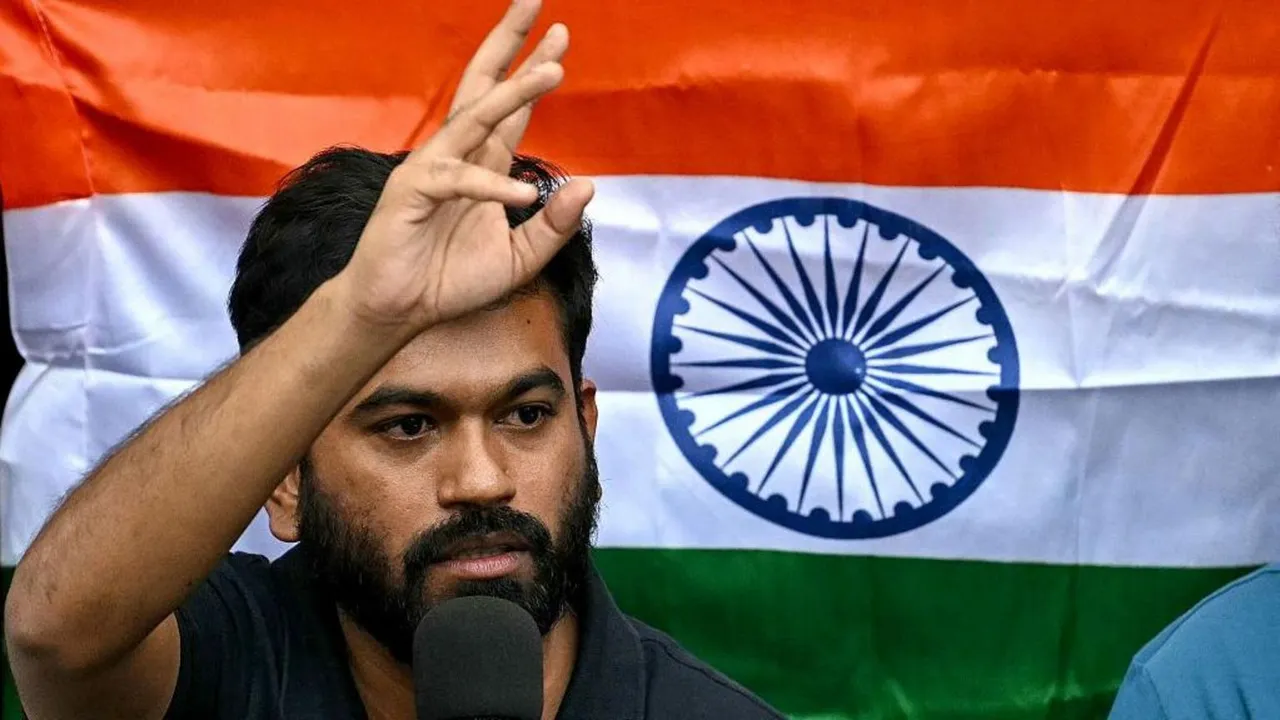
Indian police detained Abhijeet Dipke, the 31-year-old founder of the Cockroach Janta Party (CJP), ahead of a protest in central New Delhi on Friday demanding the resignation of the country's election chief.
Dipke was detained as he approached his car, with officers surrounding him and forcing him into a police vehicle. Some supporters attempted to stop the vehicle from leaving. The CJP said it had lost contact with him and accused police of taking him to an undisclosed location and denying him access to lawyers.
It was Dipke's second detention in less than a week. Last Saturday, police had boarded his plane shortly after it landed in Delhi to prevent him from reaching another demonstration. He was released the following day.
Hours before Friday's protest, police visited the house where Dipke was staying. In an exchange broadcast live on Instagram, he challenged officers who had come to caution him against holding the march, asking whether waving the Indian flag was against the law.
The CJP accuses India's Election Commission of manipulating voter lists to favour Prime Minister Narendra Modi's ruling Bharatiya Janata Party (BJP). Both deny the allegation.
The movement's two other main leaders, Saurav Das and Ashutosh Ranka, were detained last weekend and later released. On Wednesday, however, they were sent to jail for five days after returning to Jantar Mantar, a protest site near parliament that police had recently declared off-limits. Friday's march was partly intended to demand their release.
With Dipke's detention, all three of the movement's main leaders are once again in custody.
Hundreds of protesters gathered at Connaught Place, one of the capital's busiest commercial districts, waving Indian flags and shouting slogans. Police had sealed off Central Park, the planned site of the protest, and deployed thousands of police and paramilitary personnel to prevent the gathering.
Around 200 to 300 people initially assembled outside the closed park. Unable to enter, they walked around its perimeter. More protesters arrived as the evening progressed.
For much of the evening, police largely held back. But as darkness fell, officers began using force against some demonstrators. Several young protesters were pushed into a bus where women were already being held. Two people were reported injured during the police action. One protester fell to the ground and appeared to have hurt their leg.
Among those detained was Neha Bora, a prominent leader of the left-wing All India Students' Association, who had also been detained during last weekend's crackdown.
The police presence far outnumbered the protesters. Officers kept emerging from buses parked around the district, and journalists covering the event also crowded the streets.
Anish Gawande, an opposition politician who had been hosting Dipke, questioned the police action. "Detaining a lone man walking with the national flag in his hand is a bit of a joke," he said.
The CJP insisted the detentions would not halt the movement. "They may detain three people, but how will they stop 30 tomorrow? How will they stop 300 leaders?" CJP spokesperson Mehr Pasricha said.
Police have not publicly confirmed the grounds for Dipke's detention or responded to the CJP's latest allegations.
The CJP was founded barely five months ago, in May, after India's chief justice likened some unemployed young people to cockroaches. Dipke embraced the insult and turned it into a rallying cry. By July, the group had grown into a significant force, drawing thousands of young people into protests over leaked exam papers.
A march towards parliament in July descended into clashes with police, bringing the movement wider attention and intensifying pressure on the government. The unrest eventually forced the resignation of India's education minister.