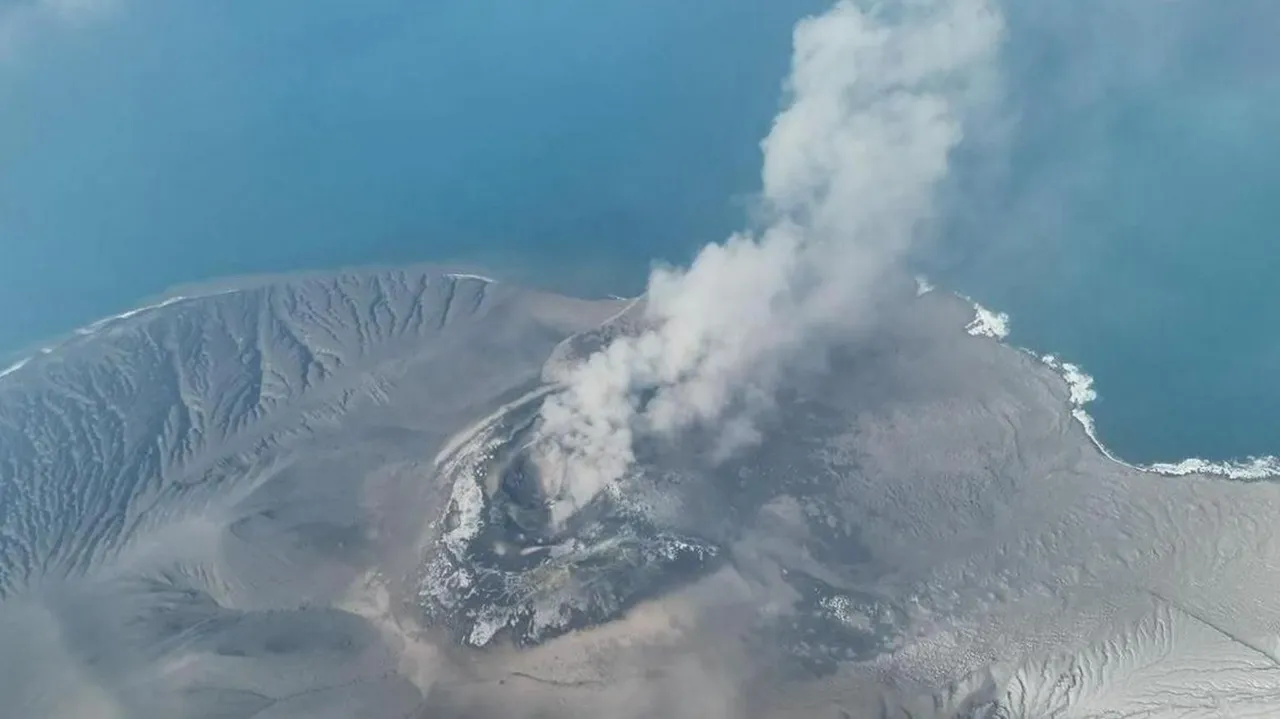
Volcanic ash from the erupting Mount Anak Krakatau has forced the suspension of hundreds of flights at Indonesia's main international airport, stranding tens of thousands of passengers.
Authorities said 209 flights were suspended after ash was detected in airspace near Jakarta's Soekarno-Hatta International Airport on Sunday morning. The suspension was extended until 13:30 local time (06:30 GMT).
The volcano, located in the Sunda Strait between the islands of Java and Sumatra, began erupting late on Friday night, producing continuous seismic activity, lava fountains, and booming sounds. According to Indonesia's meteorological agency BMKG, the sounds could be heard up to 700 kilometres (435 miles) away. Two further eruptions were recorded on Sunday.
Ash was detected as high as 6,000 metres (20,000 feet) on the Java side of the volcano, and a plume of up to 15,000 metres (50,000 feet) was recorded on the Sumatra side and in parts of Banten province in Java, BMKG reported.
An earlier suspension had been due to end at 5:30am local time, affecting 33 flights, including 16 international cancellations and seven delays. Director General of Civil Aviation Lukman F Laisa said the extended suspension followed a paper test conducted between 12:35am and 1:05am that confirmed the presence of volcanic ash at the airport.
"Safety remains the top priority in every operational decision, including flight schedule adjustments made by airlines," Lukman said, adding that authorities would continue monitoring the situation with airlines, air navigation services, and the meteorological agency.
More than 22,000 people were affected by the flight suspensions. The transport ministry said operations were mainly disrupted on routes to and from Singapore, as well as other international destinations including Doha, Sydney, and Kuala Lumpur. Singapore Airlines was among the carriers affected, cancelling two flights to and from Jakarta on Saturday and delaying two more into Sunday.
Authorities confirmed there is no tsunami warning linked to the current volcanic activity. Indonesia's disaster mitigation agency also said on Saturday that there was no imminent tsunami risk from the eruption.
The health minister urged residents in affected areas to stay indoors and wear face masks to protect against respiratory, eye, and skin risks. Several schools cancelled activities on Saturday after students and residents reported eye irritations from the ash, while some fishermen cancelled trips at sea, also reporting sore eyes.
One resident, Aldi Candra Prayogi, said he had been experiencing discomfort since Friday evening, describing the sensation as feeling like "small grains of sand had gotten into my eyes," and said he needed eye drops to ease the irritation. He added that ash fall was so heavy he had to sweep the front yard of his house every five minutes.
Anak Krakatau, whose name means Child of Krakatoa, emerged from the sea in the 1920s in the caldera formed by the catastrophic 1883 eruption of Krakatoa, one of the deadliest volcanic events in recorded history. The volcano has erupted periodically since, including a 2018 eruption that triggered a partial collapse of its crater and a tsunami that killed more than 400 people along the coasts of Java and Sumatra. Scientists found that some of the rock chunks that slid from the volcano during that collapse were approximately 70 to 90 metres high.
Volcanic ash poses a serious hazard to aircraft, capable of damaging jet engines and reducing visibility.
Indonesia sits on the Pacific Ring of Fire, a zone of frequent earthquakes and volcanic eruptions that encircles virtually the entire Pacific rim.