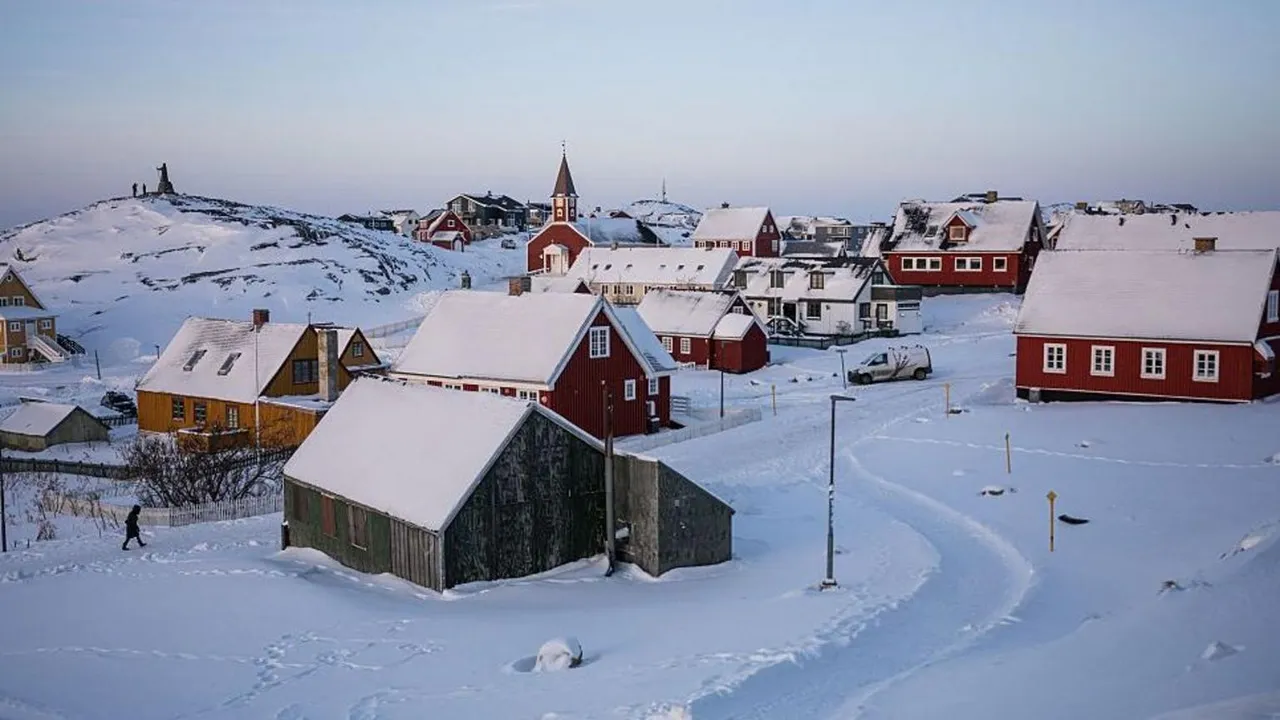
The United States, Denmark and Greenland have signed a defence agreement permitting Washington to establish two new military bases in the Arctic territory, while reaffirming Danish sovereignty over it.
The deal was signed at a ceremony on the sidelines of the UN General Assembly in New York. It amends and updates a 1951 defence agreement between Denmark and the United States.
US President Donald Trump said at the signing: "We are going to have a tremendous relationship, a secure relationship. This is tremendous for Europe and for the United States, for everybody, and for Greenland it's going to be incredible."
Trump also said the US would "immediately begin the process of developing a large military presence in the appropriate locations" and claimed last week that the deal came with "no cost to the United States."
Danish Prime Minister Mette Frederiksen called the agreement "a milestone in our long-standing co-operation" and said it was "good for the US, Denmark and Greenland" and also for Europe and NATO.
"Seventy-five years ago we entered into an agreement about the defence of Greenland. Today, we're signing an even bigger and better agreement - a deal that can last forever," Frederiksen said.
She stressed that the agreement "respects sovereignty and territorial integrity of the Kingdom of Denmark, as well as Greenland's right to self-determination."
Greenland's Prime Minister Jens-Frederik Nielsen described the deal as a "win-win-win" and said it was "not only an agreement about us, it is an agreement with us."
"It takes into account the people of Greenland, our rights, our livelihoods and the development of our country," Nielsen said, adding that Greenland "matters for North American security and for transatlantic security."
The new agreement authorises the US to establish additional defence areas at Narsarsuaq, in southern Greenland, and Mestersvig, on the east coast. The "modalities and technical details" of the bases are yet to be confirmed and must be mutually agreed by all parties.
Narsarsuaq has deep-water access and a large runway. US military engineers were surveying the site last week, according to reports. The location was previously home to a Cold War-era US military base, known as Bluie West One, which closed in 1958.
Mestersvig is a remote and far less developed outpost currently used by a Danish naval dog sled unit, also known as the Sirius Dog Sled Patrol.
Washington currently operates Pituffik Space Base in north-western Greenland, where more than 100 US military personnel are permanently stationed. The new deal also allows the US to "modernise and expand its activities" there.
The agreement further stipulates that no non-NATO state shall be permitted to establish military installations in Greenland or maintain a persistent military presence there. It also confirmed that Greenland would remain within NATO if it were to gain independence from Denmark.
The deal seemingly brings to a close more than a year of tension over the Arctic territory. Trump had repeatedly threatened to "take" Greenland, citing national security concerns, its strategic location and its vast reserves of rare earth minerals — many of which are crucial for technologies including mobile phones and electric vehicles.
His rhetoric prompted outcry from Greenlanders, Danes and European leaders, who issued a joint statement warning that his words "undermine transatlantic relations and risk a dangerous downward spiral." Polls indicated that a majority of Greenlanders rejected US control of the territory.
Tensions peaked in January when European NATO members began deploying additional troops to the island to demonstrate military readiness. Following talks with NATO Secretary General Mark Rutte, Trump said he would not pursue an invasion and would instead work toward a negotiated agreement. He also withdrew a threat to impose 10 percent trade tariffs on eight European nations that had objected to US attempts to acquire Greenland.
Trump had also argued that Greenland was an essential component of his proposed "Golden Dome" missile defence system. The signed agreement mentions the project only once and contains no concrete proposal related to it.
A NATO spokesperson welcomed the deal shortly after signing, saying it would "help advance security, stability and cooperation in this vital region."