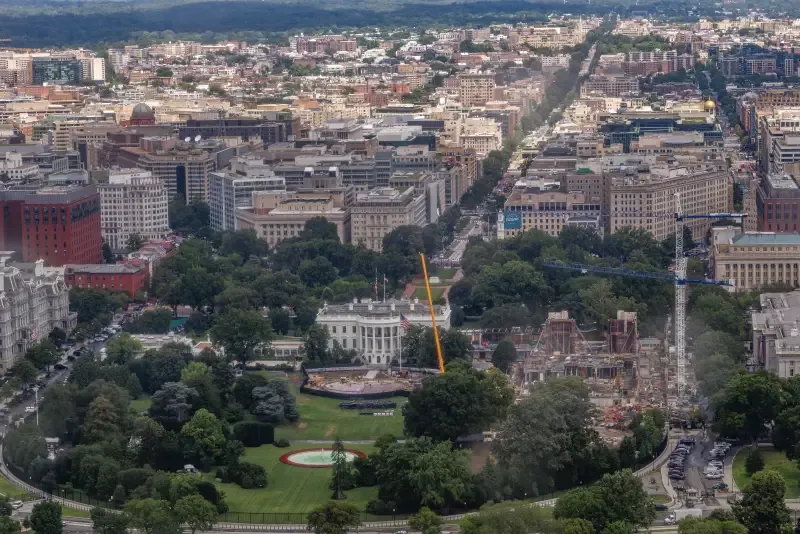
A US federal appeals court has ordered the Trump administration to halt above-ground construction of President Donald Trump's $400m (£297m) ballroom at the White House, setting up a potential Supreme Court showdown.
The three-judge panel ruled 2-1 on Friday to uphold a preliminary injunction obtained by the National Trust for Historic Preservation, which sued after the administration demolished the East Wing last year to begin the project without congressional approval.
"Whether or not a massive ballroom should be constructed is for Congress to decide and is not a matter for Executive self-help," the panel's majority said.
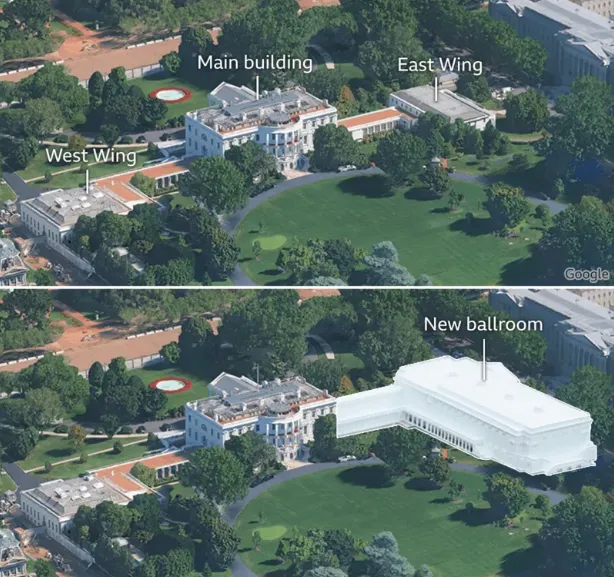
"Congress has not ceded unfettered authority to the Executive Branch to dramatically redesign, reshape, and reconstruct the White House — the People's House — to fit a particular President's desires," the panel said.
The judges also said: "Each President is a temporary tenant, not the owner, of the White House and its Executive Residence."
"The President has no - and claims no - constitutionally assigned authority over that property, which is designed and maintained for the use of all Presidents, current and future, and for the American people," the opinion said.
The administration had appealed after a federal judge twice blocked above-ground construction on the ballroom while allowing underground work to continue. Friday's ruling maintains the ban on above-ground construction without congressional approval.
The appeals court delayed implementation of its ruling for 14 days to allow the Trump administration to appeal to the Supreme Court.
Trump criticised the "horrendous" and "politically motivated" decision on social media, citing the dissenting judge's description of the order as "a blatant abuse of discretion".
He said the military and Secret Service viewed the ruling as a national security threat.
"This unjust decision must be overturned by the Supreme Court in its entirety," he wrote.
Trump also repeated that the ballroom was being built ahead of schedule and under budget as a gift to the American people, funded by a coalition of private donors.
Republicans have sought to use a portion of $1bn (£740m) in taxpayer funds for Secret Service security upgrades, although a budget watchdog rejected the plan in May.
Trump has said the new ballroom is needed to "accommodate people for grand parties, State Visits" and has described it as "vital for National Security".
The project would include a large above-ground entertaining space and a security complex below ground. Trump has cited security concerns following an assassination attempt at the White House Correspondents' Association dinner in April.
The National Trust for Historic Preservation welcomed Friday's ruling, saying that no above-ground construction can take place "unless and until" Congress takes action.
"The White House, a global landmark that symbolizes American identity and the ideals of democracy, belongs to the American people," said Brent Leggs, President and CEO of the National Trust.
"The National Trust for Historic Preservation and its partners are proud to defend this irreplaceable monument on behalf of all Americans."
Trump has promoted the ballroom project since unveiling plans for it in July 2025. It would represent the most substantial structural change to the presidential residence in more than 70 years.
The project has faced legal challenges since October, when the Trump administration demolished the East Wing, which was built in 1902, to begin construction. Trump had initially said the project would be "near" the East Wing rather than involve its demolition.
Government lawyers have argued that the additional security complex and other features are necessary to protect the White House complex from drones, ballistic missiles, biohazards and other threats. Trump said on Friday that the project includes bomb shelters, hospital and medical facilities, and top secret military facilities.
The National Trust has argued there is no basis to "disturb" the White House and that having a ballroom does not constitute a national security emergency.
The appeals court said its ruling "has nothing at all to do with whether the proposed ballroom is desirable", and does not determine whether the administration may ultimately construct it.
"What it does mean is that the Defendants may not do so during the district court's expeditious litigation without securing Congress's authorization, as the Constitution and laws require," the order said.