Chinese President Xi Jinping arrived at Joint Base Andrews in Washington on Wednesday evening for a highly anticipated state visit, the first of its kind in years.
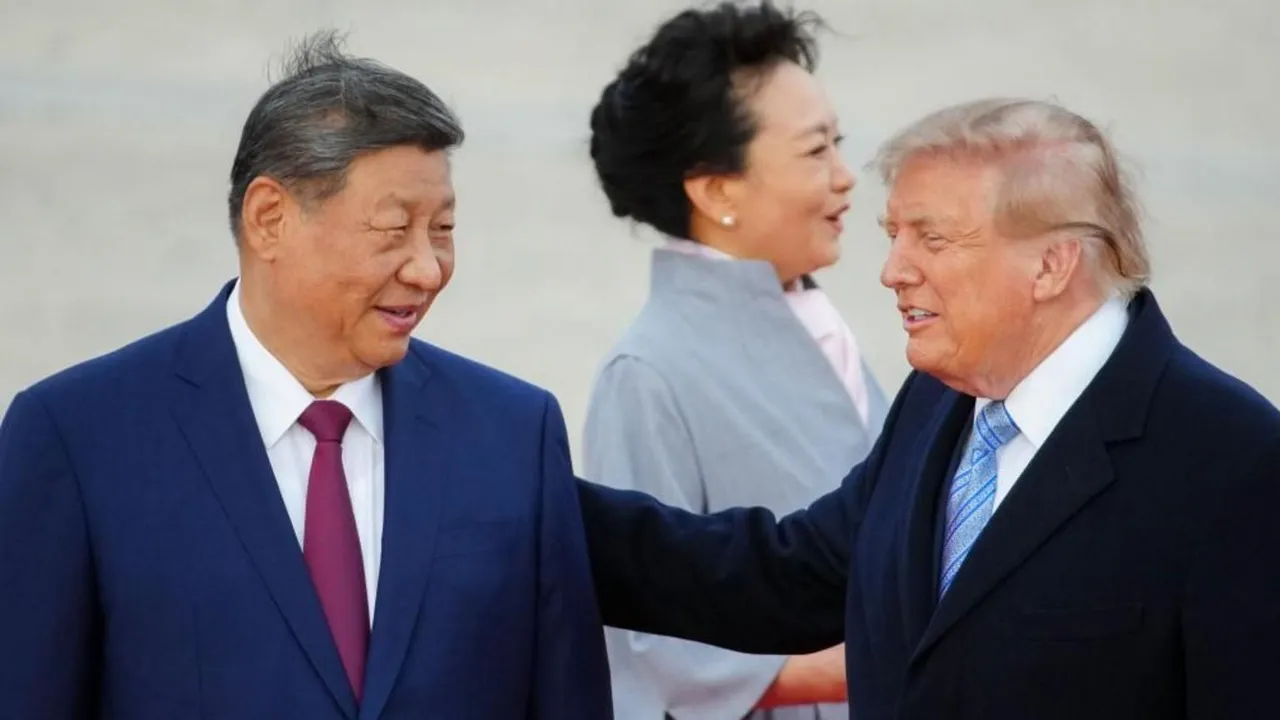
Xi's Air China plane touched down at 17:39 local time. A colour and honour guard marched to the aircraft and stood on both sides of a red carpet as two limousines pulled up. Xi and his wife Peng Liyuan exited the plane and were greeted by President Donald Trump and First Lady Melania Trump. The two couples shook hands, spoke briefly, then walked side by side down the red carpet and posed for photographs.
Two B-1 supersonic bombers flew overhead as the Army Air Force Band played the US national anthem. The B-1 is considered a key component of the US combat arsenal. After exchanging pleasantries, the two couples departed in separate vehicles toward Washington.
It is the first time since 1962 that a US president has personally welcomed a foreign leader at Joint Base Andrews, a gesture widely seen as underscoring the significance Trump is placing on the visit. In 1962, President John F. Kennedy greeted British Prime Minister Harold Macmillan at the base.
Melania Trump said she was closely involved in planning the itinerary. She told a television network that Trump decided to personally greet Xi at the airport "because they have a great relationship."
Xi is accompanied by senior Chinese officials, including Cai Qi, a member of the Politburo Standing Committee widely regarded as Xi's right-hand man, Vice Premier He Lifeng, and Foreign Minister Wang Yi, along with other delegates and ambassadors.
In a written statement published by China's state news agency Xinhua, Xi said both China and the United States are "great nations, and their people are great people." He added: "The two countries should be partners rather than rivals."
Xi also said: "Realising the great rejuvenation of the Chinese nation and making America great again can fully coexist, reinforce each other and benefit the world," expressing confidence that the visit would "yield fruitful results."
Also on Wednesday, US Treasury Secretary Scott Bessent announced that the United States and China will extend their existing trade truce to January. The agreement, under which Trump lowered tariff rates on some goods in exchange for Xi loosening restrictions on rare earth minerals, had been set to expire on November 10.
Bessent spoke after meeting Chinese Vice Premier He Lifeng and said the two sides discussed whether a more substantive trade deal between the two countries could eventually be reached.
Trump is expected to pursue further trade objectives during the visit, including lowering Chinese tariffs on American products, increasing imports of Chinese rare earth minerals, and expanding exports of US agricultural products. However, according to analysts, China appears to have fallen short of earlier promises to buy more American agricultural products and to sell more rare earth minerals to the US.
Analysts also expect Xi to encourage Trump to stall or abandon a congressionally approved $14 billion arms sale to Taiwan and to deepen US-China trade integration.
One analyst described the current state of the relationship as having "a greater degree of, let's say, stability within the relationship, or less volatility relative to where we were last year."
Artificial intelligence is also expected to feature prominently. Leaders of US AI companies are scheduled to attend a state dinner on Thursday. Trump has previously dismissed warnings about the potential dangers of AI as a "hoax," and both countries are engaged in an intensifying race for dominance in the sector.
It remains unclear whether Xi has brought Chinese business executives with him. During Trump's visit to Beijing in May, he was accompanied by senior figures from major US technology firms.
Xi's visit is scheduled to conclude on Friday.
The visit comes as American public attitudes toward China appear to be shifting. A recent poll by the Chicago Council on Global Affairs found that 41 percent of Americans view China's territorial ambitions as a threat to the United States, down from 52 percent in 2022. More than half of Americans — 57 percent — said the US should cooperate and engage with Beijing, a view shared across party lines. However, 63 percent of Trump's core political base favoured limiting US relations with China.