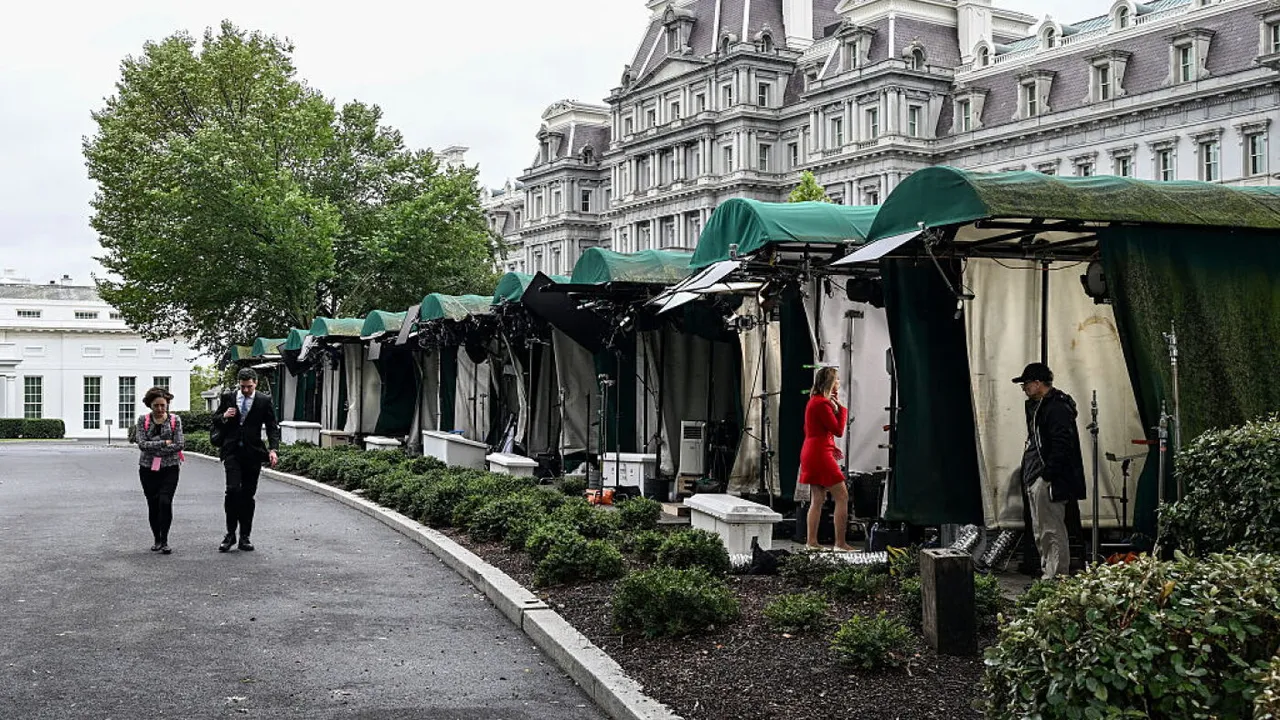
A federal judge has ordered the Trump administration to temporarily restore press credentials to three media organizations banned from covering White House events, ruling the ban was likely unconstitutional.
U.S. District Judge Timothy Kelly for the District of Columbia issued a 14-day temporary restraining order shortly after midnight on Thursday, directing White House officials to "immediately return, reinstate, and restore" hard passes to journalists from CNN, MSNBC and Politico.
The three outlets had their press credentials revoked on September 18. They filed a joint lawsuit on Monday, arguing the ban violated their constitutional rights, and sought a temporary restraining order to allow their reporters to continue covering the White House while the case proceeds.
Kelly, who was nominated by Trump in 2017 and ordered a CNN journalist's access restored in a similar case in 2018, wrote that the news outlets were "likely to succeed in showing that their hard passes were revoked without constitutionally adequate due process." He cited the principle that "individuals must receive notice and an opportunity to be heard before the Government deprives them" of a constitutionally protected interest.
The judge rejected the government's national security justification for the ban. "The record lacks factual support for defendants' contention that the revocation of plaintiffs' hard passes will in fact protect national security or that national security will be endangered if the court orders their passes reinstated while this litigation proceeds," Kelly wrote.
He noted that Trump himself had initially cited only an "alleged lack of truthfulness and negativity" in the outlets' reporting as the reason for the ban. Trump told reporters on Friday that the decision had not been sparked by any specific story but by the accumulation of what he called "two years of unfair and negative coverage."
The Department of Justice, however, argued in court filings that the three organizations were barred because their reporting jeopardized national security and spread falsehoods. White House letters dated September 22, included in the DOJ's filing, accused the outlets of "trafficking in verifiable falsehoods about national security and other issues, and publishing sensitive or classified information." The letters cited stories on topics including construction of a "top secret" bunker under the White House ballroom, talks with Iran, and reported tensions at the recent Republican convention in Dallas.
Kelly was skeptical of that rationale. He wrote that the court was "skeptical — at least on this record — that Defendants' interest in safeguarding national security is the actual motivation for, or is even advanced by, the revocation of Plaintiffs' hard passes." He also noted that the judge found no evidence explaining how any of the identified reporting had damaged national security, and pointed out that the reporters who authored the cited stories did not even hold hard passes.
The judge further found that "the record is bereft of any relevant 'formally articulated standards' in place before any of the conduct" for which the credentials were revoked, dismissing the examples cited by the White House as a standard "so vague it hardly does the trick."
At the emergency hearing on Wednesday, Theodore Boutrous Jr., the attorney representing the three outlets, argued the ban violated their First Amendment rights and amounted to retaliation for their coverage of the president, calling it "probably the clearest case in history" of viewpoint discrimination. He also challenged the late emergence of the national security argument, saying: "I guess the light bulb went off and they all decided 'Start talking about national security.'"
Justice Department lawyer Michael Velchik countered that access to the White House was a "privilege," not a right, and cited national security concerns as justification for maintaining the ban.
Following the ruling, Boutrous said in a statement: "This is a strong ruling vindicating freedom of the press, due process and the rule of law. We greatly appreciate the court's swift action."
The ban had prompted other media organizations to suspend pooled coverage of Trump events in a show of solidarity with the affected outlets.