President Donald Trump has announced plans to convert his proposed triumphal arch in Washington, D.C., into a military complex, citing national security as the reason for the change.
Trump made the announcement on his Truth Social platform on Sunday, saying the decision was made "at the strong request of the United States Military, and for National Security purposes."
"At the strong request of the United States Military, and for National Security purposes, I have agreed to convert the magnificent Triumphal Arch... into a top grade Military Complex/Triumphal Arch," Trump wrote.
The arch would "house, store, and have the rapid ability to use large numbers of drones, plus Snipers, on both the roof and plaza areas, and additionally have and hold large quantities of sniper ammunition in storage," Trump said. "There will be no facility like this anywhere in the World."
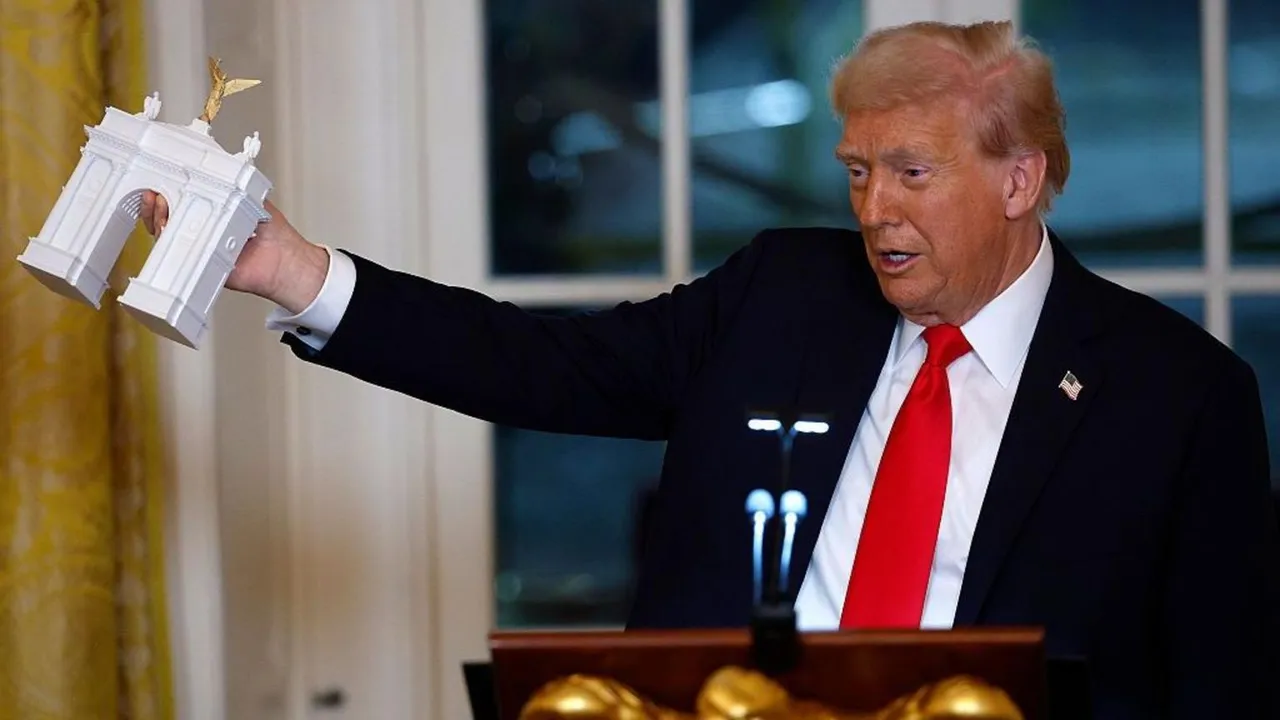
Trump first proposed the monumental arch last year to mark 250 years of U.S. independence. He described it as similar to the Arc de Triomphe in Paris, but "the biggest one of all." The structure was previously planned to stand 76 metres (250 feet) tall, which would make it roughly twice the height of the Lincoln Memorial. By law, new construction in Washington is generally subject to height restrictions.
Trump did not provide details on any changes to the design following the new military designation. The Trump-appointed U.S. Commission of Fine Arts approved a design in April featuring golden lions at the base, golden eagles, and a winged angel atop a baroque arch. The Federal Aviation Administration said last week the structure would not pose a hazard to the nearby Reagan Washington National Airport, but would require a warning beacon on top.
The project has faced sustained opposition since it was first proposed. More than 100,000 people submitted comments to the National Park Service as part of its review. Critics have raised concerns about the arch's size, its location between Arlington National Cemetery and the Lincoln Memorial, and the potential obstruction of views between the two landmarks.
In February, a group of Vietnam War veterans and an architectural historian filed a lawsuit against the plan. The plaintiffs argued the arch would desecrate the grounds of Arlington National Cemetery and that the president lacks the authority to build it without approval from Congress. In a court filing, the veterans described the view between the cemetery and the Lincoln Memorial as "carefully designed to symbolise the unification of the country after the Civil War and the strength of a united nation."
U.S. District Court Judge Tanya Chutkan ordered the government to provide 48 hours' notice before moving forward with any activity on Memorial Circle. The order came one day after Interior Secretary Doug Burgum wrote on X that the administration planned to break ground on the arch within two weeks, despite still awaiting final approval from the National Capital Planning Commission and other federal reviews.
The triumphal arch is one of several Trump projects in the capital facing public opposition. On Saturday, thousands of people rallied near the Kennedy Center for the Performing Arts, and some protesters formed a human chain around the building. Trump has threatened to demolish the venue if he is not allowed to add his name to it, saying that is the only way to ensure it receives sufficient funding.
Trump is also overseeing a $400 million project at the White House, where the East Wing was demolished to make way for an 8,400-square-metre ballroom with an underground bunker. Historic preservation groups filed a lawsuit to halt that project, but the U.S. Supreme Court last month allowed construction to continue. Trump has also described that project as a military complex and justified it on national security grounds.