President Donald Trump has signalled a willingness to work with Democrats after his Republican Party lost control of both chambers of Congress in the US midterm elections, while also making clear he retains the power to veto any legislation he opposes.
Speaking in a phone interview late Tuesday night, as midterm results confirmed a Democratic wave, Trump offered a cautious olive branch. "They've already called, and they want to work with me. I have the right to veto everything, but I don't want to be just sitting there for two years just vetoing everything," he said.
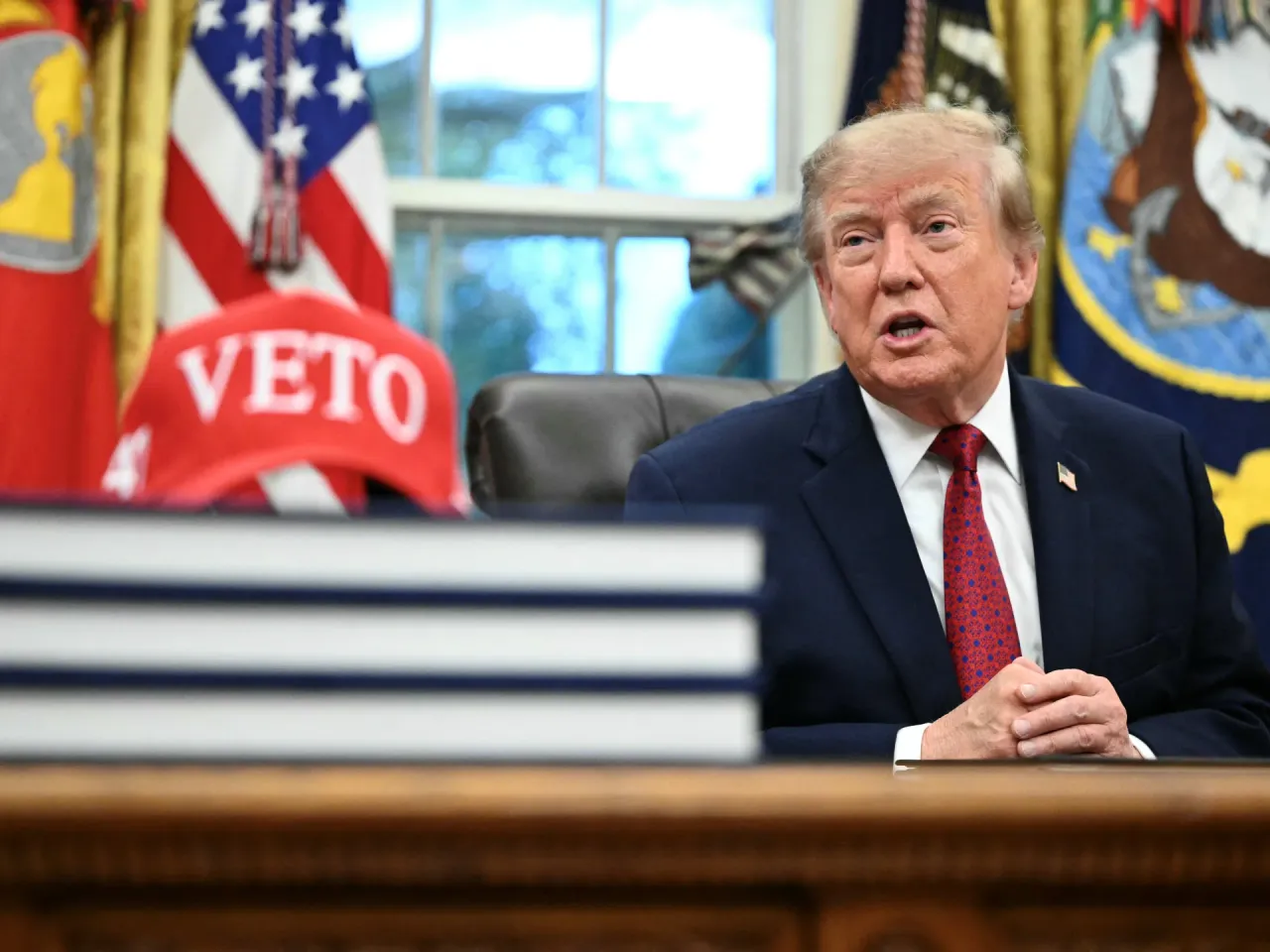
Shortly after, Trump posted an image on his Truth Social account depicting his signature red Make America Great Again cap rearranged to spell "VETO".
Democrats secured comfortable majorities in both chambers. In the House of Representatives, they won at least 253 of 435 seats. In the Senate, they took at least 54 of 100 seats, with a handful of races still to be called.
Despite the scale of the Democratic victory, Trump retains significant constitutional authority. Under Article 1, Section 7 of the US Constitution, the president may reject any legislation passed by Congress. Congress can override a veto, but only with a two-thirds majority — a threshold Democrats do not meet in either chamber.
Andrew Proctor, a lecturer in US politics at University College London, said the most likely outcome is prolonged gridlock. "The Democrats are going to try to pass policies, but he's got the power to veto them, and Democrats don't have enough seats in either chamber to overcome any vetoes that he has," Proctor said. "So that raises questions about, will he try to work with the Democrats at all on passing legislation? I think recent history says that's unlikely."
Since his inauguration in January 2025, Trump has signed 292 executive orders — 225 last year and 67 this year, according to the Federal Register. Proctor noted that with Congress now in Democratic hands, Trump has even less legislative leverage than before.
Some Democrats have nonetheless indicated a readiness to engage with the president on specific issues. Michigan Senator Abdul El-Sayed, the first Muslim elected to the US Senate, said he was open to cooperation despite Trump having used racist and Islamophobic rhetoric against him during the campaign.
"He is the president of the United States," El-Sayed said. "I'm going to be one United States senator, and if he's interested in working on issues that I want to work on — getting more people healthcare, ending the Medicare cuts, ending the stupid war, stopping these stupid tariffs with Canada — then let's talk about doing that and go and deliver for the public."
El-Sayed added that if Trump was interested in "getting money out of politics, putting money in pockets and passing Medicare for All, that's what I ran to do, and I'm looking forward to working with anyone who is willing to do that."
Progressive Senator Bernie Sanders has also said in recent interviews that he would not rule out Trump signing a Medicare for All bill if Democrats passed it through both chambers. Sanders described Trump as a "politician" who was not "too ideological".
Proctor was more cautious, saying that while Trump might pursue deals that reflected well on him personally, passing Medicare for All within two years appeared unlikely. He suggested a more realistic area of common ground could be healthcare affordability. "I do think that a place where common ground could emerge on healthcare is rolling back, specifically the sort of subsidies that were cut," he said. "So that would make healthcare more affordable for millions of Americans."
Senator Kirsten Gillibrand of New York also struck a combative tone, challenging Trump to reject bipartisan legislation aimed at restoring Medicaid coverage. "I dare him to veto that," she said.
Gillibrand said Democrats would prioritise lowering costs, restoring healthcare access and ending the war in Iran. She also raised the possibility of a third impeachment of Trump, though she did not commit to pursuing it. "We can do both," she said, proposing a ban on stock trading by members of Congress and senior administration officials.
The war in Iran emerged as a recurring theme among Democratic lawmakers. Gillibrand cited the conflict as a key factor in the party's election victories, arguing that Trump had broken his promise to avoid prolonged wars and that the conflict had driven up costs for ordinary Americans. "We have to end this war in Iran," she said.
Trump acknowledged on Wednesday that the war had contributed to Republican losses. The conflict continues, however, with Iranian officials warning against renewed US attacks. How Democrats plan to bring the war to an end remains unclear.