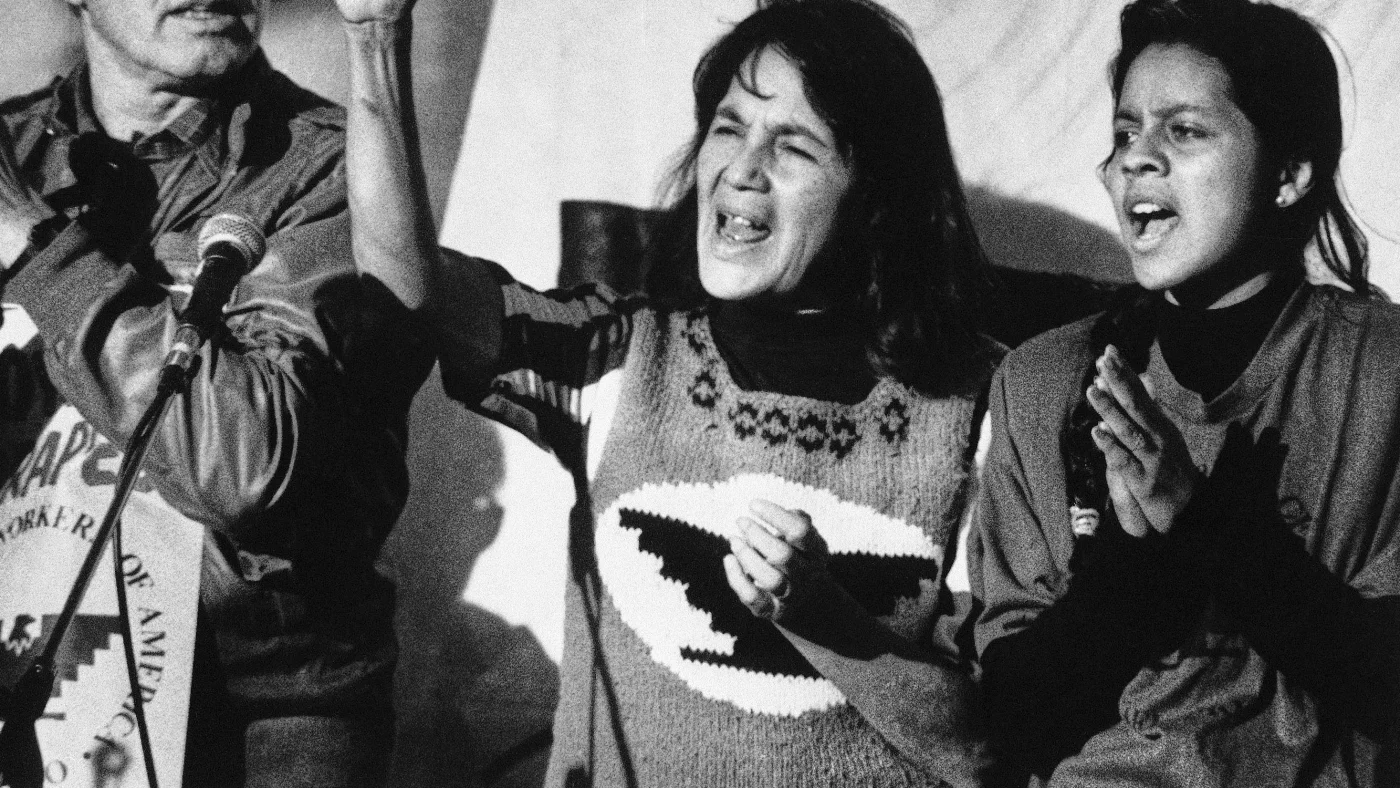
Dolores Huerta, co-founder of the United Farm Workers union and one of the most influential labour and civil rights figures in American history, has died at the age of 96. Her family announced her death in a statement through her foundation.
Huerta died on Wednesday at home in Bakersfield, California.
She co-founded the United Farm Workers union alongside César Chavez to improve working conditions in the nation's fruit and vegetable fields. She is also credited with coining the phrase "Sí, se puede!" — meaning "Yes, it can be done" — a rallying cry that became widely used across social and political movements.
When then-President Barack Obama presented Huerta with the Presidential Medal of Freedom in 2012, the nation's highest civilian honour, he praised her as a tenacious leader and joked that he had borrowed her slogan for his 2008 presidential campaign.
Huerta kept a busy schedule well into her 90s, marching in protests and speaking in cities across the country on behalf of her Bakersfield-based foundation. She continued her activism on issues of race, poverty, LGBTQ+ rights and women's rights until the last months of her life.
Huerta was born Dolores Clara Fernandez in 1930 in Dawson, New Mexico. Her father was a miner and union activist who later won a seat in the state Legislature. Her parents divorced when she was three, and her mother took her and her brothers to California.
Growing up immersed in a community of Mexican, Filipino, African American, Japanese and Chinese working families, Huerta learned from her mother — who owned a restaurant and hotel — about independence, compassion and activism.
She worked as an elementary school teacher in the farm-rich San Joaquin Valley before deciding to pursue a different path, frustrated by the poverty she witnessed among her students.
"I couldn't stand seeing kids come to class hungry and needing shoes," she said in a 2017 PBS documentary on her life. "I thought I could do more by organizing farmworkers than by trying to teach their hungry children."
Her early civil rights work in Stockton led to her meeting Chavez. In 1962, the two founded the National Farm Workers Association, which later became the United Farm Workers of America. Huerta served as a key leader and negotiator for the union for years.
She was among those who joined Filipino grape pickers on the picket line during the five-year Delano Grape Strike. Together with Chavez, she negotiated collective bargaining agreements and contracts with major growers, securing the first health and benefit plans for farmworkers.
Chavez, who died in 1993, once described Huerta as fearless, committed to the cause and tough in negotiations.
Huerta also became active in electoral politics. She met Senator Robert Kennedy during his visit to Delano in 1968 and went on to volunteer on his presidential campaign, registering Mexican Americans in California to vote.
Earlier this year, Huerta sent shockwaves through the Latino community when she revealed that she had been sexually abused in the 1960s by Chavez, leading to the birth of two children — a secret she had kept for more than 60 years, long after his death.
She said she had remained silent for so long out of fear that coming forward would compromise her life's work and undo the progress made for workers.
When asked in a 2026 interview with Latino USA about keeping the secret, Huerta said: "It was my personal pain, it was my personal problem and, you know, I think it was worth it because it was my cross to bear. I'll say it that way."
From the early 1970s, Huerta's life partner was Richard Chavez, César's brother, with whom she had four children. She also had seven children from two earlier marriages.