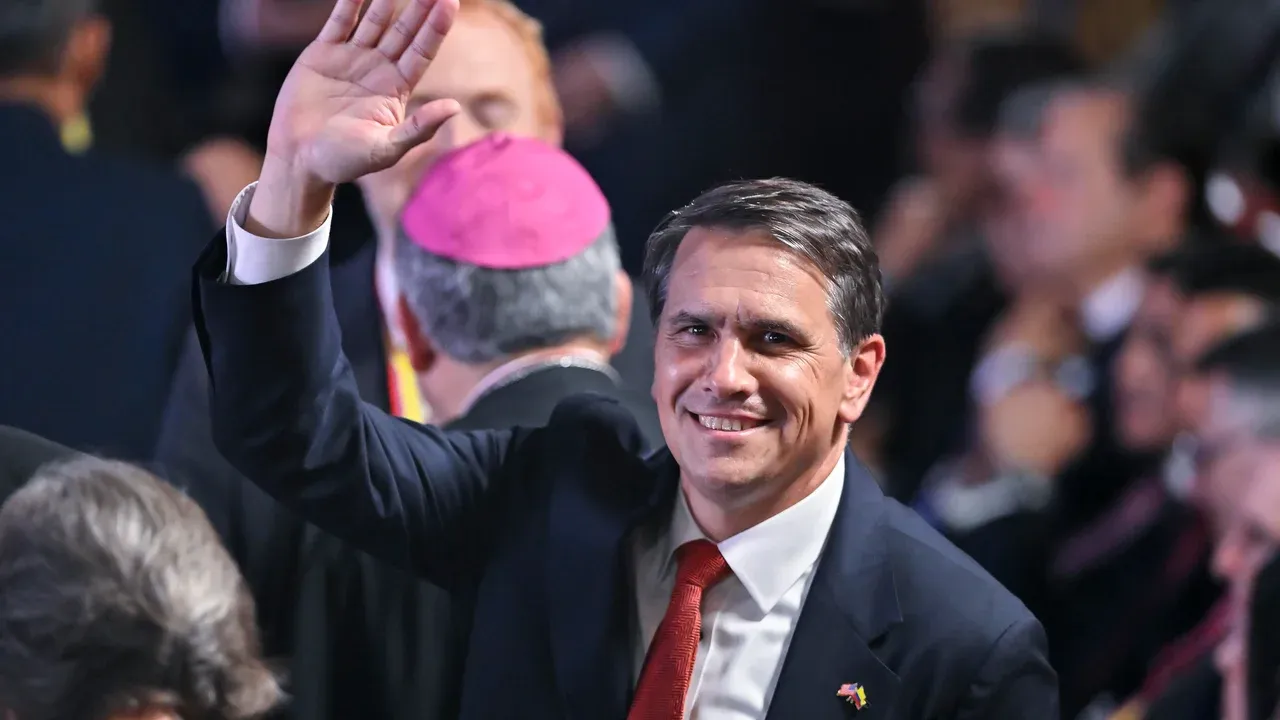
Todd Blanche, who risked his career as a prominent member of New York's legal establishment to keep Donald Trump out of jail, was confirmed on Saturday as the attorney general.
Blanche, 52, will now permanently serve as the nation's top law enforcement officer under the leadership of his former client.
He was confirmed by a vote of 50 to 49, with Republican Sens. Susan Collins and Lisa Murkowski voting with Democrats against the nomination.
Since Trump returned to the Oval Office, Blanche has been instrumental in reshaping the Justice Department in the president's image, effectively switching from being the face of Trump's defense to the face of his far-reaching retribution campaign.
He has put forward legal arguments expanding the powers and protections surrounding the presidency, overseen the mass firing of experienced prosecutors and longtime officials, and spearheaded a legal strategy that has led judges across the nation to question the department's decisions.
In the few months since he was appointed acting attorney general, the Justice Department has brought indictments against political figures, including former FBI Director James Comey, issued subpoenas seeking to identify journalists' sources, created and later abandoned the controversial anti-weaponization fund, and approved a tax-immunity deal between the president and the Internal Revenue Service.
But Blanche has been running the day-to-day operations of the department for far longer than that, and his nomination formalized what had already been the case internally for some time. CNN previously reported that even as deputy attorney general, Blanche often led meetings, including those the attorney general was supposed to oversee.
That central role became especially consequential in one of the administration's most volatile sagas, the aftermath of the Epstein files controversy.
At one point, former Attorney General Pam Bondi was sent into a weekslong media lockdown after repeatedly mishandling television appearances discussing the Epstein matter. Blanche took her place and, according to Bondi, continued to manage the crisis himself.
Sources have told CNN that Blanche will pursue a similar strategy once officially confirmed, bringing cases that highlight what the president claims were instances of Justice Department "weaponization" against him, his allies and supporters.
He will also push forward other administration priorities, including hardline immigration cases and a crackdown on fraud involving government programs.
Managing the unmanageable
Blanche worked for years as a federal prosecutor before entering private practice about a decade ago. When he took Trump on as a client in 2023, he stepped down from the white-shoe New York law firm Cadwalader, Wickersham & Taft, where he was a partner.
Trump was facing several criminal cases at the time.
Blanche's decision in April of that year to join Trump's legal team surprised those around him, according to multiple people familiar with the matter. He was registered to vote as a Democrat, and those who know him say he did not wear his politics on his sleeve. Known as a hard-working lawyer who loved being a prosecutor, some of his former colleagues were surprised to see him take on the role and echo the rhetoric of his client. As recently as this week, some former colleagues were still baffled and trying to analyze Blanche's transformation.
But the gamble paid off handsomely.
Blanche quickly became Trump's go-to attorney to navigate three federal indictments.
He was one of a select few who sat beside and advised Trump during his hush-money criminal trial in New York, when the president's freedom was at stake. He incorporated Trump's grievances into legal briefs and adopted his arguments before the judge, drawing rebukes at times.
Although Trump was convicted, Blanche's legal tactics helped delay Trump's sentencing until after the election, effectively ensuring that he would not serve prison time.
In a federal case accusing Trump of election interference, the Trump defense team won at the Supreme Court to expand protections from criminal prosecution for the president just before Trump won his second term. Blanche and his team also convinced a Trump-appointed judge in Florida to throw out charges in a second federal case accusing him of mishandling classified documents.
As rumors swirled that his work for Trump could land Blanche a job in the administration, Blanche told allies that he was not interested in a government position, sources told CNN at the time.
Still, Trump nominated him to serve as the Justice Department's number two. At the time, Trump wrote on social media that Blanche would fix "what has been a broken System of Justice for far too long."
Once in the job, sources say Blanche immediately eyed the attorney general position. His work pleased the president, sources told CNN, particularly as Trump became increasingly frustrated with Blanche's predecessor, Bondi. When she was fired, Blanche seamlessly slipped into the job, even moving into Bondi's old office during the first week after her departure.
"This is exactly what he's been waiting for," one department official said of his confirmation.
Confirmation negotiations
Blanche's path to confirmation was far from smooth. He spent weeks trying to gain the support of senators whose votes were crucial to his success, but some of his efforts were futile.
His struggle to align Republican lawmakers was most obvious with Sen. Lisa Murkowski. Despite a two-day trip to her home state of Alaska, reaching two settlements and two lawsuits, and awarding more than $6 million in grants, Murkowski voted to oppose Blanche.
"The country needs an Attorney General who will check the worst impulses of this administration," Murkowski said of her decision. "I hope Mr. Blanche is able to achieve that, if confirmed, but I simply do not have confidence that will be the case."
Blanche also concentrated on Republican Sen. Bill Cassidy, who raised concerns about the "weaponization of the Justice Department," including a probe into Cassidy Hutchinson, a former White House aide and key witness in the congressional investigation of the January 6 Capitol attack.
It is unclear whether the Justice Department will seek an indictment of the former aide.
Blanche's initial vote in the Senate Judiciary Committee was even delayed as he underwent tense talks with Republican Sens. John Cornyn and Thom Tillis, both of whom had concerns about the anti-weaponization fund and the IRS deal.
In the end, Blanche signed one memo that ended the anti-weaponization fund and released a second, unsigned memo clarifying the terms of the tax-immunity agreement.