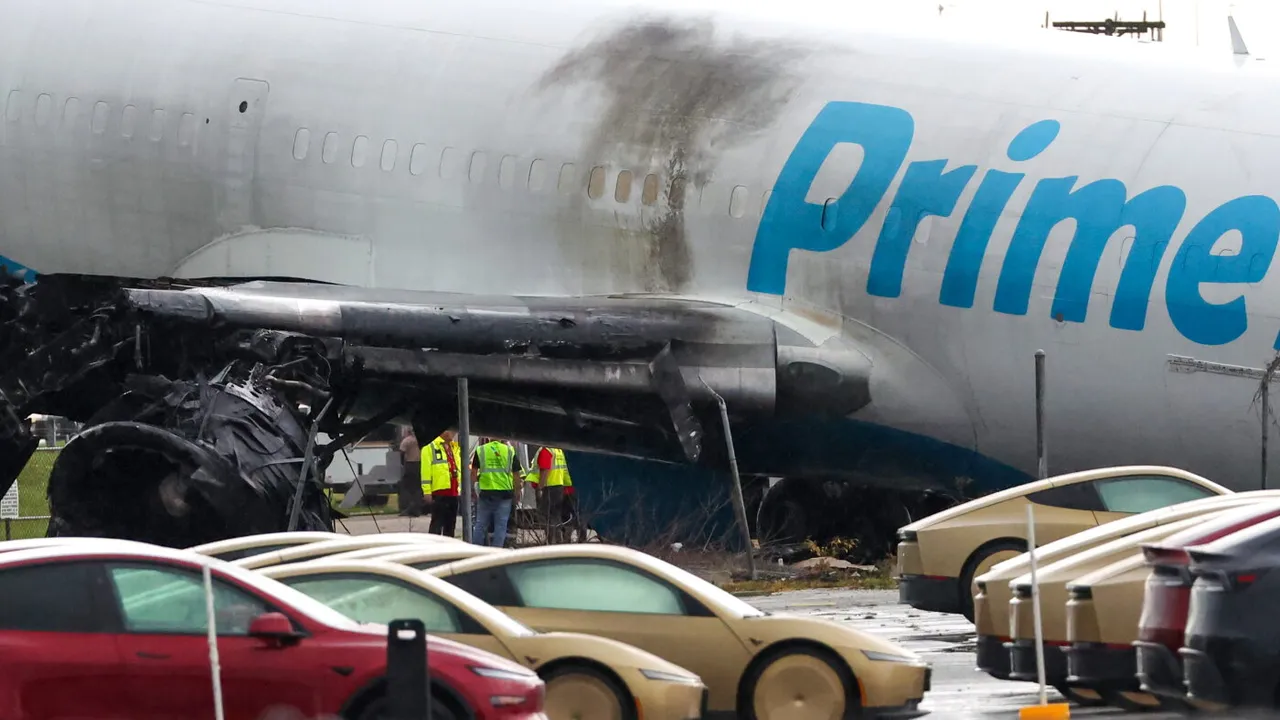
Flight data suggest an Amazon cargo plane attempted to abort an unstable landing at Miami International Airport before overshooting the runway, smashing into a van and killing five people, investigators said Tuesday.
The National Transportation Safety Board released preliminary findings a day after the crash, which occurred Sunday when the jet overran the runway and careened into airport property and a nearby city street.
NTSB Chairwoman Jennifer Homendy said at an evening news conference that investigators are reviewing flight data and cockpit voice recordings to determine what happened in the final seconds before impact. She said the data showed the plane appeared to briefly attempt a go-around — a maneuver to retry the landing approach — before the crew abandoned that effort and tried to stop the aircraft instead.
Homendy said the thrust reversers, which help slow a plane after touchdown, were never deployed. Investigators plan to interview the pilot and co-pilot on Wednesday before releasing further details from the cockpit voice recorder.
The Amazon jet had been on a two-hour flight from Puerto Rico when it landed amid stormy conditions around Miami airport. According to the NTSB, the aircraft overran the runway by approximately 1,300 feet (396 meters), struck a van on airport property, broke through a fence and then hit an SUV on a city street.
Former FAA official Mike O'Donnell said the plane's nose-first, right-landing-gear contact with the runway indicated an unstable approach. He said a go-around should have been initiated earlier.
"A go-around probably should have been executed sooner than that. And it seems like they hesitated," O'Donnell said.
O'Donnell added that by the time the crew attempted to abort the landing, there may not have been enough runway remaining to recover.
Aviation attorney Mary Schiavo, a former Inspector General of the Transportation Department, said the sequence of events raised questions about crew coordination. "It almost seems like there was a disagreement between the pilots on what to do," she said.
Weather is also being examined as a potential factor. Experts said a strong tailwind appeared to carry the plane well past its intended touchdown point. Investigators will seek to determine what weather information the pilots received and why air traffic controllers had not reversed the runway approach direction to allow the aircraft to land into a headwind.
All five people killed were inside a van owned by Professional Ocean Service Corp., a company contracted to clean aircraft. Authorities described the van as used to shuttle cleaning crews. The front end of the vehicle was entirely crushed. The SUV struck on the street was so badly damaged it was nearly unrecognizable. Both vehicles remained at the crash site Tuesday, along with the jet, which sat nose-down with a large soot mark near the letter P in the "Prime Air" livery.
Five additional people were injured in the crash. Two remain in critical condition and a third is in stable condition, Miami-Dade County Sheriff Rosie Cordero-Stutz said Tuesday. The pilot and co-pilot have been discharged from hospital.
Professional Ocean Service Corp. declined to comment on the crash, citing respect for the affected families.
"Our employees are far more than the people who work beside us each day, they are family, and they are deeply loved. Our hearts and prayers are with every employee and every family whose lives have been forever changed," the company said in a statement.
Amazon said it is cooperating fully with the investigation and extended its condolences to the victims and their families.