Democrats swept both chambers of Congress in the November 3 midterm elections, flipping the House of Representatives and the Senate from Republican control and winning gubernatorial races in states previously considered Republican strongholds, including Texas.
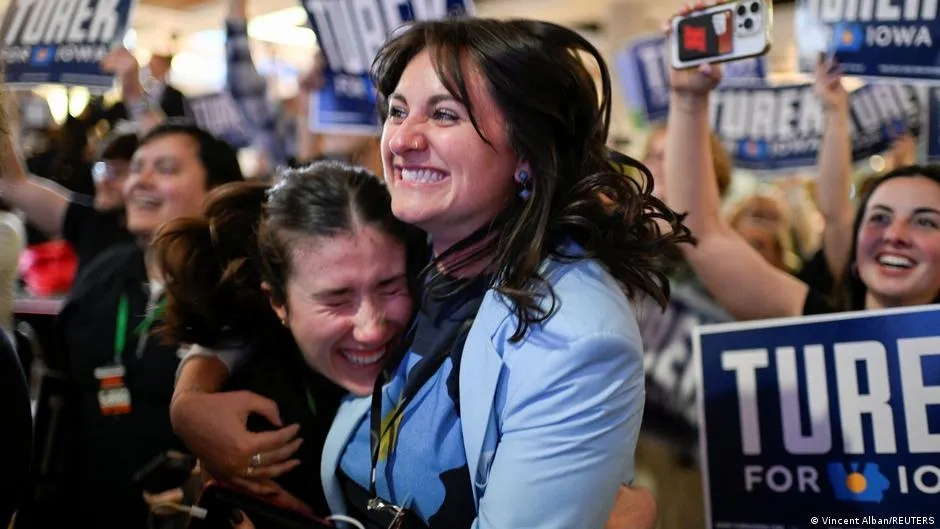
Scenes of celebration spread across the country on election night, with Democratic politicians and supporters photographed hugging and weeping with joy. The White House responded the following day with a post on X reminding Americans: "Trump is still your president."
House Democratic Leader Hakeem Jeffries, the presumptive next House speaker, addressed supporters on Tuesday night. "We're going to fight to make sure that we make this country affordable for every single American," he said. "This is a change election, and we understand as House Democrats we need to deliver dramatic change."
Senate Democratic Leader Chuck Schumer told reporters on Wednesday that "relief is on the way," while acknowledging that some voters may be skeptical Democrats can deliver on the economic message that drove their victories.
Despite controlling both chambers from January 2027, Democrats will not hold the two-thirds majority in either chamber needed to override a presidential veto, and will likely face Republican filibusters in the Senate.
Trump retains the power to veto any legislation Congress sends him. He has also, on past occasions, disregarded congressional decisions outright.
Patrick Malone, a professor in the public administration and policy department at American University in Washington, D.C., told sources that a presidential veto is not necessarily the final word. He noted that some Republicans, particularly in the House, may be unwilling to remain closely aligned with Trump following the election results.
"There are Republicans, especially on the House side, who are not going to want to tie themselves that closely to Trump anymore," Malone said. "The Republicans that survived had a very strong message sent to them. It would be illogical and foolish for them to point to a neighboring district [that turned blue] and say, 'Well, that can't happen here.'"
Malone predicted that bipartisan coalitions could form to override vetoes. "It could happen very easily," he said.
Bobby Kogan, senior director of federal budget policy at the Center for American Progress, a left-leaning think tank, cautioned that divided government carries real limitations. "That doesn't mean that nothing can happen, but it means there are real obstacles," he said.
Matt Bennett of Third Way, a center-left think tank, warned of a risk that voters may have misunderstood the scope of what Democrats promised. "What Democrats were really promising was: return us to power, we will put a check on Trump for two years, and then when we get the White House in 2028, we can actually make your lives better," Bennett said. "It isn't clear to me that voters heard the entire message. They might have just heard the last part, and so there is some risk that voters will be disappointed."
One significant power that comes with controlling both chambers is the ability to determine which bills reach the floor for a vote. Kogan pointed to the release of the Epstein files as an example of how majority control can force votes on popular measures that leadership had previously blocked.
"The difficulty was just getting it there," Kogan said. "And what Democrats can do is they can make popular things get there."
Democrats have signaled plans to advance legislation addressing health care costs, enhanced premium tax credits, and Medicaid cuts. They may also use budget reconciliation, a procedural tool that allows certain budget-related bills to pass the Senate with a simple majority, bypassing the threat of a filibuster. Massachusetts Senator Elizabeth Warren has already called on her party to use reconciliation to reverse health care cuts, expand coverage, and fund universal child care.
The question of impeachment has also surfaced. From January 2027, Democrats will hold the simple majority in the House required to bring charges. They will not, however, command the two-thirds Senate majority needed for conviction and removal from office.
Some Democrats argue the process should be initiated regardless, as a check on executive power. Others urge caution. "If we make Donald Trump the center of our focus, we will lose this moment in history," Democratic Senator Cory Booker said. "We need to deal with the American people's problems."
Congressional investigations are also expected. Malone said Democrats take their oversight role seriously and will pursue inquiries into the administration. "Congressional investigations have a much stronger impact on public opinion than on legislation," he said. "They catch people's attention."
Speculation has also grown around the future of Defense Secretary Pete Hegseth. Brandon Conradis, an editor at Bloomberg Government in Washington, D.C., said observers widely expect Democrats to push for his removal. "There's a lot of speculation about what's going to happen to Pete Hegseth," Conradis said. Whether Trump acts on any such pressure remains the president's decision alone.