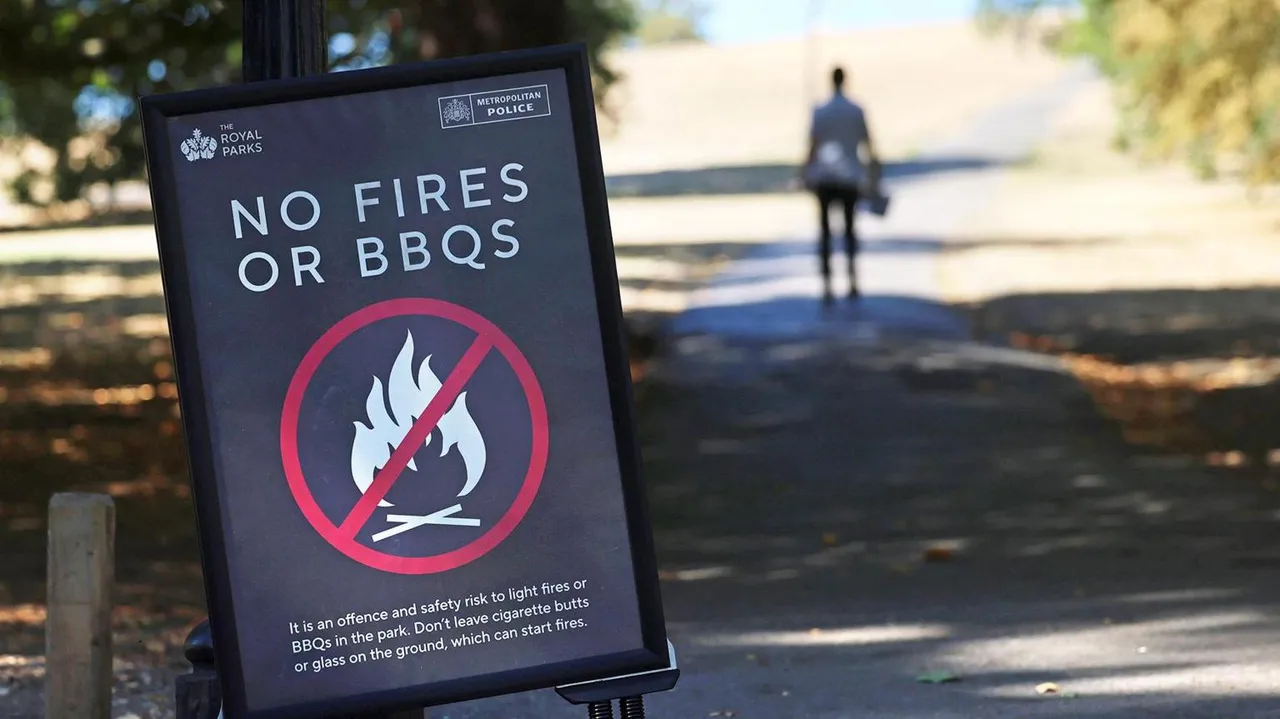
The UK government has moved to temporarily ban the sale of disposable barbecues as wildfires continue to spread across England and Wales, with the prime minister warning that Britain is "a tinderbox right now."
A total of 1,017 wildfires have been recorded in England and Wales this year, according to data from the National Fire Chiefs Council, matching last year's record. The prime minister said 37 fires were burning across the two countries, four of them classified as major incidents.
On Friday evening, an emergency alert was sent to millions of mobile phones warning of a "very high risk of wildfires nationally." The message asked residents, landowners and visitors not to undertake any activity that could cause a fire, "including disposable barbecues, firepits, garden incinerators of fireworks." The government said it was the most extensive use of the emergency alert system to date.
The prime minister said some of the wildfires burning across the country will have been started by disposable barbecues. All retailers are to receive guidance on the temporary sales ban, which will be kept under review.
Many large retailers and supermarkets had already voluntarily stopped selling the devices under a framework agreed in 2023 between fire chiefs and the British Retail Consortium. That framework states retailers should suspend sales once an extreme heat event has been declared as imminent, or in response to reasonable, evidence-based requests from local councils.
Speaking to a radio programme, the prime minister said: "We've got 37 fires across England and Wales right now, four of them are major incidents."
He added: "We're going into a difficult weekend, please just think about the situation that we're in. Britain is a tinderbox right now. Setting a fire in any outdoor setting of any kind is a risk to other people's homes, it's a risk to other people's lives, don't do it, please don't do it."
In the West Midlands, dozens of homes were destroyed as fires spread through dry grass and tore through houses on what was the UK's hottest day of the year. West Midlands Ambulance Service said it treated 54 casualties at eight different fires across the region, with 19 people taken to hospital.
In Wales, a major incident was declared near Llandovery, Carmarthenshire, after dozens of homes were evacuated and roads were closed. Gurkha logistics teams equipped with water tankers and military engineers have been deployed to assist fire services in South Wales. Further military personnel are to be deployed elsewhere if needed.
In Hampshire, firefighters spent a sixth consecutive day tackling a wildfire in the New Forest, which broke out on Sunday. Norfolk Fire and Rescue Service tackled 16 emergencies on Thursday afternoon, including a fire at Mousehold Heath.
The prime minister, speaking during a visit to Stourbridge to see the impact of a devastating blaze, said the UK's fire and rescue service is not properly equipped to deal with such incidents. "We don't have the capability in the way that we should have to fight these fires. There's thousands of firefighters out there today doing back-breaking work, in full kit, in the most difficult conditions," he said.
He called on the country to face up to the "changing climate" and transition to "more clean energy." His comments came ahead of the appointment of Baroness Blake of Leeds as fire minister.
Environmental group Friends of the Earth urged the prime minister to tackle the "root cause" of the "climate emergency" fuelling this summer's extreme weather. "Without urgent action to curb the carbon emissions driving this crisis, future heatwaves, droughts and wildfires will only get worse and the ability for future generations to adapt will disappear," the group warned.
The conditions experienced so far this summer mirror warnings from climate scientists that human-induced climate change would lead to more frequent and intense heatwaves and potential summer droughts. In England, the Rugby Football Union has delayed the start of the community rugby season due to concerns over player welfare and pitch conditions caused by the drought.