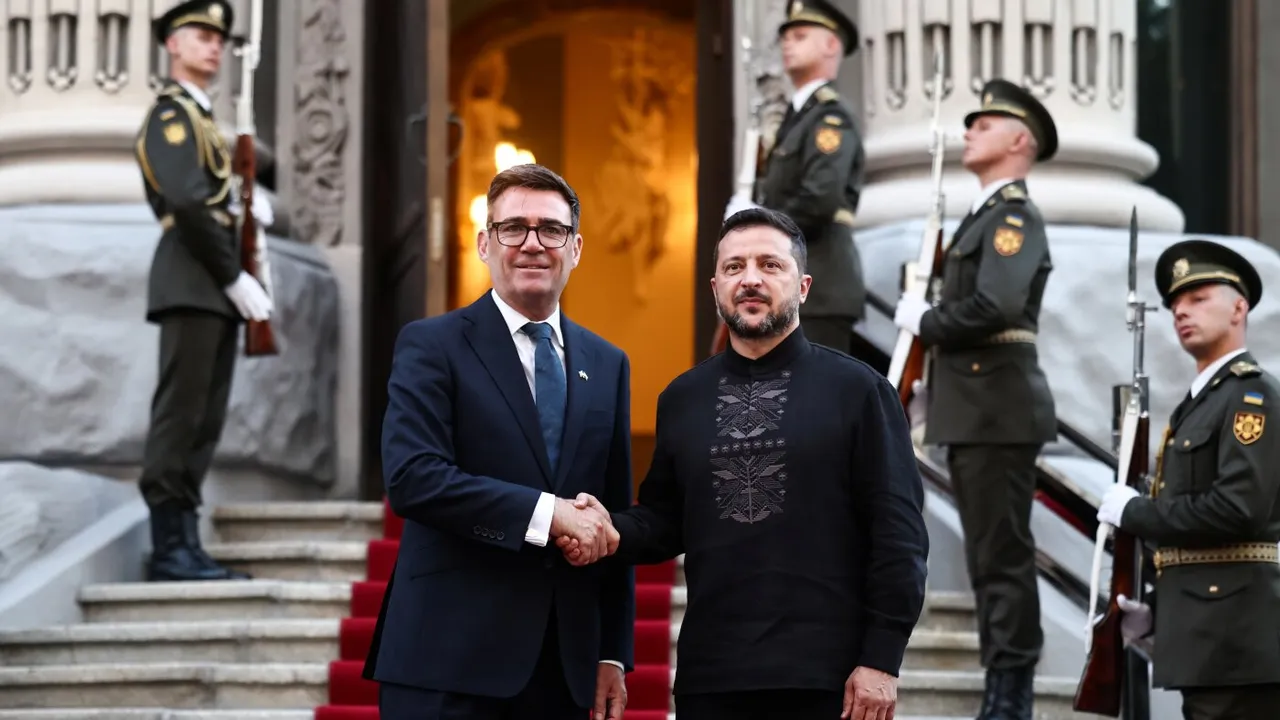
British Prime Minister Andy Burnham announced Monday that the United Kingdom will share classified technical information with Ukraine to help the country produce its own long-range missiles.
Burnham made the announcement in Kyiv, where he was attending Ukraine's Independence Day alongside other international leaders. He said defense firm MBDA will release details on UK-made components for the SCALP missile, enabling Ukraine to assemble the weapons domestically.
However, experts say the move will not result in operational missiles in the near term, nor will it address Ukraine's most pressing battlefield needs in its war against Russia.
The SCALP missile is the French-produced version of the UK's Storm Shadow — an air-launched, high-precision weapon with a range of more than 250 kilometers (155 miles). Both systems rely on shared French and British technology.
Measuring 5.1 meters (16.7 feet), the missile is designed to be difficult to detect and is intended to strike fixed or stationary targets such as hardened bunkers and key infrastructure, according to MBDA. The defense firm describes the missile as exceptionally accurate, equipped with an advanced navigation system.
Storm Shadow and SCALP missiles are in service with the British, French, and Italian air forces, as well as several export countries. They have previously been used in conflicts in Iraq, Libya, and Syria.
Ukraine is already in talks with France, which recently agreed to help establish assembly lines for the missiles on Ukrainian soil. The extent of those plans and a timeline for when such missiles could become operational remain unknown.
"Any impact will in part depend on how quickly Ukrainian-assembled SCALP cruise missiles can be introduced into service," said Douglas Barrie, a senior fellow at the International Institute for Strategic Studies.
Arun Dawson, a researcher at the Freeman Air and Space Institute at King's College London, said the announcement will not benefit Ukraine through the coming winter and is unlikely to have any practical effect until next year at the earliest.
"What Ukraine needs is protection from Russian ballistic missile attacks," he said.
Ukrainian President Volodymyr Zelenskyy said on Sunday that his country is receiving substantially fewer Patriot air defense systems even as Russian ballistic attacks are increasing. The shortfall is particularly acute as the United States and European partners struggle to expand production.
What a SCALP missile can offer, Dawson noted, is deep-strike offensive capability. "You can use it to take out the Russian sites from which they are launching these ballistic missiles," he said.
Matthew Savill, director of military sciences at the Royal United Services Institute in London, said Ukrainian development of its own ballistic and cruise missiles would complement the volume of firepower it can already deliver using drones, which are relatively slow and offer limited stealth.
A weapon like the SCALP missile "has a sophisticated warhead and strikes the target at a velocity that means it can penetrate hardened structures and destroy buried targets in a way a slower drone without such a warhead is unable to do, at present," Savill said.
The British announcement drew a sharp response from Moscow. Kremlin spokesman Dmitry Peskov accused the UK of "fanning the flame" of the war on Ukraine's side. Burnham dismissed the claim directly.
"Who started the fire?" Burnham asked reporters on Monday.
Britain became the first country to supply longer-range strike weapons to Ukraine in 2023, when it donated a number of Storm Shadow missiles to Kyiv. Those weapons gave Ukraine the capacity to strike targets deep inside Russian-held territory, including Russian-occupied Crimea.
The UK is also supporting Ukraine's development of lower-cost strike weapons. British officials have been working with domestic defense companies to test a new ground-launched strike system capable of hitting targets more than 500 kilometers (310 miles) away while carrying a 225-kilogram (496-pound) warhead.