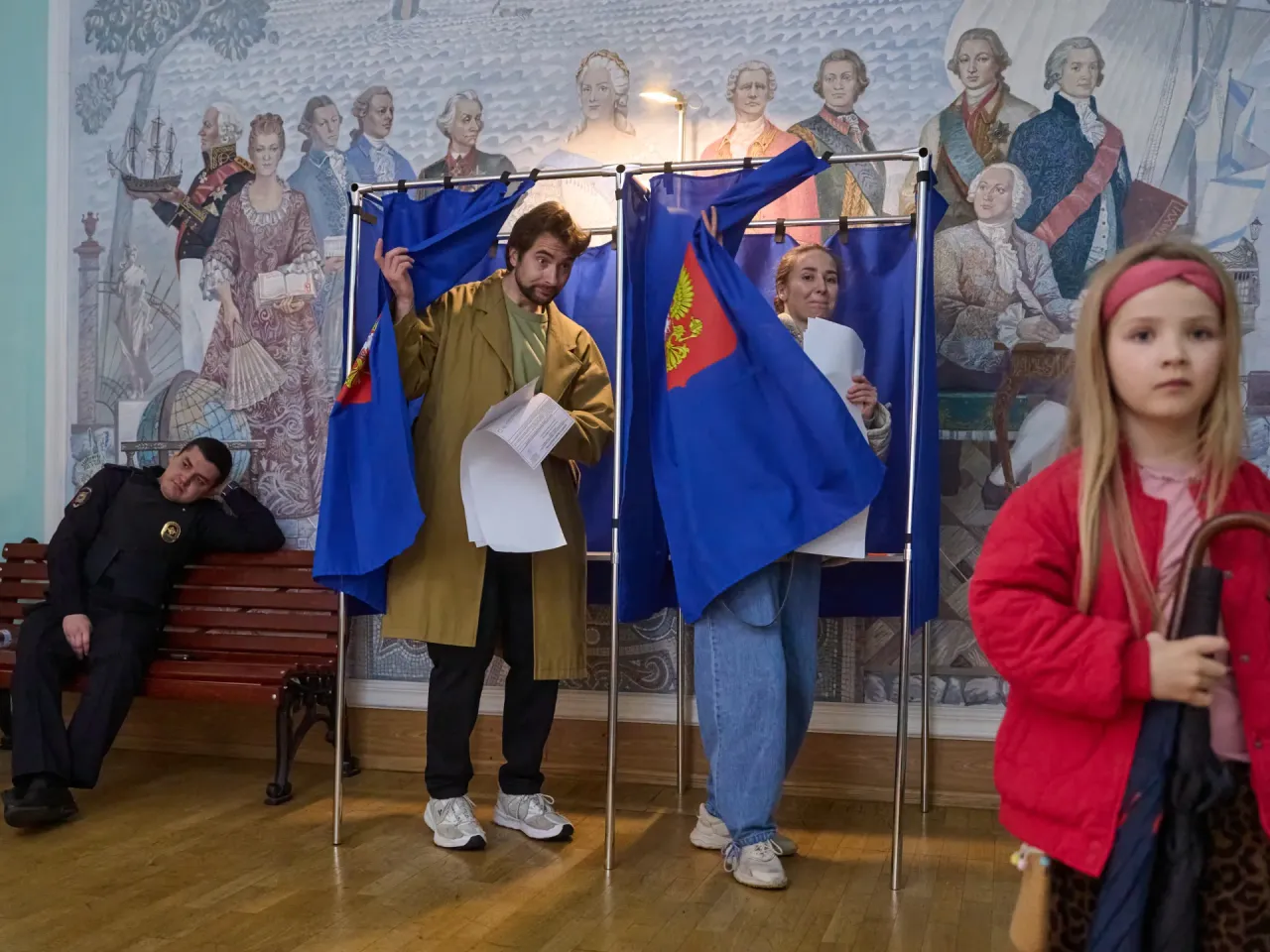
Russia's first parliamentary elections since the full-scale invasion of Ukraine concluded on Sunday, with President Vladimir Putin's United Russia party dominating the results, according to near-complete vote counts.
With 90.43 percent of ballots counted, United Russia led with 57.86 percent of the vote, according to data from the Central Election Commission (CEC) reported by state news agency TASS. Voter turnout stood just below 57 percent as of Sunday night.
The three-day election, which ran from Friday to Sunday, was held to choose members of the State Duma, Russia's lower house of parliament. A total of 450 seats were contested — 225 allocated through party lists and 225 through single-seat constituencies. United Russia is projected to win the majority of single-seat races as well.
No surprises or upsets were recorded in the early results.
Other parties trailing behind United Russia included the Communist Party of the Russian Federation (CPRF) at 13.84 percent, the ultranationalist Liberal Democratic Party of Russia (LDPR) at 8.9 percent, New People at 7.94 percent, and A Just Russia at 4.95 percent. All four parties largely vote in line with United Russia in parliament.
More than 3.6 million people cast their ballots online, according to TASS, citing the Ministry of Digital Development, Communications and Mass Media.
Voters included residents of four Ukrainian regions that Moscow illegally annexed in 2022 — Donetsk, Luhansk, Kherson and Zaporizhia — as well as those in Crimea, which Russia seized in 2014. The United Nations and most of the international community do not recognise these territories as part of Russia.
The election took place amid tight political controls. Most antiwar candidates were barred from the ballot. Candidates from the liberal Yabloko party said they feared for their freedom after two senior party figures were sentenced to lengthy prison terms before the election over comments made about the war in Ukraine. Yabloko's leader, Nikolai Rybakov, visibly spoiled his ballot paper, writing his party's name and the slogan "For peace."
The Kremlin had framed the vote as an opportunity for citizens to have their say despite the ongoing war and economic hardship. Opposition to Putin's policies remained limited throughout the process.
The Berlin-based think tank NEST, co-founded by Kremlin critic Mikhail Khodorkovsky, suggested the results could still produce uncomfortable moments for the Kremlin. It said votes for the CPRF and New People might in many cases represent a silent protest against Putin and United Russia, even though those parties do not challenge the president on most issues.
"The consequences of the war are increasingly being felt within the country, and accumulated anxiety and frustration may translate into votes for the systemic opposition parties that the Kremlin has allowed to remain on the ballot," NEST said in a note.
In the previous State Duma elections in 2021, United Russia secured an absolute majority, holding 326 of the 450 seats. The CPRF finished second with 57 seats.
The CEC was expected to announce preliminary results and turnout figures on Monday. Final results are unlikely before Friday, once all ballots are counted and legal procedures are completed, according to TASS.
Ukraine condemned the election, with officials calling it illegal due to the inclusion of voters from annexed Ukrainian territories. Moscow, in turn, accused Ukraine of attempting to sabotage the vote after a wave of Ukrainian drone strikes targeted Moscow and other Russian regions on Sunday — what TASS described as the largest such attack since the war began in February 2022.
The strikes killed three people in the Moscow region and two in the Russian-held part of Kherson, including an election official, according to the regional governor and the election commission.