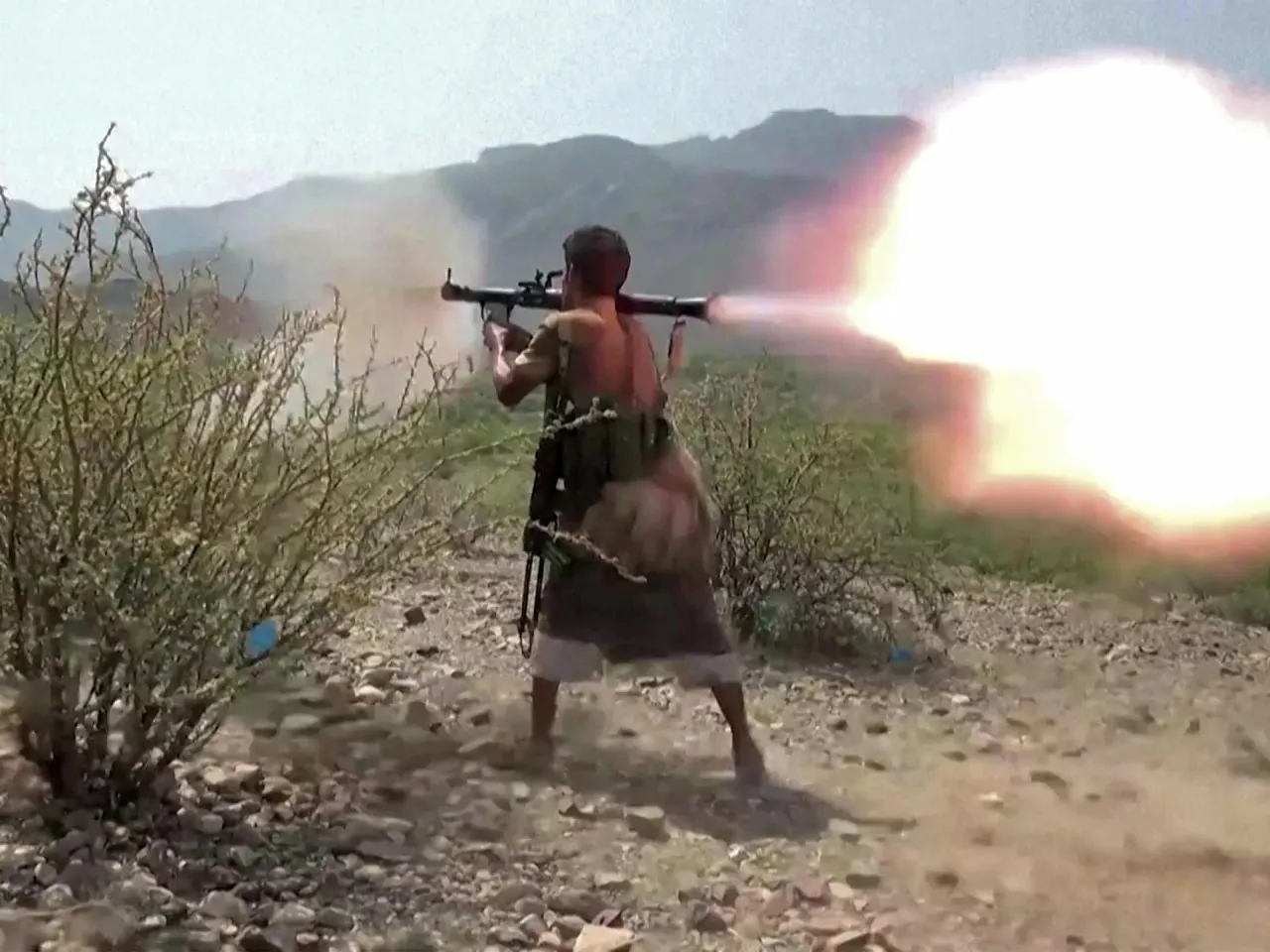
Yemen is experiencing its most serious fighting since 2022, when a United Nations-brokered truce halted eight years of war that had killed tens of thousands of people.
Military sources say more than 140 combatants were killed over the weekend in clashes between Yemen's internationally recognised government and Houthi rebels in the southwest of the country.
The fighting marks the deadliest violence in Yemen since a 2022 ceasefire collapsed in July.
This week, government forces launched counterattacks against the Houthis, with fighting intensifying in the provinces of Taiz, al-Bayda and al-Jawf. Al-Jawf is considered one of the main gateways to the Houthi-controlled capital, Sanaa.
The Houthis say they have repelled some of the government advances and have also attacked Saudi Arabia, which backs the Yemeni government.
Tensions began escalating in July after government forces claimed an attack on the Houthi-controlled airport in Sanaa, preventing an Iranian aircraft from landing. Further attacks followed.
The situation intensified last week when the Houthis launched a major offensive, pushing through western Taiz and southern Hodeidah toward the port city of al-Makha and the Bab al-Mandeb Strait on the Red Sea.
In this new phase of the conflict, the internationally recognised government has set its sights on retaking Sanaa from the Iran-backed Houthis. Both sides are also vying for control of the area near Bab al-Mandeb, a strategic waterway that has gained greater significance amid Iran's effective closure of the Strait of Hormuz, a vital artery for global oil and gas supplies. The Houthis have conducted regular attacks on Red Sea shipping since 2023.
Analysts say government-aligned forces are better resourced than at any point in the conflict, but they caution against expectations of a swift victory.
"This is likely to be a protracted war rather than a rapid campaign," said Mohammed al-Basha, a Yemeni-American analyst and founder of Basha Report, a US-based risk advisory firm.
Earlier this year, the government succeeded in reasserting control over areas in non-Houthi-controlled southern Yemen previously held by the Southern Transitional Council, a UAE-backed separatist group. Emboldened by that success, it is now focusing on the Houthis.
"The government was able to control more, and less militias [are] now on the ground... the only [other] player now [is the] Houthis in Sanaa," said Mahjoob Zweiri, a professor of Middle East politics at Qatar University.
Since the defeat of the Southern Transitional Council, the Yemeni government has worked to present its anti-Houthi forces as a unified military command, after years of internal division.
Despite those gains, analysts warn that the Houthis remain a formidable force. "[The Houthis] are going to fight tooth and nail rather than simply fold," al-Basha said.
If pushed back, the group could retreat into its northern tribal highlands around Saada, Hajjah, Sanaa and neighbouring governorates. "That would create a much more geographically defined confrontation between a Houthi-held northern heartland and territories controlled by the internationally recognised government and its allies," al-Basha said.
Analysts also point to the broader regional context as a factor driving the renewed offensive. Against the backdrop of ongoing hostilities involving Iran and its allies in the Gulf, the opportunity has been seen as favourable for the Saudi-backed government to press its campaign.
"There is a wide perspective that non-state actors — militias — should be ended regionally," said Zweiri, noting growing aversion among regional states toward such groups. "This also is influencing what's happening in Yemen," he added.