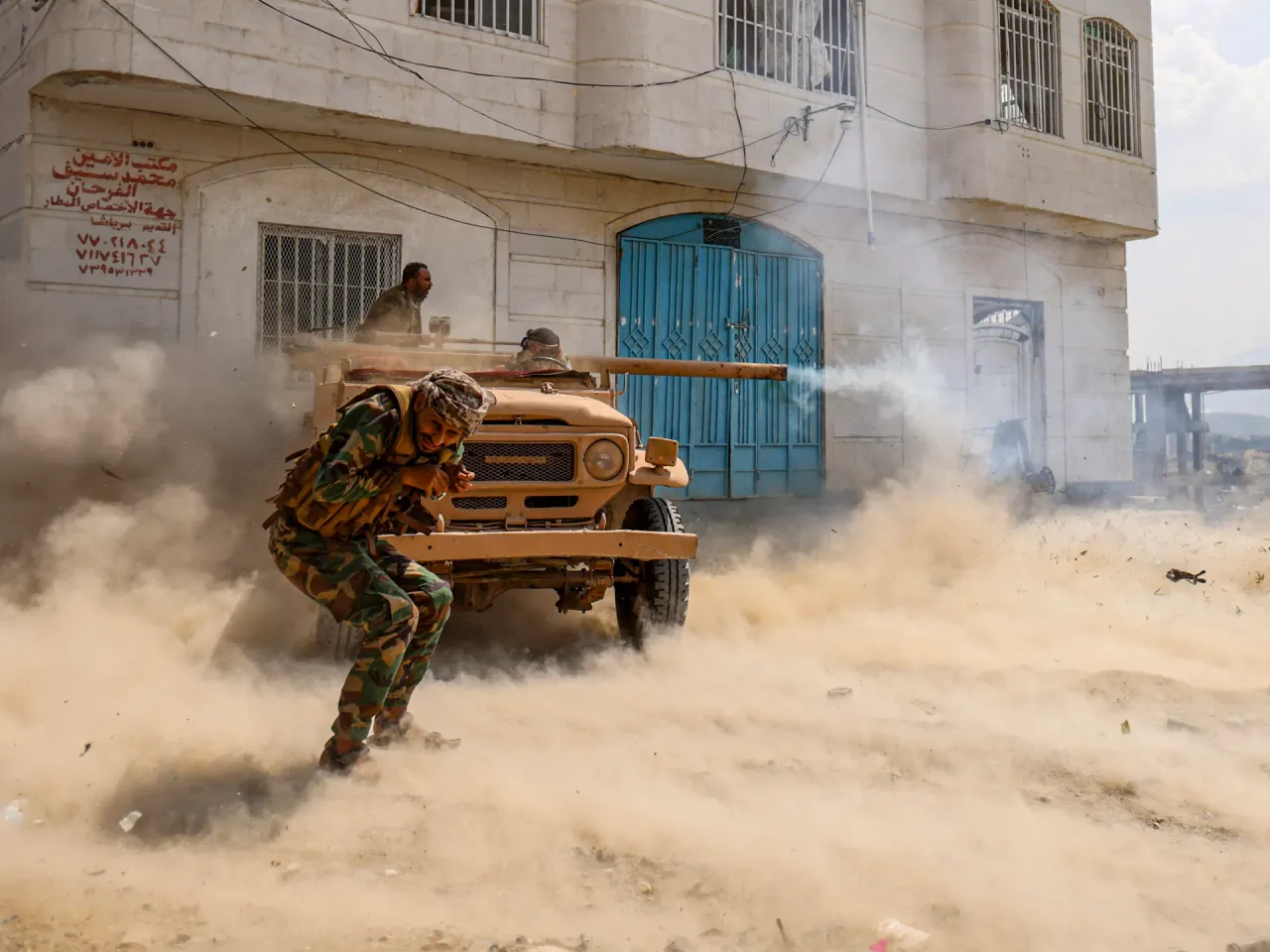
Al-Jawf governorate has emerged as a new focal point in Yemen's ongoing conflict, as government forces launch a major counteroffensive to recapture strategic territory from the Houthis in the country's north.
The offensive is part of Operation Dawn of Yemen, launched last month by the internationally recognised government to reverse Houthi territorial gains and restore state authority across the country.
Government forces have been pushing to seize strategic heights east of al-Hazm, the provincial capital of al-Jawf, which military commanders describe as a potential launchpad for further advances against Houthi positions.
The Houthis have controlled Sanaa and most of northern Yemen since the war began in September 2014. They seized al-Hazm in March 2020. Control over the city has shifted multiple times during the now 12-year conflict.
Field Commander Colonel Rabie Al-Qurashi said government forces have taken full control of the Huwaishan mountain range, east of al-Hazm. He described it as the first line of Houthi defence on the eastern axis, adding that control over the rugged terrain would allow government forces to disrupt rebel supply routes.
"Government forces succeeded in breaking that defensive format with partial control over the Al-Alam front road," Al-Qurashi said. "The government advance represents a beginning to tighten the noose on the Houthis in the upper al-Labanat camp," which he described as a vital eastern gateway to Sanaa.
Military spokesman Majed Abdullah Al-Nuzaili said on X that recent operations against Houthi positions in al-Jawf were "inflicting losses on the militia's capabilities."
Al-Jawf holds significant strategic value. The governorate shares an expansive border with Saudi Arabia and has direct geographic links to five key governorates: Hadramout, Saada, Sanaa, Amran, and oil-rich Marib. It also serves as a defensive buffer protecting Marib, which remains under government control, while simultaneously acting as a gateway to major Houthi strongholds in the north.
Military and strategic affairs researcher Ali Al-Dahab said the recent advances mark a significant shift in the conflict's trajectory.
"The recent advances of government forces in Al-Jawf are a military transformation that serves the course of future operations for their arrival to al-Hazm city," Al-Dahab said. "The government forces' recovery of a number of heights there provides a military and psychological morale advantage and confuses the Houthis' decisions, in addition to granting government forces monitoring, movement, and observation of Houthi supply lines and securing their own lines."
Security and political affairs researcher Brigadier General Ahmed Al-Awadhi also underscored the importance of the advances, cautioning however that progress should be steady rather than rushed.
"The advances of government forces in Al-Jawf cannot be ignored or their importance underestimated," Al-Awadhi said. "Control over heights or mountain ranges in the desert Al-Jawf governorate represents points of military strength regardless of their proximity to or distance from the governorate capital."
Al-Awadhi added that the developments expose a historical vulnerability for the Houthis, who have suffered repeated defeats in battles fought across desert and open terrain.
In terms of territorial control, government forces currently dominate the vast eastern desert district of Khabb wa ash Sha'af, which accounts for 82 percent of the governorate's total area. The Houthis hold the provincial capital, al-Hazm, and 10 other districts.
The military developments coincide with the Presidential Council's appointment of Major General Amin Ali Al-Akimi as governor and military commander of al-Jawf. According to reports, the appointment is part of a broader effort to restructure the theatre of operations and unify the front.


