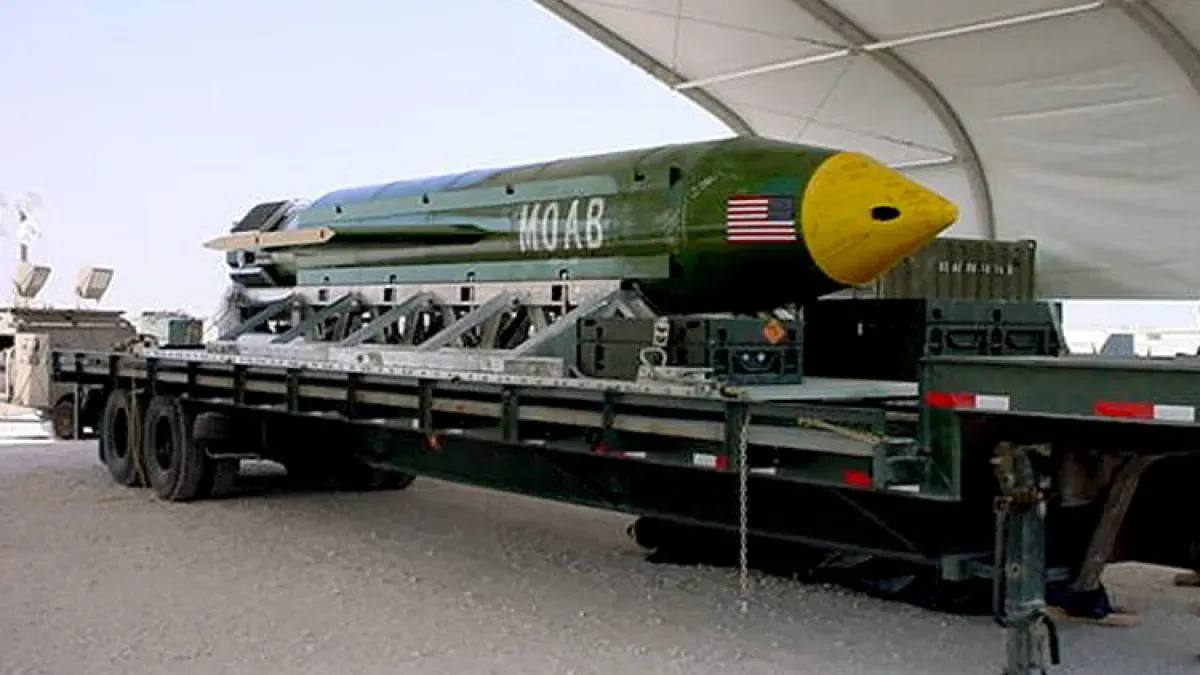
The United States has developed plans to strike Iran with the largest non-nuclear bomb in its military arsenal if President Donald Trump orders renewed combat operations, according to US officials.
The plans involve deploying the GBU-43/B Massive Ordnance Air Blast Bomb, known as the MOAB or the "mother of all bombs," against Iranian energy infrastructure and nuclear sites. Officials say such a move could significantly escalate the ongoing conflict at a time when fighting has lulled.
Concerns have been raised, including within the Trump administration itself, over what deploying the weapon would achieve. Officials familiar with military planning discussions said the MOAB would be unlikely to help the US achieve its stated strategic goals, including destroying Iran's nuclear capabilities.
Brussels-based military expert Elijah Magnier said using the MOAB would not guarantee the destruction of Iran's deeply buried underground nuclear installations. He described such a strike as likely amounting to little more than "political theatre."
The GBU-43/B Massive Ordnance Air Blast Bomb contains approximately 8,500 kilograms (18,000 pounds) of high explosives. The weapon weighs around 9,800 kilograms (21,605 pounds) in total and measures just over nine metres (about 30 feet) in length.
Because of its size, the MOAB cannot fit inside a stealth bomber and is typically deployed from a Lockheed C-130 Hercules cargo aircraft. The bomb was first manufactured between 2002 and 2003 and has undergone 12 detonation tests.
Its nickname is a reference to former Iraqi President Saddam Hussein's invocation of the "mother of all battles" during the 1991 Gulf War.
The US has deployed the MOAB only once before, during 2017 strikes on an Islamic State Khorasan Province cave and tunnel complex in Afghanistan. Afghan authorities reported that 94 fighters were killed in the blast and that no civilians were harmed. However, unconfirmed local reports indicated civilian casualties, and many homes were said to have been destroyed.
Designed to detonate a few feet above the ground, the MOAB generates lethal waves of fire upon detonation, capable of destroying buildings, cave openings, and other hard-surface structures.
"Its purpose is to generate an exceptionally powerful blast across a surface area," Magnier said.
Military expert Colonel Nidal Abu Zeid said the bomb does not require ground impact to detonate, and that its blast would destroy everything above ground within a one-kilometre (0.6-mile) radius. He said the US would likely aim to use the weapon to destroy Iranian ground-force positions above ground and to reach underground facilities, including a site at Pickaxe Mountain, which Trump has previously threatened to attack.
Magnier cautioned, however, that the bomb's radius and level of destruction would depend greatly on the terrain and population density of the target area. He added that the weapon may not be particularly effective against targets buried deep underground.
Some of Iran's nuclear sites that the US may wish to target, such as the Fordow complex and an under-construction facility at Pickaxe Mountain, are located deep underground, raising further questions about the operational effectiveness of deploying the MOAB against them.