China and North Korea have formally opened a long-delayed road bridge linking the two countries, with both governments describing the project as a symbol of deepening bilateral ties.
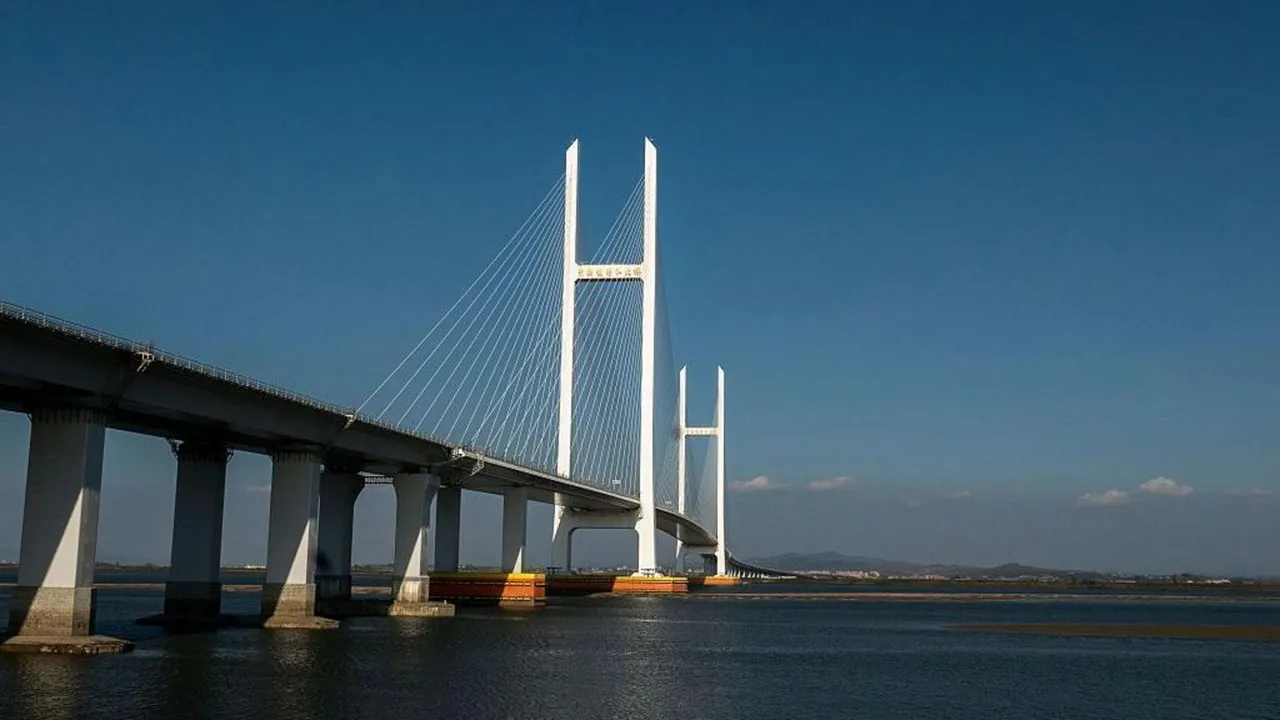
A launch ceremony was held on Thursday for the New Yalu River Bridge, which connects the northeastern Chinese city of Dandong with the North Korean border city of Sinuiju. Video from state media showed trucks decorated with the national flags of both countries lined up on the four-lane span, which was festooned with Chinese and North Korean flags.
Chinese Premier Li Qiang, speaking in a video address, called the bridge a "new landmark symbolising the traditional friendship between China and North Korea" and said the two countries were "opening a new chapter" in bilateral ties. North Korean Premier Pak Thae Song also delivered a video message at the ceremony.
The bridge spans approximately 3 kilometres and is expected to ease pressure on the ageing Sino-Korean Friendship Bridge, a decades-old structure on the same route that carries both a railway line and vehicles but can accommodate only one-way traffic at a time. More than 70 percent of official trade between the two countries currently passes through that crossing, according to Chinese data.
The New Yalu River Bridge was completed on the Chinese side around 2014 and was initially expected to open that year. No corresponding work was carried out on the North Korean side in Sinuiju, and the project stalled for more than a decade. The delay fuelled speculation that Pyongyang was wary of increased economic dependence on China, or was displeased that Beijing had backed United Nations sanctions resolutions targeting North Korea's nuclear and missile programmes. Some analysts also suggested the two governments had disagreed over the location of the crossing.
China is North Korea's largest trading partner and a critical economic lifeline as Pyongyang faces heavy international sanctions over its nuclear weapons programme. Last year, bilateral trade reached 2.7 billion dollars, recovering to pre-pandemic levels, with the figure driven largely by Chinese exports to North Korea. Separate data indicated that approximately 98 percent of North Korea's external trade was with China.
Chinese Foreign Ministry spokesperson Mao Ning described the new bridge as an "important facility for connectivity" between the two countries, adding that the route would "further facilitate trade and people-to-people exchanges."
Analysts caution that a sharp increase in cross-border trade is unlikely in the near term. "Pyongyang is also wary of a sudden flood of Chinese imports that would greatly expand China's influence over its domestic market," said Kang Jun-young, a professor of Chinese studies at Hankuk University of Foreign Studies. "China is well aware of these concerns, so trade is more likely to grow gradually."
The opening comes against a backdrop of shifting regional alignments. North Korea has grown closer to Russia in recent years, with at least 2,300 North Korean soldiers believed to have died fighting for Russia in Ukraine. In return, Russia has supplied North Korea with oil in violation of UN sanctions, with estimates suggesting more than one billion barrels were sent in 2024 as payment for Pyongyang's weapons and troops. Last month, North Korea and Russia opened their first road bridge, which Russian state media said would allow the movement of up to 300 vehicles and more than 2,000 people every day.
Beijing is widely believed to be seeking to reassert its influence over Pyongyang amid the growing Russia-North Korea relationship. Air China resumed direct flights between Beijing and Pyongyang in March after a six-year pandemic-related hiatus, and the two countries reopened passenger train services the same month. Chinese President Xi Jinping's first state visit of the year, in June, was to Pyongyang, where he met North Korean leader Kim Jong Un.
"The opening of the New Yalu River Bridge demonstrates bilateral relations are improving and that Xi Jinping's June visit to North Korea was more than symbolic," said Leif-Eric Easley, a professor at Ewha University in Seoul. "But the long delay, including North Korea's pandemic self-isolation and domestic socioeconomic crackdowns, shows what a difficult partner Pyongyang can be for Beijing."
China and North Korea are long-standing allies bound by a mutual defence treaty, the only such agreement China holds with any country. The relationship has historically been described as "as close as lips and teeth." However, ties cooled significantly during much of the 2010s as Beijing's patience over Pyongyang's nuclear programme wore thin.
"Whilst only a decade ago, Beijing was overtly critical of North Korea's nuclearisation — and indeed calling for Pyongyang's denuclearisation — China is now saying little, if anything, to this effect," said Edward Howell, a lecturer at the University of Oxford.