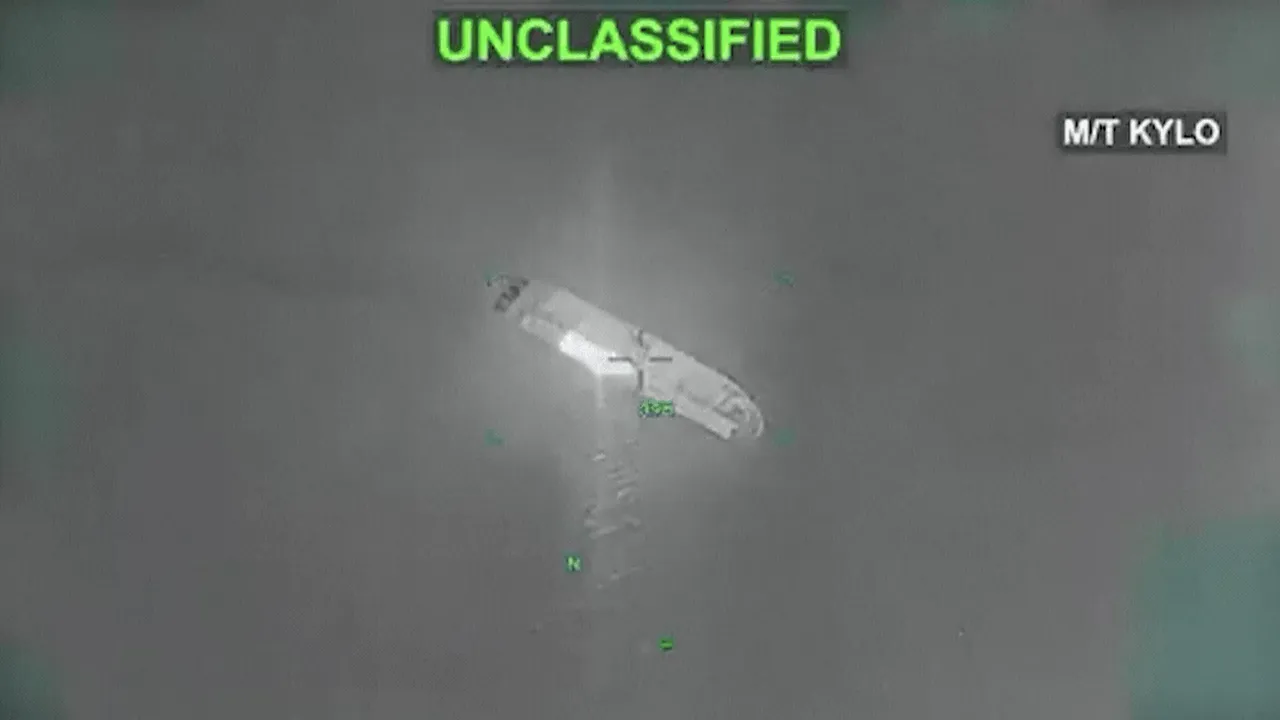
The United States-Iran war is increasingly being fought at sea, with both sides targeting oil tankers and other vessels in and around the Strait of Hormuz.
On September 8, US forces struck five Iranian oil tankers, provoking an Iranian retaliatory attack on Jordan's Al-Azraq airbase. Just three days earlier, on September 5, US Central Command said its forces had struck three Iranian crude-oil tankers — one off Kharg Island, Iran's main oil-export hub; another near Jask; and a third, an unladen tanker, in the Gulf of Oman after its crew was ordered to abandon ship.
Those strikes came after Iran launched ballistic missiles toward a US aircraft carrier and a navy destroyer near the Strait, according to US Central Command.
Iran subsequently said it had targeted three oil tankers travelling through what it called an "unauthorised route" in the Strait, as well as three US-linked vessels elsewhere.
The tit-for-tat attacks have turned Hormuz into a potential environmental tinderbox.
With tankers carrying millions of barrels of crude and petroleum products passing through or waiting around the waterway, a successful strike could trigger a fire, a sinking, or a major oil spill.
As of September 7, vessel-tracking data showed 42 tankers waiting to transit the Strait of Hormuz, while hundreds of other vessels were waiting or moving slowly in the wider Gulf of Oman and the broader Gulf region. Of those tankers, 18 were carrying oil.
While the exact cargo volumes are not known, those vessels have an estimated combined capacity of 1.76 million cubic metres of oil and petroleum products — roughly 11.1 million barrels, equivalent to approximately 11 percent of the world's daily oil demand.
Since the start of the war, at least 75 ships have been attacked, with at least 21 seafarers killed. Of those vessels, two incidents have resulted in minor oil spills, while six have caused fires.
Oil has been leaking from the tanker Caroline Bezengi since it ran aground approximately 22 nautical miles off the coast of Oman after its crew reported a suspected explosion in early June. The vessel was estimated to have been carrying 800,000 barrels of oil. Oman's Environment Authority warned that the spill could affect around 40 kilometres of coastline near Ras Madraka, as well as Masirah Island.
On August 3, the Minoan Pioneer, a Liberian-flagged bulk carrier, was struck by an unidentified projectile off Oman and caught fire. Satellite imagery taken on August 10 showed a large slick near Qeshm Island, while another slick was detected near Sirri Island. Experts said the Qeshm slick likely originated from the Minoan Pioneer but could not independently confirm its source.
A major tanker strike or sinking could release millions of litres of oil into the Gulf, potentially contaminating coastlines, fisheries, and fragile marine ecosystems. Unlike an oil spill on land, oil at sea can spread over a vast area, carried by currents and winds far from the original site.
Past conflicts in the region have left lasting environmental damage. During Operation Desert Storm, as Iraqi forces retreated, they set Kuwaiti oil wells on fire. The blazes burned for months and released millions of gallons of oil into the northern Gulf, damaging Kuwaiti and Saudi Arabian coastlines for decades. More than 770 kilometres of coastline were affected.