Saudi Arabia said on Saturday it had intercepted a ballistic missile fired at Riyadh by Yemen's Iran-backed Houthi rebels, marking the first time the Saudi capital has been targeted since fighting intensified in July.
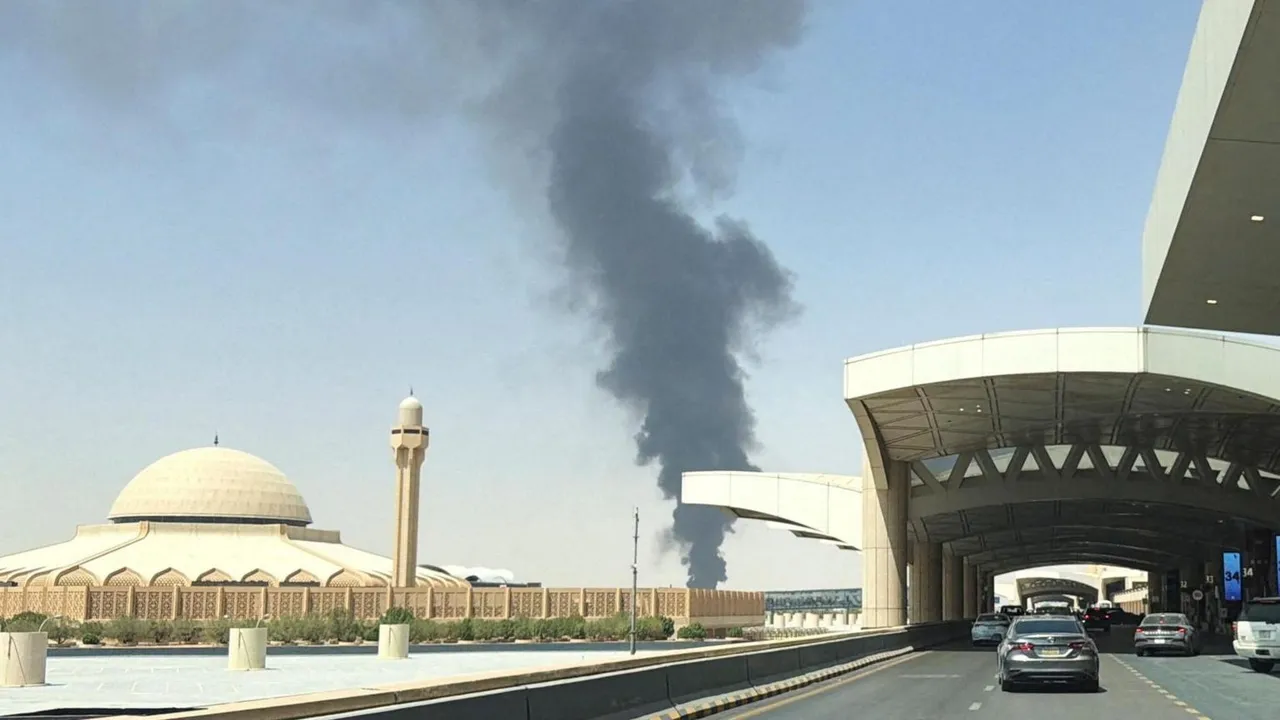
Saudi authorities confirmed the interception but reported no casualties or structural damage. Residents in Riyadh said they heard explosions, and a column of black smoke was later seen rising from fuel tanks near King Khalid International Airport, where flights were temporarily disrupted.
The Saudi Civil Defence had sent phone alerts overnight warning of potential danger in Riyadh and other regions before issuing an all-clear on Saturday morning. "I heard the alarm, then my windows shook," said a resident of northern Riyadh, aged 27. "It was definitely scary. I was not expecting this."
Saudi air defences also intercepted what an official coalition spokesperson described as "hostile attempts to target civilians" in the cities of Bish, Taif, Farasan and Yanbu, a Red Sea port city where a key Saudi pipeline terminates.
Houthi military spokesman Yahya al-Sarea said the group had deployed "a large number of ballistic and cruise missiles and drones" against "sensitive sites" in Riyadh and Aramco state oil and gas facilities in Yanbu, claiming the strikes caused "massive fires." Saudi Aramco, the world's largest oil company, did not respond to a request for comment.
Al-Sarea said the attacks were "in response to the Saudi enemy's criminal attempts" to target the Yemeni capital Sanaa, which is currently under Houthi control. He had earlier accused Saudi Arabia of carrying out 300 strikes across Yemen during the previous week.
According to unconfirmed reports citing military sources on both sides of Yemen's civil war, fighting on Saturday claimed 48 lives. The Houthis said 31 of their fighters were killed, while government sources said their side lost 17 soldiers.
On Friday, the International Organization for Migration, a UN body, reported that the number of people displaced by recent fighting had exceeded 104,796.
The Houthis have recently seized control of the strategic port city of Mokha and Perim Island, a gateway to a key shipping route used by Saudi Arabia to export oil to Asia and Europe. The group said the naval blockade was in retaliation for a Saudi blockade of ports and airports in Houthi-controlled north-western Yemen.
Saudi vessels have relied on that stretch of the Red Sea for oil exports since the Strait of Hormuz was effectively closed by the wider US-Iran war.
The head of US Central Command said the military had supported the transit of one billion barrels of oil through the Strait of Hormuz over the past two months and claimed Iran had exported zero barrels due to a US naval blockade. Admiral Brad Cooper said the strait's primary transit lanes had been cleared of mines and that the volume of oil, gas and cargo transiting over the past two weeks was the highest in six months. Shipping monitors, however, said traffic remained well below prewar levels, with Iran continuing to contest control of the waterway.
The US State Department urged Americans in the Middle East to "exercise vigilance and be prepared for potential flight cancellations and other travel disruptions." In a statement, it said: "Iranian-supported Houthis have engaged in hostilities against Saudi Arabia, including civilian airports. This military conflict has the potential to escalate rapidly." Americans "should seriously reconsider travel to and through the region," it added.
Turkish Foreign Minister Hakan Fidan said Turkey could provide military support to Saudi Arabia under a recently signed trilateral defence pact. Speaking to broadcaster NTV, Fidan said Turkey would "face no difficulty in meeting" any military needs and called it unacceptable for Saudi Arabia to be dragged into the US-Iran war. "We observe very serious attacks on Saudi Arabia's territorial integrity and sovereignty," he said. "We have an alliance agreement in place and we stand by our word."
Pakistan has made a similar pledge. Lieutenant-General Ahmed Sharif Chaudhry, a spokesperson for Pakistan's military, said Islamabad would defend Saudi Arabia "to any extent", including "physically", though he did not say whether Riyadh had requested additional Pakistani troops. Pakistan's Foreign Office said no military response was currently under discussion, adding that Islamabad would act "when time comes."
The trilateral arrangement, known as the Mecca Defence Alliance, was signed on August 7 in Mecca by Saudi Crown Prince Mohammed bin Salman, Turkish President Recep Tayyip Erdogan and Pakistani Prime Minister Shehbaz Sharif. Its founding principle holds that an armed attack against any one of the three states will be treated as an attack against all three. Analysts have questioned how much substance lies behind the pact, noting it lacks the integrated command structure and standing forces that underpin NATO.
Iran's Supreme National Security Council head Mohsen Rezaei said Tehran had conveyed conditions for ending the war to the United States via Qatar and was awaiting President Donald Trump's response. The conditions include ending the war on all fronts, releasing assets seized from Iran and lifting the US naval blockade of Iranian ports. Rezaei also said Iran wanted the fighting involving Yemen and Saudi Arabia to end.
Investment bank JP Morgan said on Friday it was struggling to predict how oil prices would be affected by the war, telling investors in a rare note that "we simply don't know how to model the endgame."