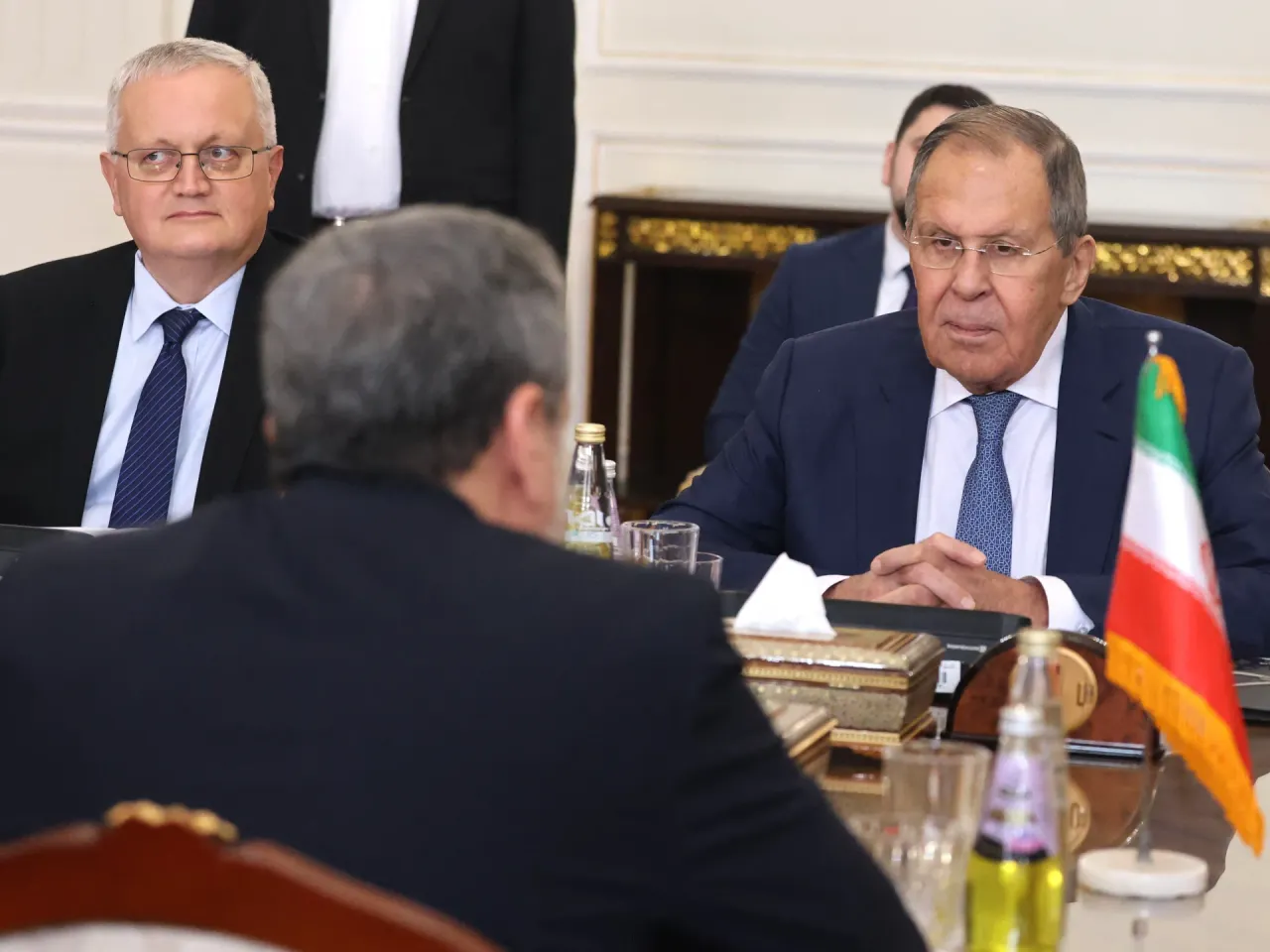
Russian Foreign Minister Sergey Lavrov arrived in Tehran on Monday for talks with his Iranian counterpart Abbas Araghchi, focusing on the ongoing war between the United States and Iran and efforts to bring it to an end.
It was Lavrov's first visit to Iran since February 2025. He is also scheduled to meet Iranian President Masoud Pezeshkian later the same day.
Araghchi said the discussions centred on regional developments, including what he described as the US-Israeli war on Iran. He also condemned Israel's "dangerous expansion" in the region, which he blamed for the current hostilities.
"The existing insecurity around the Strait of Hormuz is a direct result of the military aggression by the US and [Israel] against Iran, and it is ongoing in different forms," Araghchi said.
He added that Iran's approach was focused on diplomacy, arguing that regional problems have "no military solution." He also directed criticism at European governments, saying they shared responsibility for global instability.
"I believe Europe must also open its eyes to some truths," Araghchi said. "Just like the Americans, the Europeans suffer from miscalculations and wrong interpretations, and have caused many wars and troubles around the world with their wrong policies."
Lavrov, for his part, reaffirmed Russia's commitment to a 20-year strategic partnership agreement with Iran, which officially entered into force on 2 October. He said Russian specialists would gradually return to the Bushehr nuclear power plant, which they had left during the war. He also linked the restoration of navigation in the Strait of Hormuz to guarantees of protection for Iran against renewed attacks.
Moscow described the Tehran visit as part of broader efforts to ease months of tension following the launch of the US-Israeli war on Iran on 28 February.
The day before his Tehran visit, Lavrov was in Bahrain to participate in a strategic dialogue session between Russia and the Gulf Cooperation Council. Bahrain was among the Gulf states heavily targeted by Iran during the conflict.
GCC Secretary-General Jasem Al-Budaiwi said member states had faced more than 7,000 Iranian missiles and drones since the start of the war. GCC members urged Moscow to use its influence with Tehran to press for "serious dialogue" and to help restore commercial shipping through the Strait of Hormuz, which has been severely disrupted by attacks on vessels.
In the council's closing statement, the six Arab member states said they wanted Iran's nuclear and missile programmes, as well as its support for regional armed groups, to be addressed in any future talks aimed at ending the war.
Speaking to GCC ministers in Manama, Lavrov warned that the region was again on the brink of full-scale war and called for the establishment of a regional architecture for "collective security." He said this framework could draw on initiatives from regional countries, as well as proposals put forward by Russia and China, with the goals of restoring maritime traffic and achieving lasting peace. He also urged other states affected by Iranian strikes, including Iraq and Jordan, to participate in such efforts.
Lavrov expressed support for a Memorandum of Understanding signed between Iran and the United States in June, which later collapsed, describing it as a potential framework for reducing tension. Iran has called for a return to that agreement and for Washington to honour a separate bilateral deal between Iran and Oman on managing territorial waters in the Strait of Hormuz. The United States has opposed that arrangement and established its own designated shipping route in the waterway.
According to intelligence reports cited by US media, Russia and China have been providing military support to Iran in the form of satellite imagery for targeting purposes and weapons components. US President Donald Trump contradicted those reports, though the draft text does not detail his specific remarks.
Analyst Nikita Smagin, a researcher on Iran and Russia's role in the Middle East, said Lavrov's regional tour reflects Moscow's effort to maintain working relations with all parties to the conflict. He said Russia also seeks to preserve its standing as a potential mediator, despite the damage the Ukraine war has done to its global reputation.
"The timing of visits to the Gulf monarchies and Iran, taking place almost simultaneously, is a deliberate signal: Moscow wants to show that it approaches relations with all these countries on broadly equal terms and is equally interested in cooperation with each of them," Smagin said.