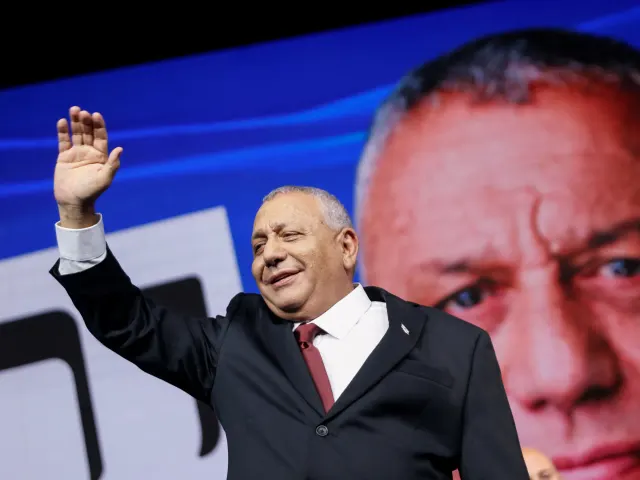
Israel's stock market fell sharply on Wednesday as exit polls and early official results showed no clear winner in the country's parliamentary elections, leaving the political path forward deeply uncertain.
The benchmark Tel Aviv 125 index dropped as much as 3.5 percent in early trading as investors weighed the unclear outcome of Israel's first election since the start of its war on Gaza.
With more than 76 percent of votes counted as of 09:30 GMT, Prime Minister Benjamin Netanyahu's right-wing coalition was on course to win 54 seats, while the opposition bloc led by Yashar party leader Gadi Eisenkot was headed for 47 seats, according to tallies published by Israeli media. Sixty-one seats are needed to form a majority in the 120-seat Knesset.
However, the various opposition groups as a whole, including a significant showing by two Arab-led factions, had more votes overall than Netanyahu's right-wing bloc, indicating broad dissatisfaction with his government among the electorate.
Voter turnout on Tuesday exceeded 77 percent, the highest in more than two decades, according to election officials. Tens of thousands of expatriates flew in from abroad to cast their ballots.
Overnight, both leaders addressed supporters and claimed early victory. "We made history! The public has voted for change," said Eisenkot, a center-right former military chief of staff who has promised more diplomacy and less extremism. Netanyahu told supporters: "The right-wing bloc has a clear, decisive majority among the Zionist public."
The tight race means weeks of political gridlock are possible, with the final outcome depending on negotiations among broader alliances.
Arab voters make up approximately 20 percent of Israel's population. Two Arab-led parties — the socially conservative United Arab List, known as Raam, and the left-wing Joint List — could play a kingmaker role. However, both Netanyahu and Eisenkot have resisted partnering with them.
The election is the first since the Hamas-led attack of October 7, 2023, which killed nearly 1,200 people and resulted in 251 hostages being taken to Gaza. Reports that the government had received repeated prior warnings of a major Hamas assault have weighed heavily on public opinion.
Israel's subsequent military campaign in Gaza has killed more than 74,000 Palestinians, according to Gaza's Health Ministry, and left most of the territory destroyed. Netanyahu currently faces an international arrest warrant for alleged war crimes, charges his government denies.
Israel's wars in Gaza and across the wider region, as well as its policies in the occupied West Bank, have strained its relations with numerous governments internationally. Public support for Israel in the United States has declined significantly, a concern cited by many Israeli voters.
Netanyahu is Israel's longest-serving prime minister, having held office across multiple tenures spanning nearly two decades. His supporters credit him with restoring Israel's regional security through military campaigns in Gaza, Lebanon and against Iran.
Despite the political uncertainty, Israel's economy has continued to grow. Gross domestic product expanded 2.9 percent in 2025 and 3.2 percent in the first half of 2026, according to government figures. The Bank of Israel last week raised its GDP growth forecast for the full year 2026 to 5.6 percent, up from 4 percent, citing increased production by Israeli firms overseas. The central bank has forecast GDP growth of 7.5 percent for 2027.