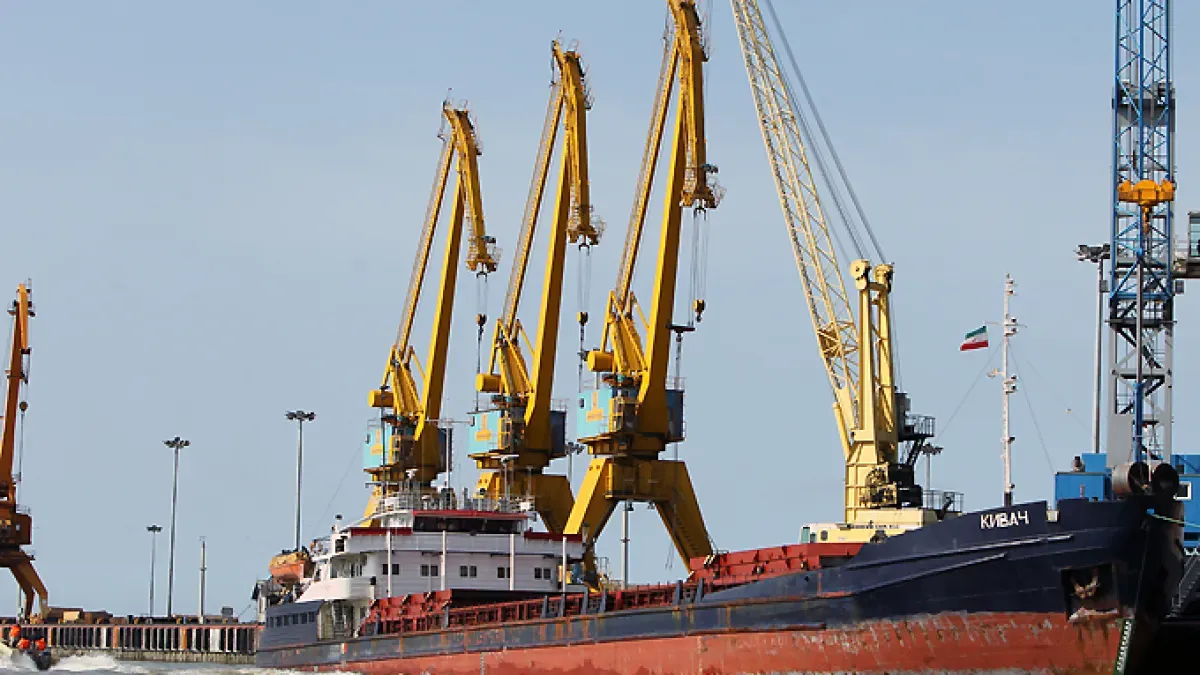
With Iran's southern ports under a United States naval blockade, Tehran is seeking alternatives to export oil and import essential goods. The Caspian Sea, on Iran's northern coast, has emerged as one potential outlet to the outside world.
Recent efforts at the United Nations to end the deadlock between Iran and the US appear to have failed. US President Donald Trump said Tehran's offer to reopen the Strait of Hormuz was unacceptable. With no breakthrough in sight following the war launched by the US and Israel on Iran on February 28, Tehran is making adjustments to sustain trade flows.
However, maritime trade via the Caspian Sea carries its own logistical challenges, experts say.
The Caspian Sea is the world's largest landlocked body of water, shared by Iran, Russia, Azerbaijan, Kazakhstan and Turkmenistan. Shipping on the sea has been increasingly hampered by declining water levels in recent years.
In April, UN Environment Programme Executive Director Inger Andersen said Caspian water levels had dropped by approximately two metres since the 1990s. Levels are projected to recede by an additional 8 to 21 metres by the end of the century.
Shahram Fadakar, director general of the Iranian Department of Environment's Office for Coastal and Marine Ecosystem Protection, told local media last week that water levels have been dropping by more than 20 centimetres annually over the past two to three years.
The falling water levels have already reduced port capacity. Masoud Polmeh, secretary-general of the Shipping Association of Iran, told state-linked media this month that Iran's northern ports could once handle vessels weighing up to 6,000 tonnes. Due to reduced water levels, they can now accommodate only 4,000-tonne vessels.
Iranian ships entering the Caspian Sea via Russia's Volga River have become stuck due to low water levels, sometimes remaining stationary for days or weeks before their crews are rescued. "Fortunately, that hasn't happened in our ports," Polmeh said.
The vast majority of Iran's maritime trade has historically passed through its southern ports. The US naval embargo and air strikes on infrastructure are now forcing Tehran to redirect trade toward the Caspian Sea and land borders.
While there are currently no active military attacks against interests in the north, the shift in logistics has placed enormous strain on Iran's land border crossings.
At the Norduz border crossing with Armenia, as many as 1,800 trucks queue for several days at a time to enter Iran. At other terminals, wait times range from 10 to 15 days.
Vali Kaleji, an independent researcher on Russia, Central Asia and the Caucasus, said the congestion is not caused solely by the freight shift. "Limited terminal capacity, customs procedures, road infrastructure and ongoing construction projects have also contributed to the congestion. Meanwhile, sanctions on Iranian airlines and the resulting influx of passengers towards Iran's land borders with Armenia and Turkey have further exacerbated problems at the border terminals," Kaleji said.
The eastern Caspian rail route offers a connection for transporting Iranian cargo to Turkmenistan, Kazakhstan and China. However, Iran's rail freight connections with the South Caucasus region, severed during the First Nagorno-Karabakh War from 1988 to 1994, remain closed.
Kaleji said the revival of the Julfa-Nakhchivan railway route, part of the Soviet-era rail network in the South Caucasus, depends on the peace process between Armenia and Azerbaijan, particularly the implementation of the TRIPP project, a US-supported transit corridor in the region.
"Since a major share of transit and trade along the western route of the North-South Transport Corridor takes place through this route, the absence of a railway connection between Iran and the South Caucasus remains a major obstacle to accelerating and increasing the volume of trade and transit, particularly under conditions of intensified maritime blockade in the south," Kaleji said.
Iranian authorities have not provided details on which commodities, or at what volumes, have been redirected northward. The Caspian ports of Anzali, Amirabad and Nowshahr have been identified as key northern gateways, with indications of a shift particularly in the import of essential goods such as food.