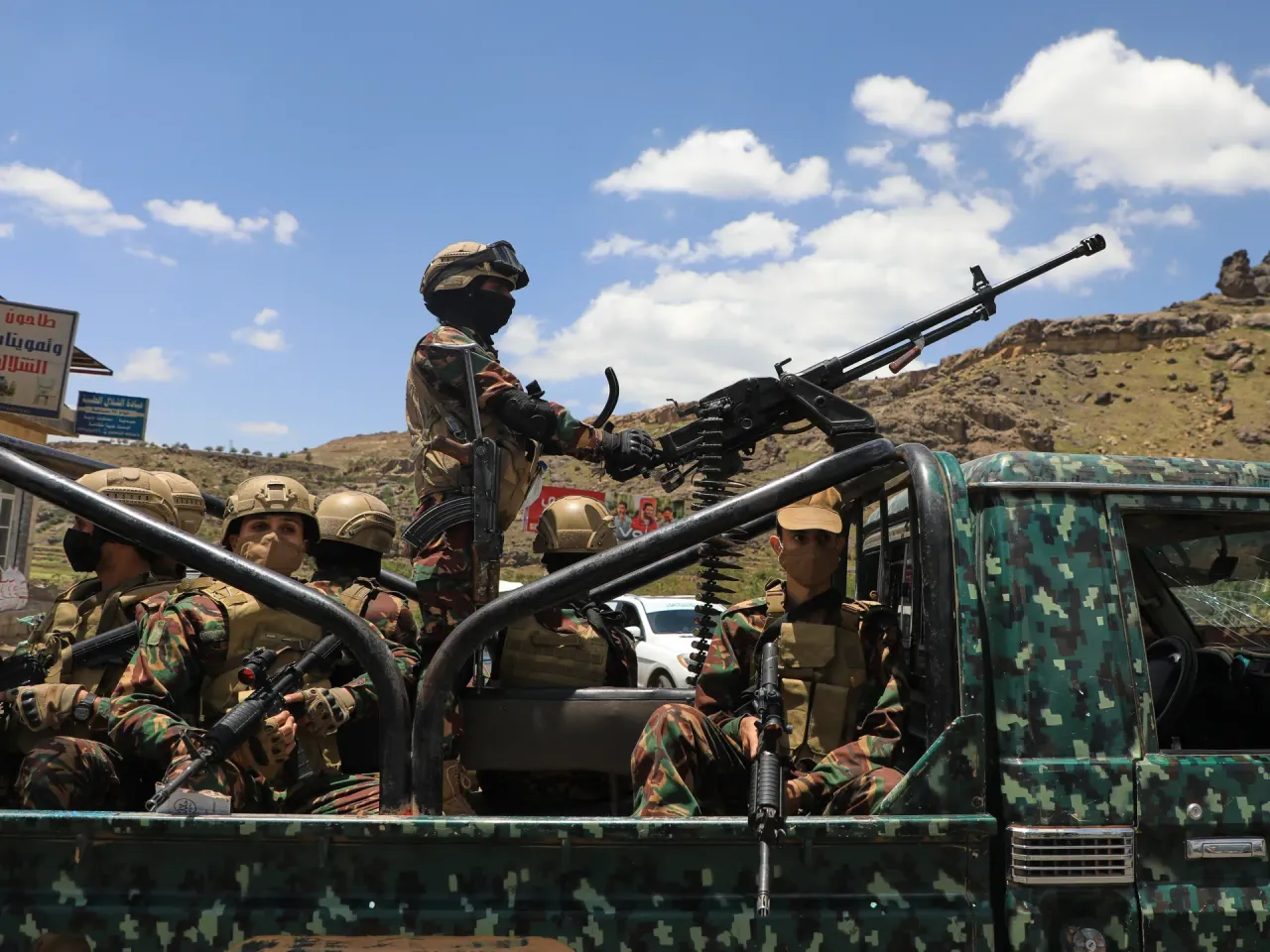
Houthi forces have seized key positions along Yemen's Red Sea coast, capturing the port city of Mocha before pushing into Dhubab and reaching Mayyun, also known as Perim Island, at the narrowest point of the Bab al-Mandeb strait.
The gains give the movement unprecedented leverage over one of the world's most strategically important maritime corridors.
More than 70,000 people have fled their homes since the offensive began. Many have sought refuge in Aden, while around 1,400 have crossed into neighbouring Djibouti. The United Nations and the International Organization for Migration warn the new displacement wave is worsening an already dire humanitarian crisis in a country devastated by 12 years of war.
Analysts say the latest escalation is not simply another episode in Yemen's long civil war. It is simultaneously a struggle for control of Yemen, a renewed confrontation between the Houthis and Saudi Arabia, and an additional front in the wider conflict involving Iran, Israel and the United States.
A UN-mediated truce had taken effect in April 2022. Although it formally expired six months later, Saudi Arabia and the Houthis largely maintained a de facto ceasefire. Saudi and Omani delegations travelled to Sanaa the following year. In June 2023, direct flights resumed between Sanaa and Saudi Arabia to carry Yemeni pilgrims to Hajj, the first such flights since 2016. In September 2023, a senior Houthi delegation visited Riyadh for talks on ending the war.
These were significant confidence-building measures. They also encouraged the assumption that Yemen's conflict was gradually resolving itself.
The internationally recognised government appears to have mistaken the absence of major fighting for a durable balance of power. Despite repeated talk since April 2025 of an offensive along the western coast, its leaders remained divided, and its armed formations answered to competing commands. Rather than using the pause to rebuild legitimacy, improve governance and establish a coherent military structure, the government and its supporters became complacent.
The Houthis used the same period very differently. The reduction in fighting gave them time and strategic space to consolidate their administration, reorganise their forces, expand their missile and drone capabilities, and recruit on a vast scale.
A 2024 report by UN experts estimated that Houthi fighting strength had risen from approximately 220,000 in 2022 to 350,000, compared with just 30,000 in 2015. Such figures must be treated cautiously, but they indicate how extensively the movement expanded during what others regarded as a period of peace. The process also involved documented coercion and child recruitment.
The conflict in Gaza provided the Houthis with a powerful mobilising cause. By presenting their attacks on Israel and their Red Sea operations as direct action in defence of Gaza, the Houthis portrayed themselves not merely as one party in Yemen's civil war, but as perhaps the only Arab force willing and able to impose a cost on Israel.
For the first six months of the broader regional war, Iran appears to have tried to keep the Red Sea from becoming another major front. Tehran had a clear interest in keeping Saudi Arabia and Egypt outside a US-led military alignment. Renewed Houthi attacks on Saudi Arabia or commercial shipping risked pushing Riyadh and Cairo closer to Washington.
It is reasonable to assume that Tehran initially pressed the Houthis not to provoke Saudi Arabia. A Saudi strike on Sanaa International Airport in July, reportedly intended to prevent an Iranian aircraft from landing, changed that calculation. It gave the Houthis a justification to retaliate and evidence that restraint would not protect them.
Iran may not have sought a Saudi-Houthi confrontation, but once the Houthis decided to respond, Tehran could not demand they remain passive without undermining the credibility of an alliance it had spent years cultivating.
The escalation also serves Iranian interests more broadly. Disruption of Gulf energy supplies had been losing some of its strategic force as Washington and its partners helped international markets adjust through alternative arrangements. The Houthi advance on Bab al-Mandeb introduces a new pressure point at a moment when that leverage was diminishing.