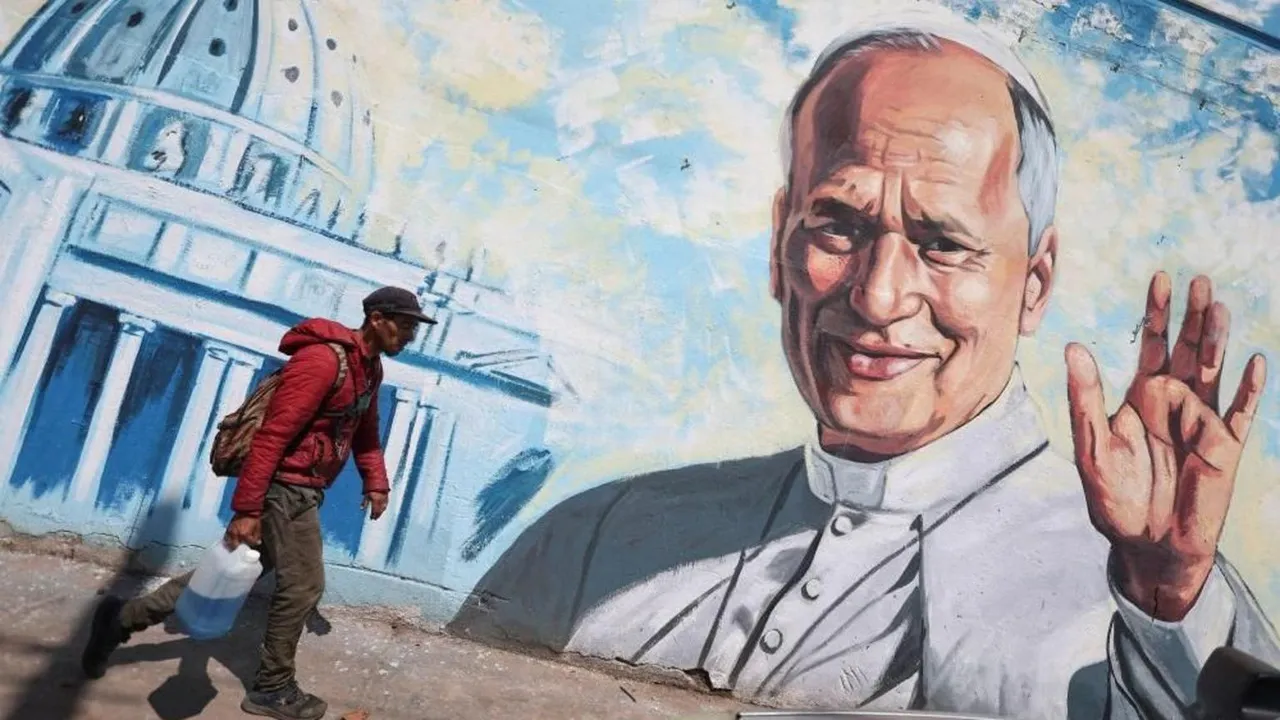
Pope Leo XIV has launched a three-nation tour of Latin America, arriving in Uruguay on Friday, November 6, three weeks after undergoing lung cancer surgery that had cast doubt over the entire trip.
The 71-year-old pontiff, who had part of a lung removed on October 13, flew from Rome to Montevideo on a flight lasting approximately 13 and a half hours. The journey marks the longest and farthest trip of his pontificate.
After Uruguay, Leo will travel to Argentina and then to Peru, where he served as a missionary priest and bishop for two decades. The tour runs until November 17.
The Vatican's communications chief, Maria Montserrat Alvar, said Leo had passed the 14-day convalescence period required by doctors and was in strong condition. "His stamina is fantastic. The way that he's singing is incredible. And you can only sing if your lungs are really strong," she said.
Alvar added that medical staff would be on board throughout the trip as a precaution. "His doctors are very confident and he'll have plenty of medical care on board should something happen, but we don't see that in his prognosis or even in the way that he's acting," she said.
Uruguay has not received a papal visit since 1988. It is widely regarded as the most secular country in Latin America, a region that is home to around 40 percent of the world's 1.4 billion Catholics. Only a fraction of Uruguayans who identify as Catholic attend Mass regularly.
The country has a long history of progressive legislation passed in opposition to the Catholic Church. It was the first country in the world to legalise marijuana for recreational use, the second in Latin America to decriminalise abortion, and the third in the Americas to legalise same-sex marriage. Most recently, it became the first country in the region to approve assisted dying legislation, reflecting an entrenched separation of church and state that prohibits any mention of God in oaths of office.
Leo is expected to address the church's opposition to abortion and euthanasia as part of a broader message on human dignity across all stages of life.
Despite Uruguay's secular character, the papal visit has generated notable public enthusiasm. Tickets to Leo's prayer vigil at Montevideo's Centenario Stadium were reported to have sold out within two days.
"It seems that the pope's presence is shifting something here and is gradually breaking down this veil that has always sought to obscure and diminish the presence of the Catholic tradition that lies at the country's foundation," said Guzmán Carriquiry, the Uruguayan former head of the Vatican's pontifical commission for Latin America.
"I believe this pope will stir up questions in the hearts of Uruguayans -- disturbing questions -- questions about meaning and, we hope, questions about faith," he added.
Leo's schedule in Uruguay is packed. On his first day, he will meet with President Yamandú Orsi, leader of the centre-left alliance that came to power in March 2025, before delivering a welcome address to government officials and diplomats. The day concludes with a vespers service at Montevideo's cathedral.
He will also visit a neighbourhood affected by gang violence, celebrate Mass in the city of Paysandú, approximately 375 kilometres from the capital, and attend another Mass in the city of Florida, around 100 kilometres away.
The Florida visit carries particular historical and religious significance. On November 8, Leo is expected to mark the feast of the Virgin of the Thirty-three, a small wooden Guaraní statue of the Virgin Mary closely linked to Uruguay's independence movement. According to tradition, 33 independence patriots carried the icon when independence from the Brazilian empire was declared in Florida on August 25, 1825.
Carriquiry said he expects Leo to use the occasion to revive awareness of Uruguay's Catholic roots and their connection to the country's founding history.
In Peru, anticipation is already building. Banners bearing the pope's image have appeared in Chiclayo, in the country's north, ahead of his arrival later in the tour.


